
Will He Delay Long Over Them?

the_world_in_his_hands_by_saviourmachine


In Lk. 18:1-8 the Lord told a parable “to show that at all times they ought to pray and not to lose heart” (v. 1).  The crux of the parable is that a widow persisted in bringing her petition before the judge in her city.  This judge, the Lord said, “did not fear God and did not respect man” (v. 2).  Initially the judge was unwilling to act on behalf of the widow, but she continued to come before him anyway.  Finally the judge gave in to her and settled her case in her favor.

In vs. 6-8 Luke recorded the point of this parable.  He wrote, “And the Lord said, ‘Hear what the unrighteous judge said; now will not God bring about justice for His elect who cry to Him day and night, and will He delay long over them?  I tell you that He will bring abut justice for them quickly.  However, when the Son of Man comes, will He find faith on the earth?'”

The lesson for disciples to understand from this parable is that God does not have to be nagged in order to act on behalf of His people.  He will, in fact, bring about justice for His people, and He will not delay His response to their prayers.  Our God is not like the unrighteous judge.  He is already inclined in our favor because we have been purchased by the blood of His one and only Son.  His desire is to respond favorably to our petitions, so long as those requests are in accordance with His revealed will.

This truth should be of great comfort to Christians.  As we struggle with the many challenges of life, we are not left without recourse by our God.  He stands ready to act on our behalf, if we will only bring our needs before Him in prayer.  Unlike the gods of the pagans, or the unrighteous judge in the parable, our God does not have to be goaded into answering our prayers.  All we have to do is to ask in faith, nothing doubting.  This is what James said in Jas. 1:5-8.  In context James was speaking about asking for wisdom from God, but the principle still stands.  If we expect God to answer our prayers, we must ask in faith.

This is a principle that the Lord alluded to in the parable in Lk. 18.  In v. 8 as the Lord declared that God would bring justice quickly for His people, He asked, “However, when the Son of Man comes, will He find faith on the earth?”  His question points us squarely to the matter of faith.  As we make our requests to the Lord in prayer, we must believe that He will answer our prayers and grant them.  For the Lord to wonder if He would find faith on the earth at His return suggests that we need to give this more attention than perhaps we have previously done.

There is another aspect of this parable that is interesting, and which bears upon the question of prayer.  In v. 7 the Lord said that God would bring justice for His elect “who cry to Him day and night”.  This phrase suggests that the prayers of the elect will be offered continually until an answer is received from the Lord.  While we do not have to nag God in order to get a response from Him, it is clear that He expects us to repeatedly offer our petitions to Him.  This repetitive asking demonstrates our dependence upon Him, and also indicates our faith in Him.  Too often we pray about something once or twice and give up on it.  Then we wonder why our request was denied.

If we truly have faith in God, we will pray continually until our petitions are answered.  We will pray in confidence that God will answer in the way that is best for us, and in confidence that He will not delay long over our requests.
Come, Lord Jesus!

come-lord-jesus


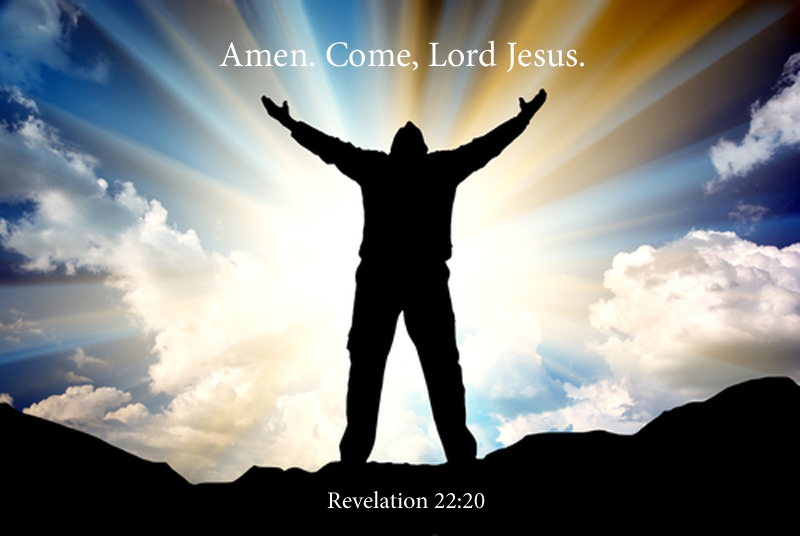
At the end of the book of Revelation, the Lord said, “Yes, I am coming quickly,” to which John replied, “Amen.  Come, Lord Jesus” (Rev. 22:20).  Anyone who has read the scriptures understands that the Lord may return at any time.  Most of us, however, tend to overlook, or ignore, His statement that He is coming quickly.  Fewer still of us, it seems, think about, or pray, as John did, “Amen.  Come, Lord Jesus!”

Why is this the case?  There may be many reasons why we do not utter these words in prayer, not all of which are motivated by unholy concerns.  Obviously the wicked are not anxious for the Lord to return, but even godly people, being human, don’t know what the other side of life is like.  Therefore, we’re not generally anxious to get there.  We know the world, and we know life on earth.  So we want to cling to it as long as possible, whether it is because of our fear of death, or of our uncertainty about the Lord’s return.

This reality aside, though, there are at least three reasons for us to pray every day for the Lord to come.  In the first place, when the Lord comes again, He will deal out retribution to the wicked (2 Th. 1:7-8).  One of the most difficult aspects of life on earth is the fact that justice is not always meted out on the wicked.  In too many cases, it seems as though the bad guys are winning, and this makes life much harder.  However, when the Lord returns, justice will be rendered to the wicked.  This is something many psalmists prayed for in ancient times, and it will happen when the Lord returns.

Secondly, when the Lord comes the godly will receive relief from all the suffering that they have endured here on earth.  2 Th. 1:7 promises that the Lord “will give relief to you who are afflicted,” even as He deals out retribution to the wicked.  We are also promised that when the godly are taken into heaven, the Father Himself “will wipe every tear from their eyes; and there will no longer be any death; there will no longer be any mourning, or crying, or pain; the first things have passed away” (Rev. 21:4).  This is also an important reason for us to pray for the Lord to come quickly.

Third, when the Lord comes the righteous will be taken into the heavenly realm, where the Lord has been preparing a place for them to reside for eternity.  This is the promise that Jesus made to His disciples on the night of His betrayal (Jn. 14:1-3), and it is the promise that each and every Christian has from Him.  In 1 Pet. 1:3-4 Peter blessed the God and Father of our Lord Jesus Christ, because we have been born again in order to receive an inheritance that is “imperishable and undefiled and will not fade away, reserved in heaven for you.”  For this reason we should pray for the Lord to come, so we may quickly reach our final reward.

We live in troubling times.  There is so much evil in the world.  There is so much opposition to our Lord and to His word.  In so many instances, it appears that the wicked are winning, and we may wonder about the promises of God in which we have placed our hope.  The scriptures declare that God is faithful, who will not allow us to be tempted beyond what we are able to bear, but will provide a way of escape so we may endure it (1 Cor. 10:13).  “He is faithful and righteous to forgive us our sins and to cleanse us from all unrighteousness” (1 Jn. 1:9), and His desire is for all men to be saved and to come to the knowledge of the truth (1 Tim. 2:4).

Our faithful Father in heaven hears our prayers and responds to our needs in every way, in accordance with His divine will.  If we pray for our Lord to come, God the Father will respond to that prayer as well.  Therefore, let us earnestly pray, “Come, Lord Jesus!”

Just A Man

george-cardinal


There is no question that Peter was one of the foremost among the apostles.  When the gospel was proclaimed on the first Pentecost after the Lord’s resurrection, Peter was the chief spokesman.  His words are the ones we read in the record of this event in Acts 2.  He was also the first to proclaim the gospel to the Gentiles.  In addition to this, he is the primary character in the first half of the book of Acts.  This prominence in the record of the early church as led some to give Peter special status in the history of the church.

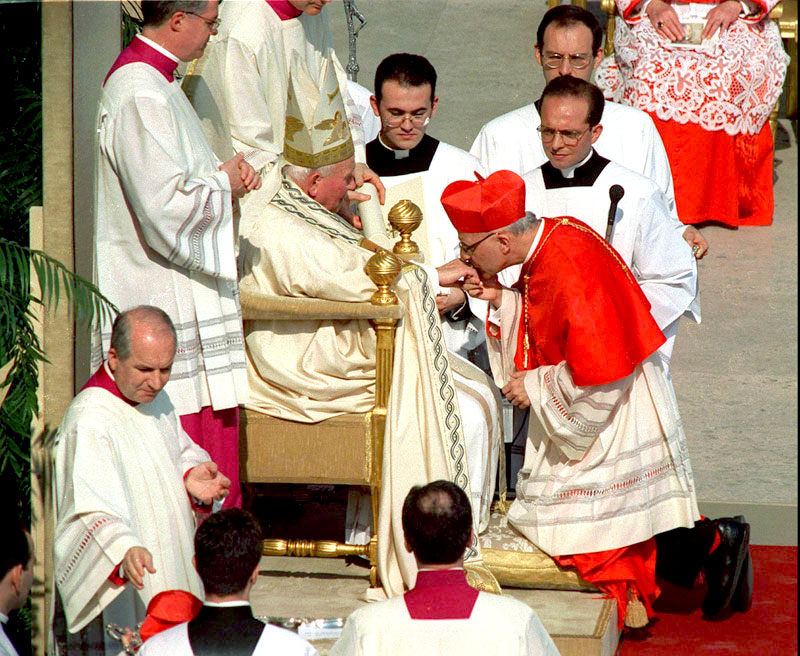
The leader of a large religious body today believes himself to be the direct descendant of Peter as the head of the church on earth.  This man is accorded special honor and reverence by members of this body, and is addressed in terms that signify his exalted status.  It is customary to see even high-ranking officials of this church bowing before him and kissing his ring of office.  He is called “The Vicar of Christ”, and is considered to be above all others in this church.

While it is claimed that Peter is the origination point for this office, Peter’s life belies that claim.  In Acts 10:25-26 when Peter entered the home of the Gentile Cornelius, the scripture says, “When Peter entered, Cornelius met him, and fell at his feet and worshiped him.  But Peter raised him up, saying, ‘Stand up; I too am just a man.'”  The last words in this statement are powerful.  Peter refused to accept Cornelius’ worship and declared that he was just a man.  In other words, it was not appropriate for Cornelius to worship him, or for Peter to accept such worship.

This, of course, is a fundamental truth of scripture.  We are not to worship any man, no matter how great, or important, or dear to us he may be.  Jesus declared this truth during His temptation by Satan.  When Satan offered to give the Lord all the kingdoms of the world if He would fall down and worship him, the Lord replied, “Go, Satan!  For it is written, ‘You shall worship the Lord your God, and serve Him only.'”

This same truth was declared when John received the revelation from the Lord on the island of Patmos.  Twice during this revelation an angel spoke directly to John.  Both times John fell down at the angel’s feet to worship him, and both times the angel told John not to do that.  In both cases the angel said, “Worship God” (Rev. 19:9-10; 22:8-9).  Angels are important beings as special messengers of God.  But it is clear that not even they are to be worshiped.

If angelic beings will not accept worship, then how much less so should humans?  Peter was indeed one of the greatest of the apostles, but by his own admission he was just a man.  Who among us today can claim to be anything more?  In point of fact, we cannot.  Peter could not accept worship, no matter how innocently or sincerely it was offered.  This is something reserved only for deity.

The veneration that Roman Catholics offer to the Pope is perhaps the most extreme example of humans accepting worship, but it is not the only example.  Many religious people accord special status to their preachers, addressing them as “reverend”.  While they may suggest that this is a term of respect rather than of worship, the fact is that this word is reserved in scripture only for God.  In Psa. 111:9 in the King James Version, the scripture says of God, “Holy and reverend is His name.”  No apostle, not even Peter, used such a title, or accepted the use of such a title to refer to himself.  They were just men.  They were servants of God, and were unworthy of such veneration.  So it must be still today.  Even the greatest among us is just a man.  Therefore, worship God and serve Him only.

One Step At A Time

24490_Father_And_Son_Walking_cn_b_sm


We sometimes sing a song that begins with these words: “One step at a time, dear Savior; I cannot take any more; the flesh is so weak and hopeless; I know not what is before.”  Each stanza of this hymn reflects the human dilemma of walking by faith.  We cannot see the future, and often cannot even perceive what lies just beyond arm’s length.  As the song declares, we want to reach the goal of eternal life, but we often feel that getting there is outside the realm of human capability.

This, of course, is exactly the point.  The Lord does not expect us to make the journey solely by virtue of our own strength and resolve.  He knows that we cannot do this alone, and He expects us to depend on Him to help us take each step on the pathway to life.  The sooner we realize this truth and accept it, the easier our journey will become.

King David of Israel understood this truth and extolled it in Psa. 37:23-24.  There he said, “The steps of a man are established by the Lord, and He delights in his way.  When he falls, he will not be hurled headlong, because the Lord is the One who holds his hand.”  The imagery here is that of a father holding the hand of a child and guiding his steps.  Even though the child is taking each step on his own, the father is there making sure that he safely completes each step.  When the child stumbles, the father keeps him from falling on his face because he is holding the child’s hand.

David’s point was not that God will keep us from physically falling down as we walk, but rather that He holds our hand as we make our spiritual journey to heaven.  When we struggle with sin, stumbling and falling, our Father lifts us up so we do not fall hopelessly into the abyss of sin.  He helps us to our feet and gently leads us again in the right direction.  We will suffer some scrapes and bruises in the experience, but if we are willing to keep walking with Him, our Father will continue to lead us toward our heavenly reward.

There is one important aspect to this imagery that must not be overlooked.  It is the fact that we must continue to take each step along the way in order to reach the goal.  The scriptures call on us to walk with God.  He will not drag us against our will in the direction of heaven.  He will, however, lead us by the hand as we take each faltering step that direction.  In 1 Jn. 1:7 John said, “But if we walk in the Light as He Himself is in the Light, we have fellowship with one another, and the blood of Jesus His Son cleanses us from all sin.”

The inspired apostle did not say if we sit in the light the blood of Jesus will cleanse us.  He said we will be cleansed if we walk in the light.  This means that we must be making progress toward the goal.  It doesn’t matter how swiftly or slowly we are walking.  It only matters that we are walking.  In 2 Cor. 5:7 Paul said that we walk by faith and not by sight.  This is because we cannot yet see the goal.  We believe it is there, and we believe we will reach it if we continue to walk with God.

This is why the idea of taking “one step at a time” is so important.  One step at a time is within the capability of even the most fragile in the faith.  One step at a time is doable.  One step at a time will not tax us beyond our ability to bear it.  One step at a time, in the direction of heaven, will get us there without fail.  In Eph. 5:15 Paul said to be careful how we walk, not as unwise men but as wise.  If we are wise, we will always walk in the direction of heaven by following God’s word.  If we are wise, we will make the journey all the way to goal, one step at a time.

A Woman Who Fears The Lord

64dd95c0cecb4454cf60e5716a00e3c7


It is difficult to underestimate the power and influence of mothers.  They give us life, and they teach us everything we need to know in order to function in life.  They comfort us when we’re hurt or sick or sad, and they correct us when we go astray.  They teach us what love is, and become the first object of our love.  In many respects, the old adage, “The hand that rocks the cradle rules the world,” is absolutely true.

These truths are all the more important when we consider the spiritual influence mothers have.  The scriptures teach that both fathers and mothers share responsibility for the spiritual development of their children (Deut. 6:4-9; Eph. 6:4), but we also know that mothers have a special influence in this regard.  Their influence is typically greater than fathers’ simply because they are with us more hours in the day than our fathers are.  This being so, it is vitally important that mothers be women who fear the Lord.

Solomon used this phrase to describe the worthy woman in Prov. 31.  As he brought his praise of this godly woman to a close, he said, “Charm is deceitful and beauty is vain, but a woman who fears the Lord, she shall be praised” (v. 30).  The term “fears” in this context does not mean being terrified of God.  Instead, it conveys the idea of reverence for God.  This is a common Old Testament expression for one’s devotion to and respect for Almighty God.  One who fears the Lord honors Him by doing His will in every circumstance.

This is an essential attitude for everyone, of course, because without this attitude, none of us would ever obey the Lord’s will.  In mothers, however, this attitude, or the lack of it, is multiplied in the lives of her children.  A mother who does not fear the Lord will raise children who do not fear the Lord.  One such woman was Athaliah, the mother of King Ahaziah of Judah.  In 2 Chr. 22:3, speaking of Ahaziah, the scripture says, “He also walked in the ways of the house of Ahab, for his mother was his counselor to do wickedly.”  How said and horrible that a mother would purposely counsel her son to do wickedly!  As a result of her wickedness, her son was also wicked, and the whole nation of Judah suffered.

In contrast to Athaliah, however, are two women who truly feared the Lord.  Their names are Lois and Eunice, and Paul spoke of them in 2 Tim. 1:5.  Speaking to Timothy, Paul said, “For I am mindful of the sincere faith within you, which first dwelt in your grandmother Lois and your mother Eunice, and I am sure that it is in you as well.”  In 2 Tim. 3:15 Paul revealed how these women who feared the Lord instilled faith in Timothy.  They taught him “the sacred writings” from the time he was a child.

Lois and Eunice are important examples of how mothers should conduct themselves.  They did not let the fact that Timothy’s father was an unbeliever deter them in the exercise of their own faith, or in instilling faith in Timothy.  They lived their faith before Timothy so he would know what it means to be a believer, and they taught him God’s word so he would know for himself what the Lord requires of His people.

This is a model that every mother who fears the Lord must follow today.  The souls of our children are too precious for their spiritual development to be neglected.  A mother who fears the Lord will show her reverence for God by living in accordance with His will every day.  She will also do everything within her power to instill the same fear of the Lord in her children.  Those who do so will be worthy of praise, just as Solomon wrote so long ago.  Those who fail to do so place their souls and the souls of their children in eternal jeopardy.

May every mother be a woman who fears the Lord!

Mayday!

logo


In the early years of commercial flight, and with the advent of voice radio transmission, officials determined that they needed an easily understood term for use in emergencies.  A senior radio officer at Croydon Airport in London came up with the term “mayday,” derived from a French term that means, “come and help me.”  This term became the universal distress signal for voice procedure radio communications.  It is primarily used by aviators and mariners, and is repeated three times to signify an actual emergency.  An aircraft pilot or ship’s captain who sends a “mayday” signal is declaring a state of emergency and is requesting assistance from all available sources.  At that moment nothing is more important, because it is literally a life or death situation.

We do not normally associate “mayday” with spiritual matters, but it certainly fits.  During Paul’s second missionary journey, he and his companions came to the city of Troas in Asia Minor.  In Acts 16:6-8 Luke tells us that Paul intended to go into the areas north and east of the group of cities in southern Galatia that he had visited on his first journey.  God, however, had other plans for the apostle.  In Acts 16:9 the scriptures say, “A vision appeared to Paul in the night; a man of Macedonia was standing and appealing to him, and saying, ‘Come over to Macedonia and help us.”  In effect, Paul received a “mayday” call from Macedonia.

In response to this call, Paul went into Macedonia and preached the gospel in the cities of Philippi, Thessalonica, and Berea.  From there he went into the province of Achaia and preached in the cities of Athens and Corinth.  The “mayday” call in Paul’s vision was God’s way of directing Paul into a fertile field for evangelism.  The success of this mission was such that thriving churches existed in several Greek cities for many years thereafter.

It is clear from this miraculous vision that God wanted Paul to go into this region to preach the gospel.  Was it because God knew that the people in this region would be more receptive to the gospel than those in the other areas Paul wanted to visit? This is certainly possible, since God sees the heart.  We don’t know if the Macedonians realized that they were lost until Paul preached to them, but God knew they were.  It may have been that God, seeing their lost condition, issued the “mayday” call on their behalf, by means of Paul’s vision, so the opportunity for salvation could be brought to them more quickly.

The issuance of a “mayday” call, however, does not guarantee salvation in a life or death situation.  Sometimes help does not arrive in time, as in the Titanic disaster.  Even when help arrives in time, though, the ones in danger must respond to that help in order to be saved.  When Paul arrived in Macedonia, he preached the gospel to them.  Some of them believed and obeyed.  Others did not.  For those who refused to believe and obey, the “mayday” call did them no good.

The same is still true today.  Whether we realize it or not, if we are outside of Christ we are like the passengers on a sinking ship.  Our souls are in jeopardy, and we have no means to save ourselves.  We desperately need someone to come and help us.  God has sent out a “mayday” call, by means of the Great Commission, so we may be saved.  When someone comes and preaches the gospel to us, this is the help we need to save our souls.  But it will only save us, if we obey it.  A drowning man may call for help, but if he refuses to grasp the life preserver when it is thrown to him, he will still drown.

“Mayday!  Mayday!  Mayday!” means one is in a life or death emergency.  This is our situation if we are outside of Christ.  The answer to our spiritual “mayday” is the gospel of Jesus Christ.  If we obey the gospel, our souls will be saved.  Why would anyone be so foolish as to refuse this salvation?

Why Do You Delay?

Unknown


At the end of Paul’s third missionary journey, he returned to Jerusalem for the first time in many years.  He was bringing a gift from Gentile Christians for the needy Jewish brethren in Jerusalem.  While Paul was in the temple grounds with some of the Jewish Christians of that city, the Jews took exception to his presence and began to beat him.  Roman soldiers came to his rescue and when order had been restored, they allowed Paul to address the crowd of Jews.

The record of Paul’s defense is found in Acts 22:1-21.  In the course of his defense Paul declared his heritage as a Jew and publicly admitted that he had personally persecuted Christians, even going so far as to obtain letters from the leaders of the Jews so he could go to Damascus in search of Christians.  In vs. 6-11 Paul told the crowd what happened to him as he approached the city.  A bright light shined on him from heaven, and the Lord spoke to him, commanding him to go into the city where he would be told what he must do.

In vs. 12-16 Paul told of the visit by Ananias, who had been sent to him by the Lord.  Ananias restored Paul’s sight, which had been lost when the bright light shined upon him.  Then Paul related what Ananias told him on that occasion.  Ananias said, “Now why do you delay?  Get up and be baptized, and wash away your sins, calling on His name” (Acts 22:16).  This statement is extremely important because it tells us that Paul was not yet saved, even though he had seen Jesus and spoken to Him.  He was not yet saved, even though a miracle had been performed on him.  He was not yet saved, even though he had spent three days fasting and praying while waiting in Damascus (Acts 9:9, 11).

Paul’s conversion is important because it contradicts the things that many people believe save them today.  Some believe that some kind of supernatural overwhelming by the Holy Spirit is what saves them.  Paul saw and spoke to Jesus, but Ananias commanded him to be baptized to wash away his sins.  Some believe that praying in penitent contrition saves them.  Paul prayed and fasted for three days, far longer than anyone does today, and still Ananias told him to be baptized to wash away his sins.  Some believe that all one has to do is call on the name of the Lord in order to be saved, so they offer a prayer in order to do so.  Ananias, however, told Paul that being baptized to wash away his sins is how one calls on the name of the Lord.

A few years after the incident in Acts 22, Paul stood before the Roman governor of Judea, Porcius Festus, and the Jewish King Agrippa.  As Paul made his defense before these rulers, he again told his conversion story.  In Acts 26:19 Paul said, “So, King Agrippa, I did not prove disobedient to the heavenly vision.”  In this brief statement Paul affirmed Luke’s record in Acts 9:18 that he immediately obeyed Ananias’ command to be baptized to wash away his sins.  Paul understood that his soul was in jeopardy before God, and that his only hope was to have his sins washed away by the blood of Jesus.  He also understood that his sins would only be washed away when he submitted to baptism into Christ.  This is why he did not delay to obey.

All who have not yet been baptized into Christ for the forgiveness of their sins (Acts 2:38-39), are still covered with their sins.  All who face God in judgment in this condition will be lost for eternity.  This truth makes this matter urgent.  We do not know when we will die, and we do not know when the Lord will return for judgment.  We do know, however, that when the Lord returns, He will deal out “retribution to those who do not know God and to those who do not obey the gospel of our Lord Jesus” (2 Th. 1:8).  So then, why do you delay?  Get up and be baptized, and wash away your sins, calling on His name.

Spiritual Succession

generational_faith_327072438


When Moses wrote the song that became Psalm 90 in our Bibles, he spoke of the limitation of human life.  In Psa. 90:10 he said, “As for the days of our life, they contain seventy years, or if due to strength, eighty years, yet their pride is but labor and sorrow; for soon it is gone and we fly away.”  This limitation on the number of years we live creates challenges for us.  One challenge is to not waste our lives on frivolous things.  Life is too short to be spent on things that truly don’t matter.

Another challenge is to make provisions for the continuation of one’s life’s work.  A prudent business owner, for example, will prepare a successor to carry on after he is gone.  He will also initiate protocols so the business will continue to function in a productive manner.  After all, no one wants the fruit of his labor to come to nothing after his passing.

This same challenge exists in spiritual matters because even the most godly and spiritually-minded of people are going to pass away some day.  This is certainly one of the reasons why God’s word instructs parents to teach the scriptures to their children in every aspect of life (Deut. 6:6-9; Eph. 6:4).  It is also why Paul instructed Timothy to teach faithful men who would be able to teach others also (2 Tim. 2:2).  This is the only way in which faith in Jesus Christ can be sustained from one generation to the next (2 Tim. 1:5).  We must instill this faith in others and thus create a line of spiritual succession, as it were.

As important as this principle is, it is surprising how rarely we see it followed in the scriptures.  Eli the priest was a godly man who served the Lord for many years.  His sons, however, were not like him.  1 Sam. 2:12 says that they were worthless men and did not know the Lord.  This is one reason why Samuel succeeded Eli as a priest of Israel.  Samuel, likewise, was an outstanding priest and judge over Israel, but his sons also did not follow in his footsteps.  1 Sam. 8:3 says that they turned aside after dishonest gain and took bribes.

Both Eli and Samuel were godly men.  Even so, their godliness was not a building block for their sons.  At least part of the reason for this failure had to be because their sons were unwilling to follow their father’s example of faith and service.  This is a key aspect of their character that must not be overlooked.

In contrast to Eli and Samuel, Paul was able to pass on his faith in Christ to the next generation of preachers of the gospel.  In Acts 16 he took the young man Timothy into his charge and molded him into a capable and trusted gospel preacher.  He did the same with Titus, whom he called “my true child in common faith” (Tit. 1:4).  Both these men did outstanding work in the kingdom and built upon Paul’s good works with their own faithful service.  The difference in Timothy and Titus is that they were willing to follow Paul’s footsteps, and to build upon his example of faith.  Because they were willing to learn from Paul and to do as he did, the church prospered for many years after the great apostle passed on to his reward.

This is the challenge that we face in every generation.  We must be willing to learn from, and to emulate, the godly men and women who have gone before us.  Whether they were our parents, preachers, elders, or Bible class teachers, we must not refuse the mantle of discipleship that they have worn.  If we are unwilling to build upon the good works of those who have preceded us, how will the church continue to accomplish God’s purposes?  Therefore, let us be like Timothy and Titus, and step up to continue building faith in Christ as long as we live.

Render To Caesar

denarius-001


From time to time Christians may be prompted by events in the nation to question what their obligations are to civil government.  Some may be drawn to the libertarian point of view that sees government as essentially evil and advocates virtually no governmental control in our lives.  Others, leaning more toward the socialist perspective, may support the idea of expansive governmental intervention in the lives of its citizens.  At tax time, however, nearly everyone tends to wish, if not openly advocate, that government would just go away and leave us alone.  It is interesting that this tension exists in a country such as ours, for we have been, until recently, blessed with a government that was generally supportive of Christian values and that was not an impediment to the pursuit of faith in Jesus Christ.  Few in the world’s history have lived in such a political environment, certainly not the first Christians, who lived under the thumb of the Roman Empire.

During the Lord’s ministry on the earth, the Jews used every possible means to have something with which they could accuse Him.  In one attempt, they asked Him if it were lawful to pay the poll-tax (Mt. 22:15-21).  His answer, they assumed, would with put Jesus at odds with the Roman government, or at odds with the Jewish people.  His response, however, did neither of these things.  Instead, it put His accusers to flight.

In Mt. 22:19 the Lord asked the Jews to show Him the coin used to pay the poll-tax.  In v. 20 He asked whose image was on the coin.  The answer, of course, was Caesar’s image.  It was at this point that the Lord said, “Then render to Caesar the things that are Caesar’s; and to God the things that are God’s” (vs. 21).

This simple, yet profound, answer is still our guide today.  As the Lord’s people, we are bound by our obedience to the gospel to follow every command of the Lord (Mt. 28:20).  Therefore, we too are to render to Caesar (our government) the things that belong to Caesar.  In context this means that we must pay our taxes in accordance with the laws of our land.  We don’t have to be happy about it, but we must do it because our Lord requires it of us.  In application this means the we must always conduct ourselves in accordance with the laws of society, as good citizens ought to do.  Christians should never be law-breakers, but rather should be an example of how godly people live.

There is, however, more to our obligation.  The Lord also said to render “to God the things that are God’s.”  The things that are God’s are our lives spent in obedience to His word.  This most certainly refers to our souls, which His Son purchased with His blood (1 Cor. 6:19-20; Acts 20:28), but it also includes our earthly possessions, which His Son promised to provide to us if we seek first His kingdom and His righteousness (Mt. 6:33).  In addition to this, rendering to God the things that are His involves the focus of our minds upon His word so we will handle it accurately (2 Tim. 2:15), and so we will share it with others so they will have the opportunity to be saved (Mt. 28:19-20).

Understood in all of this, of course, is that when Caesar’s things contradict God’s things, our first obligation is to God.  Human governments will always tend toward things that violate God’s will.  We are seeing more and more of this very thing in our current government.  Nevertheless, God’s word instructs us that “we must obey God rather than men” (Acts 5:29).  We are, after all, citizens of God’s kingdom first (Phil. 3:20).  Then we are citizens of our earthly nation.  If we keep this priority straight, then we will be good citizens of both realms.

The Paradise of God

jannah-4-538x218


At the end of the Lord’s message to the church in Ephesus, He said, “He who has an ear, let him hear what the Spirit says to the churches.  To him who overcomes I will grant to eat of the tree of life which is in the Paradise of God” (Rev. 2:7).  This exhortation was the incentive the Lord offered this church if they would repent as He instructed them in v. 5.  In the context, of course, the Lord was referring to their eternal reward in heaven.  His characterization of it as the “Paradise of God” is an interesting imagery.

The word “paradise” originated in the ancient Persian language.  It was incorporated into the Hebrew, Aramaic, and Greek languages, and from these into modern English.  The term originally referred to an enclosure and came to mean a park surrounded by a wall.  Such an enclosure was an especially appealing site because it typically contained lush, beautiful plants and trees.  Being enclosed by a wall separated it from the mundane and less beautiful landscape beyond the wall, and also protected it from many predators.  In time, the term “paradise” came to refer to the garden of a king, which would be far more beautiful than any other park.

When Jewish scholars translated the Hebrew Scriptures into Greek, they used the Greek word paradeisos to refer to the Garden of Eden.  They also used this term several times in Isaiah and Ezekiel to refer to a garden of God.  Thus in Jewish thinking this term began to take on a spiritual meaning.  One of the ways in which this was so is that “paradise” became the preferred designation for the resting place of the righteous dead.  The righteous, then, could look forward to a beautiful resting place where all the pain of life would be forgotten.  The Lord Himself used this word in Lk. 23:43 when He told the thief on the cross that he would be with Him in Paradise.

The imagery of the final resting place of the righteous dead as paradise provides a strong incentive for us.  The Lord’s story about the rich man and Lazarus (Lk. 16:19-31) shows us the stark contrast between the waiting place of the wicked dead, versus that of the righteous dead.  In this story the Lord said Lazarus went to “Abraham’s bosom”, while the rich man went into “torment”.  Although He did not use the word in this story, there is no question that Lazarus was in paradise.

As wonderful as this imagery is, however, the Paradise of God, as the Lord used it in Rev. 2:7, is even more wonderful.  The Paradise of God in this sense is the place that is prepared for the righteous in heaven.  In Jn. 14:1-4 the Lord told the apostles that He was going to prepare a place for them in His Father’s house.  In that place God the Father will dwell with His people, and He will wipe away every tear from their eyes.  In that place there will no longer be any death or mourning or crying or pain (Rev. 21:3-4).  The righteous will dwell there in peace and security because no evil person or thing will ever enter there (Rev. 21:27).  In that place the redeemed of earth will have free access to the tree of life and to the river of the water of life, which flows from the throne of God (Rev. 22:1-2).  There is simply no other king’s garden to compare with the Paradise of God.

The contrast to the Paradise of God is the Lake of Fire, into which the unrighteous will be thrown after judgment (Rev. 20:11-15).  Therefore, it behooves us to make the right choices in life so that our names will be found written in the Lamb’s book of life at judgment.  There is a paradise awaiting all those who obey the gospel and live faithfully for the Lord.  It is the ultimate paradise.  It is the Paradise of God.