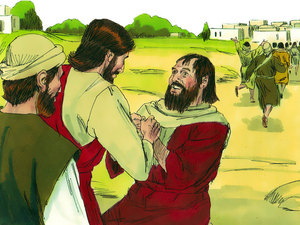
Where Are The Nine?


004-jesus-ten-leprosy

In Lk. 17:11-19 Luke recounts an incident in which ten leprous men encountered Jesus as He entered a village while traveling between Samaria and Galilee on His way to Jerusalem.  The text says, “While He was on the way to Jerusalem, He was passing between Samaria and Galilee.  As He entered a village, ten leprous men who stood at a distance met Him; and they raised their voices, saying, ‘Jesus, Master, have mercy on us!’  When He saw them, He said to them, ‘Go and show yourselves to the priests.’  And as they were going, they were cleansed.  Now one of them, when he saw that he had been healed, turned back, glorifying God with a loud voice, and he fell on his face at His feet, giving thanks to Him.  And he was a Samaritan.  Then Jesus answered and said, ‘Were there not ten cleansed?  But the nine — where are they?  Was no one found who returned to give glory to God, except this foreigner?’  And He said to him, ‘Stand up and go; your faith has made you well.'”

This incident is interesting in several respects.  First, the Lord performed an incredible miracle when He cleansed these men of their leprosy.  What makes this so powerful is that He didn’t openly do anything to heal them.  He simply told them to go and show themselves to the priests and they were healed as they went on their way.  This certainly demonstrates His great power.  The Lord didn’t have to do or say anything in order to heal the sick.

Second, the occasion of this miraculous healing became an object lesson in gratitude.  We generally assume that those who were healed by the Lord were grateful for their healing, but the accounts rarely make mention of it like this one does.  Ten men with a serious disease asked the Lord for mercy.  He responded by healing them, but when only one of them returned to give thanks, the Lord took special note of it.  His reaction tells us that He was disappointed in the nine who failed to give thanks.  While it might be argued that the nine were doing exactly what the Lord told them to do by going to show themselves to the priests, it is obvious that the Lord would have been more pleased if they had delayed going to the priests long enough to return and say, “Thank You.”

The attitude of the Samaritan who returned to thank the Lord is a model for all of us.  He did not take the Lord’s blessing for granted.  He so appreciated the healing the Lord bestowed upon him that he could not do anything else until he had expressed his gratitude for it.  When we consider the manner of his expression, it makes the ingratitude of the nine all the more disturbing.  Luke says the Samaritan “turned back, glorifying God with a loud voice.”  There can be no question that the nine heard his cries, but they were unmoved to join him in giving thanks to God.

The Lord made no other statement about the nine, but His question, “Where are they?”, should jar us from any complacency about our gratitude for God’s blessings.  The absence of any further comment about the nine suggests that they didn’t return to thank the Lord even after they had shown themselves to the priests.  The nine should have been as grateful as the Samaritan was.  The fact that they were not says a lot about their character.  It says they did not have the faith that the Samaritan had.  It says they did not have faith that was grateful for God’s goodness.

As we go about our business from day to day, we must take care that we do not become faithless like these nine men.  We are abundantly blessed in many ways, and we should daily give thanks to our Father in heaven for all He does for us.  May we never become so complacent about expressing our gratitude that our Father in heaven is prompted to ask, “Where are they?”

Believers

Belief is a fundamental requirement to be pleasing to God.  In Heb. 11:6 the scripture says, “And without faith it is impossible to please Him, for he who comes to God must believe that he is and that He is a rewarder of those who seek Him.”  During His earthly ministry Jesus said essentially the same thing.  In Jn. 8:24 He told the Jews, “Therefore I said to you that you will die in your sins; for unless you believe that I am He, you will die in your sins.”  Everyone who claims to be a Christian today espouses this important truth and requires it of anyone who wishes to be right with God.

As it is practiced by many today, however, the expression of belief in God and belief in Jesus Christ is only an expression.  An individual states that he or she believes that Jesus is the Son of God, and on the basis of this statement alone is deemed to be saved.  That person might have to repeat some version of the “Sinner’s Prayer,” or some other formulaic statement to claim salvation, but the point is that his or her acceptance as a believer is solely upon the strength of an oral statement.

When we turn to the pages of the New Testament, especially in the book of Acts, we find a very different presentation of the idea of a believer.  The first thing we notice is that nowhere can we find any version of the “Sinner’s Prayer.”  Neither do we find believers identified solely on the basis of an oral profession of faith.  There is no question that people professed their faith in Jesus Christ, but according to the scriptures, true believers acted on their faith by obeying the gospel.

In Acts 8:12, 13 as Luke recorded the evangelistic work of Philip in the city of Samaria, he made this statement about what happened: “But when they believed Philip preaching the good news about the kingdom of God and the name of Jesus Christ, they were being baptized, men and women alike.  Even Simon himself believed; and after being baptized, he continued on with Philip, and as he observed signs and great miracles taking place, he was constantly amazed.”  Later, in Acts 11:21, Luke tells of the response of the Gentiles to the preaching of the gospel in Antioch.  He says, “And the hand of the Lord was with them, and a large number who believed turned to the Lord.”  The same language is used about the proconsul, Sergius Paulus, in Acts 13:12.  All of these believers were baptized in the name of Jesus Christ to have their sins forgiven, just as the 3,000 were on Pentecost (Acts 2:38-41).

What this demonstrates is that true believers did not simply profess their faith in the Lord, but also obeyed the gospel as the apostles had commanded since the first Pentecost after the Lord’s resurrection.  To the believing Jews on Pentecost, Peter said, “Repent, and each of you be baptized in the name of Jesus Christ for the forgiveness of your sins; and you will receive the gift of the Holy Spirit” (Acts 2:38).  In every other instance of conversion in the book of Acts baptism was required for salvation.  This requirement was emphatically stated by Paul as he recounted his own conversion in Acts 22:16.  The preacher Ananias told the penitent, believing Saul of Tarsus, “Now why do you delay?  Get up and be baptized, and wash away your sins, calling on His name.”

In the New Testament true believers did more than simply profess faith in Christ.  They obeyed the command to be baptized in His name in order to have their sins washed away.  The Lord Himself stipulated this requirement in Mk. 16:16, where He said, “He who has believed and has been baptized shall be saved; but he who disbelieves shall be condemned.”  This statement illustrates the fact that in the scriptures belief and obedience go hand in hand.  In Jn. 3:36 John the Baptist said, “He who believes in the Son has eternal life; but he who does not obey the Son will not see life, but the wrath of God abides on him.”  One who truly believes will obey.  The one who disobeys does not truly believe.

No one is called a believer in the New Testament who had not been baptized for the forgiveness of his sins.  Those who wish to be true believers today must also obey this essential command.

Just Like Me?

The New Testament teaches us that even though we will each individually stand in judgment, the growth and development of the church depends on all of us working together.  In Eph. 4:11-16 Paul spoke of the various works that the Lord placed within the church for the purpose of building it up.  We recognize most of these as areas of leadership within the church, such as evangelists, pastors (elders), and teachers.  However, at the end of this passage we see that every member of the church is expected to contribute to this process.  In vs. 15, 16 he said, “But speaking the truth in love, we are to grow up in all aspects into Him who is the head, even Christ, from whom the whole body, being fitted and held together by what every joint supplies, according to the proper working of each individual part, causes the growth of the body for the building up of itself in love.”

It is easy to speak of the church in the third person, as in “they” are doing this or that.  When one speaks of the church in this manner he has taken the position of an outsider.  Whether he realizes it or not, he has effectively separated himself from the church and from its work.  He is a spectator, rather than a participant.  He may still want the church to grow and prosper, but his manner of expression shows that he expects others to make this happen.

Knowing that the scriptures call upon each of us to do our individual part to contribute to the good of the church, we need to ask ourselves a series of questions.  What if everyone in the church were just like me?  What if everyone in the church attended worship and Bible study like me?  What if everyone sang and prayed and contributed of their means like me?  What if everyone listened to and applied the sermons like me?  What if everyone lived their faith like me, or shared their faith like me?  What would happen to the church then?

For some of us this would mean that we could never depend on anyone showing up for worship on the Lord’s day.  It would mean that when they did show up, they would sit silently during the singing, and doze during the preaching, and pass the collection plate without putting anything in.  It would mean that no one would be able to tell that we belong to Christ, and the lost would never hear the gospel.  It’s a frightening thought, or at least it should be.

The man who said the church grows because of what every joint supplies, and by the proper working of each individual part, demonstrated this truth in his own life.  Paul the apostle truly put the kingdom of Christ first in his life.  He devoted himself to doing everything within his power and ability to further the gospel and to cause the church to grow.  Consequently he could honestly say to his readers, “Be imitators of me, just as I also am of christ” (1 Cor. 11:1).

To whatever degree we may have been treating the church as “they” instead of “we,” we need to repent and ask the Lord’s forgiveness.  The church’s growth will be helped or hindered by what each one of us does in the Lord’s service.  The church as a whole will not cease to exist, even if everyone in it is just like its fringe members.  But, the church will not be able to effectively fulfill its purpose until each one of us takes ownership of his or her place within it.

Let us resolve to follow Paul’s example so we too may encourage others to imitate our life of service in the glorious church of our Lord and Savior Jesus Christ.

One Man, One Woman, For Life

The media continues to be full of stories about the ongoing efforts of homosexual activists to make same-sex marriage legal in all fifty states.  Professed believers are understandably concerned about this issue.  Some have openly declared their opposition, while others quietly fret over the potential consequences of this push by the homosexual lobby.  In sermons, letters to the editor, and in public displays, the biblical teachings on the subject of homosexuality are being strongly and accurately proclaimed.  This is a stand that must be taken if we are followers of Christ, but there is another, related issue that also needs open discussion.

While talk of same-sex marriage dominates the media, an equally serious problem is virtually ignored.  That subject is divorce.  We have long heard that 50% of all marriages end in divorce.  That number is actually inaccurate and is based upon faulty extrapolation of the data.  In 2011 the Centers for Disease Control reported 6.8 marriages for every 1,000 people in the U.S.  For the same year, the CDC also reported 3.6 divorces for every 1,000 people.  That looks very close to 50%, but it is an inflated number because it includes children and those who have never married.

A more accurate survey was conducted among married women in 2008.  This survey revealed that there were 16.9 divorces per 1,000 married women for that year.  While this number appears to be much better than the 50% of the other survey, it is still alarming.  Part of what makes this number so much lower, however, is that more people are living together without being married.  If these couples split up, as many of them do, it is not reflected in the divorce rate because they were never married in the first place.

These statistics demonstrate that we have a serious marriage problem in our country.  A large number of people either have no idea of the biblical teachings on marriage, or they choose to ignore those teachings.  If we ever hope to make a dent in the number of divorces and live-ins in our nation, we must return to the divine plan instituted by God in the Garden of Eden in the beginning.

In Gen. 2:18-25 God saw that it was not good for the man to be alone, so He did two things.  First, He brought all the animals to Adam to see and to name.  In Gen. 2:20 the scripture says Adam named all the animals, but none of them was suitable to be the helper God knew he needed.  Then God did the second thing.  He put Adam to sleep, took one of his ribs, and from it made a woman.  The woman was the suitable helper Adam needed and God gave her to Adam for that purpose.  Thus, the first marriage was instituted.

During His earthly ministry the Lord referred back to this first marriage as the example of what God intended for mankind (Mt. 19:3-9).  Although divorce was allowed under the Law of Moses, the Lord said this was only because of the hardness of men’s hearts, and from the beginning it was not so.  The Lord taught that divorce should only be because of marital infidelity (Mt. 5:31, 32).

The Lord’s teaching went beyond the incidence of divorce, however.  In Mt. 5:27, 28 the Lord went to the heart of the matter.  The Law of Moses said not to commit adultery, but the Lord said not to lust after a woman.  This is the root of the divorce problem.  If our hearts are not committed to the Lord’s way for marriage, we will sin against our spouse and sow the seeds of divorce.  On the other hand, if we commit to the Lord’s way, our marriage will be blessed, and it will last until death, as God intended from the beginning.

Fully Engaged

A recent article discussing the resurgence of muscle cars in the U.S. market noted the absence of stick-shift models from the Big Three American manufacturers.  Driving enthusiasts lament this absence because they enjoy the feel of going through the gears as they drive.  Among the reasons given for the lack of stick-shift models is the fact that automatic transmissions are much more fuel-efficient today than in the past.  In many cases fuel mileage is not appreciably increased by the use of a stick-shift transmission.

The mechanics of a stick-shift transmission are interesting.  When the clutch is depressed the gears of the transmission disengage.  This allows the driver to shift to the next higher or lower gear, as the situation may require.  Once the proper gear is in place the clutch is released allowing the new gear to fully engage the drive train.  When properly engaged, the gears allow the engine to propel the vehicle down the road.  If the gears are not properly engaged, however, the driver hears a grinding sound which signifies a problem than can result in damage to the transmission.  The gears must be fully engaged for the drive train to function properly.

This process illustrates a spiritual truth about our walk as Christians.  In order for us to make progress on the path that leads to life we must be fully engaged with our spiritual drive train, Jesus Christ.  If we are disengaged, our engine may rev at a high rate, but we won’t move.  If we are only partially engaged, our spiritual gears will grind, leaving us sputtering along with the potential to become completely disabled.  If we intend to make it all the way to the goal, we must be fully engaged with our Lord.

In 1 Pet. 2:21, 22 Peter said, “For you have been called for this purpose, since Christ also suffered for you, leaving an example for you to follow in His steps, who committed no sin, nor was any deceit found in His mouth.”  Peter said we are to follow in the Lord’s steps.  To do this we must be fully engaged with Him.  The mechanics of being fully engaged with the Lord can be illustrated by using the word “steps” as an acronym.  Briefly stated, the word “steps” stands for:  Serve, Tell, Exemplify, Pray, and Sacrifice.

In Mk. 10:45 Jesus said that He did not come to be served, but to serve and to give His life as a ransom for many.  If we are fully engaged with our Lord we will serve others as He did, doing good to all and pointing them to the Father in heaven.

In Mk. 16:15, 16 Jesus told His disciples to tell the good news to all creation.  He said those who believe and are baptized will be saved.  The first century disciples told this good news everywhere they went.  We must do the same in order to be fully engaged.

Peter said that Jesus left us an example to follow.  The Lord lived what He preached.  When we live in accordance with His commands, we exemplify our faith, showing that we are fully engaged with our Lord.

On many occasions the Lord spent long hours in prayer to His Father in heaven.  He understood the importance of this spiritual connection.  We must devote ourselves to prayer each day to be fully engaged.

The central feature of first century preaching was the sacrifice of Christ on the cross.  He gave His life for our sins.  We may not be called upon to give up our lives, but we must make sacrifices in our lives in order to be fully engaged with our Lord.

May each one of us be fully engaged with the Lord as we follow in His steps toward the eternal goal.

Your Will Be Done

On the night of His betrayal, after observing the Passover with the twelve, the Lord began to feel the anguish of the sacrifice He would make the next day for the sins of the world.  He took the disciples, minus Judas, into the Garden of Gethsemane where He spent perhaps as much as three hours in prayer to His Father in heaven.  The burden of His impending death was so great that Luke says, “And being in agony He was praying very fervently; and His sweat became like drops of blood, falling down upon the ground” (Lk. 22:44).

Matthew gives us the most complete account of the Lord’s prayers on that occasion in Mt. 26:36-46.  A key feature of those prayers is the statement found in v. 39.  Here the Lord said, “My Father, if it is possible, let this cup pass from Me; yet not as I will, but as You will.”  We correctly exalt the Lord for being willing to do the Father’s will in this circumstance, even though He truly wished there were another way to accomplish it.  We also correctly draw from His example that our prayers should likewise express the wish that God’s will be done.

We most often express this attitude when praying for the sick.  We lay before the Father our desire that the sick person will recover, and then we add, “if it is Your will,” or words to that effect.  When we do so, what do we mean by it?  Do we say this simply because we have been taught that we should do so, in the same way that we add “in Jesus’ name” at the end of our prayers?  Do we say this as a hedge against the sick person not recovering, so that if he does not recover we can say it was not God’s will for him to recover?  Only the person saying these words can answer these questions, but perhaps we would do a better job with our prayers if we considered what the Lord meant by this statement.

We tend to view the Lord’s statement as something of a concession, as though He finally gave up and agreed to do it the Father’s way.  This seems to be the way we use this statement in our prayers.  We tend to say, “Lord, this is what we want, but if we can’t have what we want, we’ll settle for what You want.”  A better way to look at this statement, however, would be to view it as an extension of what the Lord taught in the model prayer.

In Mt. 6:10 the Lord taught His disciples to pray, “Your kingdom come, Your will be done, on earth as it is in heaven.”  In other words, we should pray that God’s will would always be done on the earth in every circumstance of life.  With this as the foundation, the Lord’s statement in the Garden of Gethsemane becomes an affirmation of the Father as the sovereign God of the universe.  It is a statement of submission and obedience that exalts God, instead of being a concession to Him. Our Lord was saying, “Father, let Your will be accomplished in this matter, in spite of my feelings about it.”

This view of the Lord’s statement exalts Jesus in a far greater way.  It shows that He was consistent in His attitude toward God’s divine purpose and will.  He not only taught His disciples to pray that the Father’s will be accomplished on earth, but He also modeled it before them in His final prayer before His crucifixion.  Even in the face of His impending death the Lord prayed for the Father’s will to be done.

If our Lord prayed in this manner, how much more so ought we to do so?  Think of how empowering it is to pray for God’s will to be done in every aspect of life.  When we pray with this attitude we are affirming the greatness and majesty of the Father in heaven, and we are acknowledging our submission to Him in a positive manner, rather than as a concession.  In everything, therefore, let us pray, “Father, Your will be done!”

Reserved For Fire

Fire is one of the most terrible forces on the face of the earth.  Whether sparked by natural causes, such as a lightning stoke, or caused by human intent or mistake, there is little else that evokes such fear.  Part of our fear of fire is due to its volatile nature and unpredictability.  We fool ourselves when we think we can control it, and from time to time we are reminded of this truth in catastrophic ways.

Fire is an indiscriminate force.  It plays no favorites.  To the degree that a substance will burn, fire will consume it.  The more susceptible to flame the substance is, the more quickly it is destroyed by the flames.  Our most solidly constructed homes and buildings are still subject to fire, if not by the materials from which they are constructed, at least by the contents we place inside them.  Human beings are especially susceptible to the force of fire.

Our bodies are composed of materials that cannot withstand fire.  Our hair is especially volatile and can ignite in a moment.  Our skin begins to burn if we stay out in the sun too long, and when exposed to flame, it almost immediately begins to blister.  Even though our bodies contain a large amount of liquid, fire can reduce them to a mere pile of ash in a short period of time.  The most painful injury we can sustain is a burn, and those whose bodies have been severely burned endure extreme pain throughout their recovery.

We generally have a healthy respect for fire because we understand how dangerous it can be.  Our fear of this powerful force makes us wary of it in life.  Even as we put it to use in our daily affairs, we exercise great caution with it lest we suffer injury or death from it.  This respect and fear of fire guides us in life and should also affect the way we think about and plan for eternity.

The reason why it should affect our thinking in this respect is because God has forewarned us that He has fire reserved for the world.  In 2 Pet. 3 as Peter dealt with those who mocked Christians’ faith in the coming of the Lord, he said, “But by His word the present heavens and earth are being reserved for fire, kept for the day of judgment and destruction of ungodly men” (v. 7).  He went on in vs. 9-10 to describe how the Lord will destroy everything in the physical realm on the last day by means of fire.  In vs. 11-12 Peter urged his readers to consider how they should live, knowing that this fire is certainly coming.

This is not the only fire that is reserved by God, however.  In Rev. 20 John was shown a vision of the judgment.  In v. 10 John said that the devil would be thrown into the lake of fire and brimstone where he would be tormented day and night forever and ever.  In vs. 11-15 he described the judgment of all mankind.  He tells us that those whose names are not written in the book of life will be thrown into the lake of fire, which is the second death (vs. 14-15).  This is the same lake of fire into which the devil will be thrown, and all those in this lake of fire will be tormented day and night forever and ever, just as he will.

The most horrible death we can imagine is to be burned alive.  The very thought of it makes us shudder.  How much more so ought we to fear a fire which will never go out, and in which we will suffer all the pain without ever losing consciousness?  It is a terrifying thought that should move us to obedience, for this fire is reserved only for the wicked.  Knowing this truth, we must obey the gospel so our names will be in the book of life and so we will not be among those who are reserved for fire.

The Truth in Love

Many years ago, one of my professors at preaching school said this: “The work of a preacher is to comfort the afflicted, and to afflict the comfortable.”  At the time we all sort of chuckled at this idea, but we came to realize that this simple statement encompassed much of what we were called to do.  Our ministry was to all those who had needs, even if they were unaware of those needs.  Our ministry was to help soothe the pain of life, but also to motivate the complacent.

Unfortunately, some preachers, especially young ones, fixate on the “afflicting” side of this statement.  Their words become harsh and cutting, and they pride themselves in their perceived fidelity to God’s word by the number of people who are offended by what they say.  It is a testimony to the patience and wisdom of elders and congregations of God’s people that many preachers like this are helped to grow out of the immaturity that spawns such a harsh attitude.

Preachers, however, are not the only ones who may be infected with this attitude.  Sometimes the people in the pews can be just as harsh and cutting in their remarks and attitudes as the brashest young preacher.  The result of this kind of attitude is predictable.  Some sincere seekers are driven away from the truth because of an unloving attitude expressed in harsh terms.  They go away with feelings hurt, and we shrug and persuade ourselves that it is because they didn’t really love the truth.

We know from the scriptures that some people are not interested in the truth (Rom. 1:18; 2 Th. 2:11, 12; 2 Tim. 4:3, 4).  These people will not be persuaded to obey God’s will no matter how kindly they are entreated.  Others, however, because they do not understand the importance of truth, may be driven away by the manner in which we present it to them.  Each person will answer for his decision to obey the gospel or to reject it, but we must be certain that we do not do anything to prejudice anyone against the truth.

The great apostle Paul made a simple statement that gives us the guidance we need on this subject.  In Eph. 4:15 he said, “But speaking the truth in love, we are to grow up in all aspects into Him who is the head, even Christ.”  He said we are to speak the truth, but we are to speak it in love.  When we think about it, this just makes good sense.  We have the greatest good news that the world will ever know.  It is the news of salvation from sin by the blood of the Son of God, Jesus Christ.  This is a message of love, and should be communicated as such.  Doing so does not negate or compromise the truth.

Paul himself is the example of this in his sermon on Mars Hill in Athens.  This was a city that was among the most idolatrous in the ancient world, yet as Paul began speaking he said, “Men of Athens, I observe that you are very religious in all respects” (Acts 17:22).  If he were like some today, he might have said, “You people are a bunch of ignorant idol worshipers.  Let me tell you the truth about these false gods you worship.”  Paul’s approach drew them to listen to what he had to say, even though most of them ultimately rejected his message.  The other approach would have gotten him thrown out of town before he even had a chance to speak.  Doing it the way Paul did at least gave them the opportunity to learn the truth.  This is something we must always bear in mind.

In 2 Cor. 5:21 Paul said, “We beg you on behalf of Christ, be reconciled to God.”  One who begs another to do what is right is speaking the truth in love.  One who berates and offends may speak the truth, but his words and attitude rob it of its power to change lives.  Let’s always make sure we speak the truth.  But, let’s always make sure we speak the truth in love.

Treat Him As Holy

One of the more troubling aspects of modern evangelical Christianity is its emphasis on the casual and the familiar.  Whereas worship used to have a very formal and solemn atmosphere, the current trend is to make it more like a pep rally.  Several things characterize this trend.  One is that many preachers have stopped wearing coats and ties in the pulpit.  Some wear sports coats over t-shirts, while others have taken to “camp” shirts over khaki trousers.  In one church, the preacher recently wore a white t-shirt, wind pants, and running shoes.  With preachers dressing in this manner, it is no wonder that the people in the pews have become more casual in their attire.

While it is true that the scriptures do not dictate a style of dress for preachers or worshipers, the trend away from more formal attire is indicative of a greater issue.  That issue is the concerted effort to make God more “approachable” in the worship assembly.  The result is that He is treated far more casually than is appropriate for who He is.  It is not unusual today for worshipers to address God as though they were speaking to their best buddy down on the block.

An enthusiasm to have a close relationship with God is commendable, but we must never lose sight of the fact that He is God, first, last, and always.  Because He is God, He must be treated as holy.  This is not just the preference of an old “fuddy-duddy,” but it is what God Himself has said.  When Nadab and Abihu violated God’s instructions for conducting the worship in the tabernacle, He consumed them with fire from heaven (Lev. 10:1, 2).  Then God instructed Moses to tell their father Aaron why they died.  In Lev. 10:3 Moses said, “It is what the Lord spoke, saying, ‘By those who come near Me I will be treated as holy, and before the people I will be honored.'”

Nadab and Abihu did not treat God as holy because they ignored His command to use specific fire in offering incense to Him.  Their action showed their lack of respect for Him as they worshiped.  We might be tempted to wonder what the big deal was, since fire is fire, but we must not miss the importance of what God said through Moses.  Doing exactly what God commands is one way in which we treat Him as holy, and He will not overlook us failing to treat Him as holy.

Moses and Aaron learned this lesson firsthand at the waters of Meribah in Num. 20:8-13.  God instructed Moses to take his rod and speak to the rock in order to bring forth water for the Israelites.  Moses spoke rashly before the people, as though he and Aaron were supplying the water for them (v. 10), and then he struck the rock twice with his rod (v. 11).  God brought forth the water, but He punished Moses and Aaron for failing to treat Him as holy before the people (v. 12).  Because of their sin neither one of them was allowed to enter the promised land.

The requirement to treat God as holy did not end with the Old Testament, however.  God is still God.  He is still holy, and we must still treat Him as holy.  Peter said that we must be holy in all our behavior just like the Holy One who called us, because the scriptures say, “You shall be holy, for I am holy” (1 Pet. 1:15, 16).  Nowhere in the New Testament is God addressed by His people in anything but the most respectful terms.  This isn’t because He is aloof from us, but because His holiness is such that we cannot bring Him down to our level.  He loves us and wants us to be with Him for eternity, but He is God, and we must treat Him as holy.

Faithful Until Death

The book of Revelation was written by the apostle John to the seven churches of Asia in order to reassure them as they faced persecution from the Roman Empire.  Although this book is full of symbolic language that defies our ability to understand it, the basic message is a simple one.  It is that the Lamb, Jesus Christ, will be victorious over the evil one.  It is a message of hope and encouragement that sustained these early churches in troubling times.  It is a message that continues to sustain Christians today because nothing has changed.  The Lord will still be victorious in the end, and those who stand with Him will be victorious as well.

In Rev. 2-3 the Lord spoke directly to each of the seven churches of Asia.  In each message He exhorted these churches to live up to their calling as Christians, and He challenged them in the specific areas of faith and conduct in which they were lacking.  In Rev. 2:10, as the Lord spoke to the church in the city of Smyrna, He gave them an exhortation that is universal in its application.  He said, “Do not fear what you are about to suffer.  Behold the devil is about to cast some of you into prison, so that you will be tested, and you will have tribulation for ten days.  Be faithful until death, and I will give you the crown of life.”

The Lord’s exhortation to Smyrna was that they must remain faithful to Him until death in order to receive the promised reward at the end of time.  In their case, being faithful until death might mean being martyred for their faith.  Even at that time, however, martyrdom was a rare circumstance.  The more common situation, even then, was for a Christian to live until he or she naturally passed from life.  This is actually the greater challenge, and is what makes the Lord’s exhortation timeless.

When one obeys the gospel, he commits himself to live for the Lord from that day forward.  It is a lifetime commitment that requires our very best, as any worthwhile endeavor does.  The Lord, having washed our sins away, expects us to remain faithful to Him until our walk on earth is done.  This is certainly what the imagery of Mt. 7:13, 14 suggests when the Lord said to enter the narrow gate that leads to life.  One does not enter a gate and then stop.  Having entered the gate, we must continue on the way until we reach the goal.

A common adage in our time is, “Quitters never win, and winners never quit.”  Whether we know it or not, this is the biblical principle of being faithful until death.  Those who win with the Lord at the end of time are those who never quit their faithful walk as children of God.  Among those who lose at the end of time are those who did not remain faithful to their commitment to Christ.

In ancient Judah, King Asa is an example of one who began well, but did not remain faithful until death.  It is a tragic story that illustrates the folly of giving up one’s commitment to the Lord.  Early on in his reign, Asa fully depended on the Lord, placing his destiny and that of Judah in God’s hands.  His trust in the Lord was rewarded with great victories over his enemies and favor from His God.  Near the end of his reign, however, Asa turned away from God.  He suffered for doing so, and is today remembered as an unfaithful king.

Being faithful until death is the greater challenge, but we draw strength to remain faithful from the words the seer Hanani spoke to Asa long ago.  In 2 Chr. 16:9 Hanani said, “For the eyes of the Lord move to and fro throughout the earth that He may strongly support those whose heart is completely His.”  The Lord wants us to remain faithful until death, and He will empower us in this endeavor if our hearts are fully committed to Him.