This program will air on KIUN 1400 AM in Pecos, TX on October 16, 2015.
This program will air on KIUN 1400 AM in Pecos, TX on October 16, 2015.

The ancient Chinese philosopher Lao Tzu said, “The journey of a thousand miles begins with one step.” Most of us have heard this statement in one form or another many times in our lives. We understand it to mean that we cannot reach any goal, no matter how near or far, until we have taken a step toward that goal. This makes perfect sense, but it is not the whole story.
The Greek philosopher Aristotle, who lived about 300 years after Lao Tzu, said, “Well begun is half done.” This statement is less well-known, but perfectly complements Lao Tzu’s proverb. Aristotle understood human nature. He knew that we often content ourselves with the fact that we’ve begun something, but then never complete it, or complete it inadequately. Thus, he admonished against being satisfied simply with a good beginning.
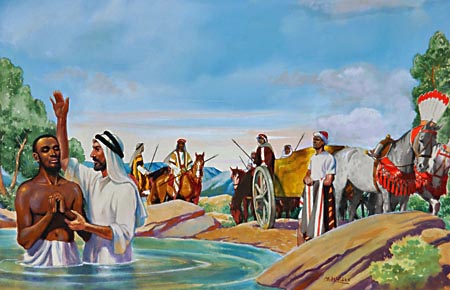
As useful as these proverbs may be in secular matters, neither of them adequately addresses the most important issue of all: the journey to eternal life. The scriptures, not surprisingly, cover every aspect of this journey. In Mt. 7:13, 14 the Lord said, “Enter through the narrow gate; for the gate is wide and the way is broad that leads to destruction, and there are many who enter through it. For the gate is small and the way is narrow that leads to life, and there are few who find it.” This is the beginning of the journey to eternal life. This step is taken when one obeys the gospel by being baptized for the forgiveness of his sins (cf. Acts 2:38; 22:16, et al). If one does not take this step, he will never reach heaven.
Then, in Mt. 24:10-13 the Lord said, “At that time many will fall away and will betray one another and hate one another. Many false prophets will arise and will mislead many. Because lawlessness is increased, most people’s love will grow cold. But the one who endures to the end, he will be saved.” This statement covers the completion of the journey to eternal life. Taking the first step begins the journey, but only those who remain faithful to the Lord until the end will reach heaven (Rev. 2:10).
In between the first step and the last step, the scriptures offer this admonition from the pen of Peter: “For if, after they have escaped the defilements of the world by the knowledge of the Lord and Savior Jesus Christ, they are again entangled in them and are overcome, the last state has become worse for them than the first. For it would be better for them not to have known the way of righteousness, than having known it, to turn away from the holy commandment handed on to them” (2 Pet. 2:20, 21). This is the inspired equivalent to Aristotle’s “Well begun is half done.” Peter tells us that having begun the journey to eternal life, we must not turn off the path until we reach heaven. Those who begin well, but do not finish, will suffer condemnation from the Lord.
A modern proverb says, “Winners never quit, and quitters never win.” We understand that this refers to one’s heart, rather than to the results on the field of competition. We use it to encourage each other in whatever endeavor we might undertake, and it fits that purpose well. When we reflect upon this proverb in a spiritual context, however, we discover that it applies both to one’s character (heart), and to the results of his efforts. In 2 Tim. 4:7, 8 Paul told Timothy that he anticipated receiving the crown of righteousness because he had been faithful to the Lord to the end. He also said that this reward is reserved for all who would do as he had done.
Here’s the point: All who are faithful to the end will enter heaven, just as Jesus said: “But the one who endures to the end, he will be saved.”

This program aired on KIUN 1400 AM in Pecos, TX on September 30, 2015.

Amos was a prophet from Tekoa, which was about six miles south of Bethlehem. He ministered during the reigns of Uzziah over Judah and Jeroboam II over Israel in the 8th century B.C. His primary message was a warning to the pagan nations and to Israel of God’s impending judgment. A key part of this warning is in the form of a discourse in which God lamented Israel’s departure from the faith (Amos 3:1-8). This departure was made all the worse because God had chosen Israel from among all the families of the earth to be His, but they had rejected Him (v. 2).
In Amos 3:3-6 God asked a series of questions, each of which implied a negative response. The most important of these questions is in v. 3, where God asked, “Do two walk together, unless they have agreed to meet?” (ESV) The obvious answer is, “No.” Two people cannot walk together if they have not agreed to do so. The implication, of course, is that Israel was no longer in agreement with God. They were walking their own way, which was clearly not God’s way.
This is such a simple, yet powerful illustration of a fundamental truth in our relationship with God. We cannot walk together with God if we are trying to go our own way through life. The Old Testament certainly affirms this truth in case after case. Moses frequently admonished Israel to carefully keep God’s commandments and to not turn aside to the right or to the left (Deut. 5:32). In other words, Israel must agree to walk God’s way in order to be blessed.
This principle was reaffirmed by our Lord during His earthly ministry. In the Sermon on the Mount He stated it very simply in Mt. 7:13, 14. He said, “Enter through the narrow gate; for the gate is wide and the way is broad that leads to destruction, and there are many who enter through it. For the gate is small and the way is narrow that leads to life, and there are few who find it.” (NASB) He further emphasized this truth in Jn. 14:6, where He said, “I am the way, and the truth, and the life; no one comes to the Father but through Me.” (NASB)
It is hard to argue with these statements. God the Father said two cannot walk together unless they agree to do so. His Son, our Savior, said there is only one way that leads to life, and He is it. No one will come to the Father except through Him. Therefore, we must agree to walk the Lord’s way in order to have eternal life.
Agreeing to walk the Lord’s way means that we subjugate our will to His will. It means that we do not second-guess God’s will, or question the direction it leads us. It means that we commit to obeying all that He commanded us, just as Jesus said in Mt. 28:20. Walking together with the Lord means that we acknowledge that He is God and His will must be done, on earth as it is in heaven.
There are many today who claim to be walking with God. The airwaves are full of preachers who eloquently declare their fidelity to God and call others to walk with them, as they walk with God. The proof in the pudding, as it were, however, is whether these proclamations agree with what God’s word has revealed. God accepted no variation from His will among His chosen people Israel, even though they served what the book of Hebrews calls “the shadow of good things to come” (Heb. 10:1). How much more so, then, is this the case for those who live and serve in the reality of the kingdom, as we do today? The only way we can get to heaven is to walk together with our God as He leads us there through His inspired word. Don’t you agree?

This program aired on KIUN 1400 AM in Pecos, TX on September 25, 2015.

Some who read the title above will immediately respond that we don’t go “to church,” we are the church, and we go “to worship.” This, of course, is completely accurate, but it is a technicality that does not negate the basic question. Some honestly wonder whether it is absolutely necessary to be present every time the church gathers for worship or Bible study. Others ask only to validate their laxity about church attendance.
Elders and preachers have struggled with this question for generations. Some take the view that a “faithful” Christian will be present every time the doors are open, unless providentially hindered. Others take the view that once a week, sometime on Sunday, is enough, and anything more is optional. One side will argue from scripture that we must be present at every assembly, while the other side argues that to believe such is Pharisaic.
Complicating this discussion is the fact that the scriptures simply do not give the kind of answer either side desires. Nowhere in scripture do we find any statement that specifically requires attendance at multiple assemblies each week. Neither, however, do we find any statement granting the freedom to be absent from the assembly for whatever whim might strike us.
The clearest statement about attendance in the assembly is in Heb. 10:23-25. Here the scripture says, “Let us hold fast the confession of our hope without wavering, for He who promised is faithful; and let us consider how to stimulate one another to love and good deeds, not forsaking our own assembling together, as is the habit of some, but encouraging one another; and all the more as you see the day drawing near.”
The writer of Hebrews says we must not forsake the assembly, but did he mean three or four such assemblies every week? The simple answer is, “No.” The scriptures suggest that first century Christians met once on the Lord’s Day to worship and to observe the Lord’s Supper. They did so because of the realities of their work week, rather than as a doctrinal statement. They worked seven days a week and thus had to meet either early on Sunday morning before going to work, or late Sunday evening after finishing work (cf. Acts 20:7-8).
The rise of multiple assemblies each week came about in modern times, and for at least two reasons. At one time the morning assembly was when communion was served, and was thus closed to those who were not members of that church. The evening assembly was an evangelistic assembly, when non-members were invited to attend. Later, especially during World War II, an evening assembly was deemed necessary because so many people worked shifts at defense factories that operated around the clock. The addition of Bible classes, or Sunday School, and mid-week Bible study or prayer meeting arose from a perceived need to facilitate knowledge of God’s word among members of the congregation.
The point in assembling together, as stated in Hebrews, is as a sign of holding fast to our confession, and to stimulate one another to love and good deeds in view of the imminent return of the Lord. Compared to our first century brethren, many of whom met daily and from house to house (Acts 2:46-47), even meeting four times a week seems insignificant. As we consider this issue we have to ask two questions. First, “Is worshiping God less important than anything else we might do when the church assembles?” And, second, “Is holding fast our confession and stimulating one another to love and good deeds less important than anything else we might do?” If so, then, no, we don’t have to go to church. But, if we love the Lord and appreciate the salvation He has given us, then we won’t want to be anywhere else when the church meets, however often that might be. In the end, we know that this pleases God, and isn’t that more important than anything else in life?
One of the most beautiful of the psalms is Psalm 46. It is attributed to the sons of Korah, and it extols God as “our refuge and strength, a very present help in trouble” (Psa. 46:1). This psalm encouraged Israel to not lose heart as they faced various challenges because God is always with His people to care for them and to provide for them in every situation.
In v. 8 the psalmist invited Israel to “behold the works of the Lord, who has wrought desolations in the earth”. Then, in v. 9 he says, “He makes wars to cease to the end of the earth; He breaks the bow and cuts the spear in two; He burns the chariots with fire.” In other words, Israel’s dependence upon God was well founded. He had more than adequately demonstrated His power, and they could therefore be confident no matter what might come.
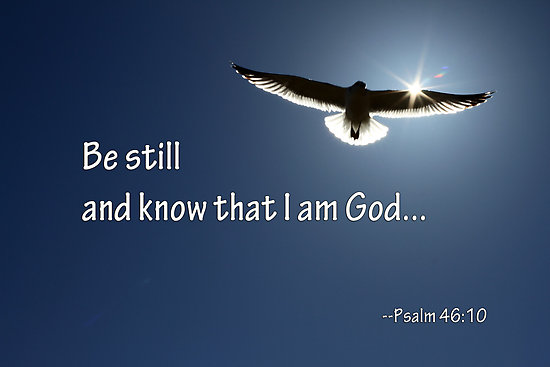
In v. 10 the psalmist spoke for God and said, “Cease striving and know that I am God; I will be exalted in the earth” (NASB). Most of the other English translations say, “Be still, and know that I am God.” Both renditions are accurate, but we are generally more familiar with the latter. This simple statement, however, is the key to the power of this psalm.
How often have God’s people today missed out on the refuge and strength of God because they refused to be still and acknowledge Him as God? This loss can be attributed, at least in part, to the fact that modern society has become averse to quietness. It seems we cannot go anywhere without our ears being bombarded with the cacophony of the modern world. Our culture has become one of incessant noise of various kinds and silence makes people uncomfortable, even in worship.
Our worship assemblies are highly structured, even those that give the appearance of informality and spontaneity. Something is supposed to be going on at all times, and the absence of sound means that something is wrong. Silence in the assembly for more than a few seconds puts worshipers on edge. The discomfort is palpable. Nevertheless, God says, “Be still, and know that I am God.” How much more fulfilling might our worship be if we took more time in quiet reflection as we worshiped? How much more prepared to face the challenges of life might we be if we followed God’s command?
The command to be still, however, is not limited to our worship assemblies. In fact, Psa. 46 actually speaks more to our day to day affairs than to our worship. This is where it gets tricky for us. We scurry about each day like a hamster in a wheel, immersed in the noise and chaos of life, and we wonder why we feel overwhelmed by it all. Perhaps if we took more time to be still, and to reflect on who our God is, we would find the fortitude and peace to successfully navigate our way through life.
Just being quiet, of course, is not the answer. God said to be still AND know that He is God. Our quiet time should be time when we reflect on God and on His word. It should be time when we approach Him in prayer or just quietly meditate on some truth from the scriptures. The point is that the refuge and strength we all need to face life is there, if we are willing to take advantage of it. But, we need to be quiet in order to access it. So then, let’s turn off the volume of life and sit quietly before the Lord. Let’s turn of the TV, the computer, our cell phones, and our game devices, and be still so we can see and hear the God who is our refuge and strength, a very present help in trouble.

This program aired on KIUN 1400 AM in Pecos, TX on September 11, 2015.

The advent of social media (Facebook, Twitter, etc.) has made it possible for us to be connected, albeit loosely, with people literally around the world. We post pictures about our daily lives and make comments on all manner of topics from the mundane to the sublime. Even though all users have identities on these media, our comments are essentially anonymous. The fact that they are made in cyberspace, rather than face to face, makes it tempting to say things we might not otherwise say. As a result, comments can be derogatory and hurtful, if not downright mean. Even among professed believers comments can get out of hand.
This brings to mind the story of a new rabbi who was constantly berated behind his back by a businessman who was a member of his synagogue. After many weeks of this, one of the other synagogue members confronted the man and reprimanded him for his behavior. Chastened, the man went to the rabbi to ask forgiveness and to make restitution. The rabbi told him to take one of his most expensive down-filled pillows up to the highest hill outside the village, scatter its contents to the four winds, and then return to him. The man complied with this request, and when he returned, the rabbi instructed him to go back and gather up all of the feathers. The man objected that this was impossible, to which the rabbi replied that so it was with gossip. Hurtful words, once spoken, can never be retrieved, and the damage they do cannot be undone.
This story illustrates a potential danger inherent in social media. When we make comments we have no idea how far they will travel, or what damage they may do. What we may have intended for one person can literally travel around the world before the day is done. Whatever our motivation may have been for making the comment, it is soon beyond our reach, either to correct, or to retract. Even if we later apologize, there is no guarantee that all who saw the initial comment will also see the apology. The damage will have been done and it cannot be undone.
This is an especially important truth for Christians. Our words are to be “with grace, as though seasoned with salt” (Col. 4:6). We are commanded to speak “only such a word as is good for edification . . . . so that it will give grace to those who hear” (Eph. 4:29). We are also commanded to treat others in the way we want them to treat us (Mt. 7:12). We are warned that the tongue is a fire, the very world of iniquity, which can set a great forest aflame (Jas. 3:5-10).
These commands apply to every facet of our lives, even the things we post on social media. When the prophet Nathan confronted David over his sin with Bathsheba, he told David that his actions had given the enemies of the Lord an occasion to blaspheme (2 Sam. 12:14). Christians who post hurtful words on social media are just as guilty as David was. When we act like the world, whether in word or deed, our connection to Christ is compromised, and we give unbelievers an opportunity to mock the Lord and His church.
We must thoughtfully consider every comment we post online. We must do so, first, because scripture commands us to speak only that which edifies. Second, we must do so because of how far our words may spread and what damage they may do. Third, we must do so because of the Golden Rule. None of us appreciates it when others speak badly of us, especially in a public setting (which social media is), so we should never do so to others. We must let our light shine before others so they will see our good works (and words) and glorify our Father in heaven (Mt. 5:16). This applies to everything we say and do, even on social media.

 ". . . let God be found true, though every man be found a liar."