24 Hours

24-Logo.svg


In 2001 a new television series called, 24, premiered on the Fox network.  The series revolved around a fictional counter-terrorism unit based in Los Angeles, and featured agent Jack Bauer in the lead role.  The premise behind the series was that each season constituted 24 hours, in which Jack Bauer and his organization thwarted some major terrorist act.  Each episode reflected one hour in the 24-hour period and used a digital clock display to keep viewers apprised of the elapsed time.  Because it was a work of fiction, the characters were always able to do things in much less time than in real life, like driving across Los Angeles in a matter of minutes instead of the hours it normally takes.

The concept of time is one of the few aspects of life that is equally distributed among all people.  Each day we live we have 24 hours at our disposal.  It doesn’t matter how rich or poor, how young or old, how well or infirmed, or where in the world one lives, we all have the same amount of time each day.  What separates us from one another in this regard is how we make use of that time.

In Eph. 5:15-16 Paul said, “Therefore be careful how you walk, not as unwise men but as wise, making the most of your time, because the days are evil.”  We often think of the 21st century as being unique with respect to the demands that are made on our time, but Paul’s words suggest that this is not the case.  Even in the first century, it seems, time was at a premium.  The fact is that in every age of mankind, and in every place and culture, there have been, and will continue to be, elements that can and do try to occupy our time.

Some of these things are essential to life.  For example, we recognize the necessity of working to earn a living.  We cannot take care of ourselves or our families if we refuse to work.  In the same way, eating and sleeping are an important part of each day.  Although some might balk at this, learning and study are also pursuits that have a positive effect on our lives.  So, also, do recreation and exercise.

Our problems arise when we allow some things to occupy too much of our time to the detriment of more important things.  In our day and time the most visible culprits in this regard are electronic devices.  Wherever we go most people have their attention focused solely on their smart phones or tablets.  Even at home we are immersed in web surfing or gaming on our computers and other devices.  Most responsible people agree that we are spending too much time in these activities, and not enough time on more important pursuits.

This is especially the case in spiritual matters.  If we were to compare the amount of time we spend in spiritual-growth activities with our other interests, we would find that spiritual things get by far the lesser amount of our attention.  If all a person does is attend a Sunday morning Bible class, two Sunday worship assemblies, and a mid-week Bible study or prayer meeting, he will have spent only about four hours out of the 168 hours that week on spiritual things.  If that person is not engaged in personal Bible reading and study at home, and is not engaged in personal prayer, or in conversation about spiritual things with other believers, he is starving his soul of its sustenance.

Of all the things to which we give our time, many are important and ought not to be neglected.  Other things are not as important and should occupy an amount of our time proportionate to their importance.  But, none of these things should take up so much of our time that we do not give adequate time to our spiritual needs.  We have 24 hours each day we live.  We must make the best use of that time in order to prepare our souls for eternity.

How are you going to use the 24 hours at your disposal today?

One of These Days. . . .

highway


In 1962 a record was released entitled, “Old Rivers.”  Walter Brennan, a famous character actor of that time, recited the words with a choir singing in the refrain in the background.  The song was about Old Rivers, an elderly farmer whose life was being remembered by a man who had spent his childhood following him as he worked in his fields.  The refrain of the song spoke of Old Rivers’ desire to depart and be with the Lord.  It began with the words, “One of these days, I’m gonna climb that mountain, walk up there among them clouds.”

The phrase “one of these days” is a statement of a wish that is hoped for, but without any definitive schedule attached to it.  In the song, Old Rivers knew that one day he would pass on to the other side, but he did not know when he would make that trip.  This is why he said, “One of these days, I’m gonna climb that mountain.”  He could not mark a date on the calendar for his passing.  All he could do was acknowledge the fact that one day he would.

We often use this phrase in a slightly different manner.  We may tell a friend, “One of these days, we’ll do this or that.”  When we say this, we may fully intend for that thing to happen, but we do not set a specific time to do it.  In such cases the occasion may never come about because neither friend ever schedules it.  In other instances, we may say this to be polite and to appear friendly, when we actually do not intend to make it happen.  It is a way to deflect making a commitment without appearing to be unkind.

We also use this phrase sometimes with regard to our obedience to the gospel, and to our faithfulness to the Lord.  One who is not a Christian may say, “One of these days, I’ll start coming to church, and I’ll get my life right with God.”  A wayward Christian may make the same statement when he is urged to renew the practice of his faith.  We have no way of knowing if this is a true statement of that person’s intent, or if it is just a polite way of saying, “No, thank you,” to the Lord.

Even if we were to take such a statement at face value, we cannot allow it to go without noting an important consideration.  “One of these days” is an ambiguity.  It is a dangerous balm to salve one’s conscience about any subject that he actually wants to avoid.  “One of these days” cannot be found on any calendar, and thus postpones the action that might resolve whatever issue is under discussion.  Whether it is health issues or exercise, pursuit of some educational or vocational goal, or following through on one’s commitment to the Lord, “One of these days” just kicks the can down the road.

“One of these days”, however, plays right into the devil’s hands.  It has been said that one of the devil’s greatest lies is that we have plenty of time to get right with God.  If he can convince us to wait until “One of these days”, he knows that we will very likely never follow through with our obedience to the Lord.  The reason why this is so is because we have no guarantees that “One of these days” will ever come.  In Jas. 4:14 James warned that our life is a vapor that appears for a little while and then vanishes away.  We never know when our life will end, so we can’t wait for “One of these days.”  Likewise, in Mt. 24:36 Jesus warned that no one knows the day or hour of His return for judgment, so we can’t wait for “One of these days” because we don’t know when the Lord will return.

This is why Paul said, “Behold, now is the acceptable time, behold now is the day of salvation” (2 Cor. 6:2).  Our only guarantee is this moment, and this breath we take.  To put off obedience in the hopes of some future opportunity is to court eternal condemnation.  To wait for “One of these days” is to play Russian roulette with one’s soul.  Make today your “One of these days” and get right with the Lord in obedience to His word.

Treasures In Heaven

Treasure_Chest_Costume_icon


The story is told of a wealthy man who died and appeared at the pearly gates.  An angel met him to escort him to the place where he would live for eternity.  As they walked along the man was overwhelmed by the beauty of the golden streets and the incredible mansions that lined it.  “Surely one of these is mine,” he thought, but the angel just kept walking.  Soon he noticed that the streets were no longer gold, and the houses were smaller, but still very nice.  He again thought that one of these must be his heavenly home, but the angel continued walking.  Finally, they came to a dirt path.  The angel led the man down the dirt path and stopped in front of a dilapidated shack.  “Here is your home,” the angel said, and turned to leave.  The man began to protest, saying that there must be some mistake.  How could he be assigned to such a poor dwelling place when they had bypassed so many fine mansions and houses?  The angel quietly replied, “Sir, we did the best we could with what you sent ahead.”

This little story helps us visualize an important spiritual principle, but like many human illustrations it misses the mark in one aspect.  The idea of there being mansions in heaven comes from a mistranslation in the King James Version of Jn. 14:2.  The Greek text says there are many rooms in the Father’s house.  The King James translators, working from the Latin Vulgate translation, mistook the Latin term, mansio, which means a place where someone stays, for mansion, a place where a lord lived.  This was never the intent of the Lord’s words in Jn. 14, and for this reason we should not expect to live in a mansion in heaven.  However, the idea of sending something ahead is a valid point, for the Lord Himself exhorted us to do so.

In Mt. 6:19-21 the Lord said, “Do not store up for yourselves treasures on earth, where moth and rust destroy, and where thieves break in and steal.  But store up for yourselves treasures in heaven, where neither moth nor rust destroys, and where thieves do not break in or steal; for where your treasure is, there your heart will be also.”  We understand that the Lord was not talking about sending physical building supplies ahead for one’s eternal comfort.  Instead, He was talking about one’s priorities and focus in life.  This point is made clear in v. 24 where the Lord said, “No one can serve two masters; for either he will hate the one and love the other, or he will be devoted to one and despise the other.  You cannot serve God and wealth.”

The context for these remarks is the Sermon on the Mount, and in particular the Lord’s discussion of mankind’s preoccupation with the necessities of life.  Even in the first century people were so focused on making a living that they were tempted to neglect their responsibility toward God.  The Lord’s message on that occasion was to put God first in their lives, and then all these things would be added to them (Mt. 6:33).  This is not only the divine prescription to alleviate worry in life, but is also the way in which we store up treasures in heaven.

The reason for the Lord’s concern is seen in His statement that where our treasure is, our heart will be there also.  This is a fundamental truth that transcends time and culture.  Our treasure is those things on which we place the greatest value.  If we place greater value on the physical things of life, our focus is going to be limited to this earthly realm.  If, on the other hand, we place greater value on spiritual things, our focus will be on God and on His will.

The scriptures warn us that at the end of time the physical realm will be destroyed by fire (2 Pet. 3:10-13).  If our treasure is worldly things, it is going to be lost when the Lord returns.  However, if our treasure is in heaven, we will be among those who are welcomed into the heavenly city at the end of time to live with the Lord forever.  There is no greater treasure than this.

So then, where is your treasure?

The One Who Endures

finish-line-2


The ancient Chinese philosopher Lao Tzu said, “The journey of a thousand miles begins with one step.”  Most of us have heard this statement in one form or another many times in our lives.  We understand it to mean that we cannot reach any goal, no matter how near or far, until we have taken a step toward that goal.  This makes perfect sense, but it is not the whole story.

The Greek philosopher Aristotle, who lived about 300 years after Lao Tzu, said, “Well begun is half done.”  This statement is less well-known, but perfectly complements Lao Tzu’s proverb.  Aristotle understood human nature.  He knew that we often content ourselves with the fact that we’ve begun something, but then never complete it, or complete it inadequately.  Thus, he admonished against being satisfied simply with a good beginning.

As useful as these proverbs may be in secular matters, neither of them adequately addresses the most important issue of all: the journey to eternal life.  The scriptures, not surprisingly, cover every aspect of this journey.  In Mt. 7:13, 14 the Lord said, “Enter through the narrow gate; for the gate is wide and the way is broad that leads to destruction, and there are many who enter through it.  For the gate is small and the way is narrow that leads to life, and there are few who find it.”  This is the beginning of the journey to eternal life.  This step is taken when one obeys the gospel by being baptized for the forgiveness of his sins (cf. Acts 2:38; 22:16, et al).  If one does not take this step, he will never reach heaven.

Then, in Mt. 24:10-13 the Lord said, “At that time many will fall away and will betray one another and hate one another.  Many false prophets will arise and will mislead many.  Because lawlessness is increased, most people’s love will grow cold.  But the one who endures to the end, he will be saved.”  This statement covers the completion of the journey to eternal life.  Taking the first step begins the journey, but only those who remain faithful to the Lord until the end will reach heaven (Rev. 2:10).

In between the first step and the last step, the scriptures offer this admonition from the pen of Peter: “For if, after they have escaped the defilements of the world by the knowledge of the Lord and Savior Jesus Christ, they are again entangled in them and are overcome, the last state has become worse for them than the first.  For it would be better for them not to have known the way of righteousness, than having known it, to turn away from the holy commandment handed on to them” (2 Pet. 2:20, 21).  This is the inspired equivalent to Aristotle’s “Well begun is half done.”  Peter tells us that having begun the journey to eternal life, we must not turn off the path until we reach heaven.  Those who begin well, but do not finish, will suffer condemnation from the Lord.

A modern proverb says, “Winners never quit, and quitters never win.”  We understand that this refers to one’s heart, rather than to the results on the field of competition.  We use it to encourage each other in whatever endeavor we might undertake, and it fits that purpose well.  When we reflect upon this proverb in a spiritual context, however, we discover that it applies both to one’s character (heart), and to the results of his efforts.  In 2 Tim. 4:7, 8 Paul told Timothy that he anticipated receiving the crown of righteousness because he had been faithful to the Lord to the end.  He also said that this reward is reserved for all who would do as he had done.

Here’s the point: All who are faithful to the end will enter heaven, just as Jesus said: “But the one who endures to the end, he will be saved.”

Do Two Walk Together?

marriage-harmony-is-a-beautiful-thing-2-638


Amos was a prophet from Tekoa, which was about six miles south of Bethlehem.  He ministered during the reigns of Uzziah over Judah and Jeroboam II over Israel in the 8th century B.C.  His primary message was a warning to the pagan nations and to Israel of God’s impending judgment.  A key part of this warning is in the form of a discourse in which God lamented Israel’s departure from the faith (Amos 3:1-8).  This departure was made all the worse because God had chosen Israel from among all the families of the earth to be His, but they had rejected Him (v. 2).

In Amos 3:3-6 God asked a series of questions, each of which implied a negative response.  The most important of these questions is in v. 3, where God asked, “Do two walk together, unless they have agreed to meet?” (ESV)  The obvious answer is, “No.”  Two people cannot walk together if they have not agreed to do so.  The implication, of course, is that Israel was no longer in agreement with God.  They were walking their own way, which was clearly not God’s way.

This is such a simple, yet powerful illustration of a fundamental truth in our relationship with God.  We cannot walk together with God if we are trying to go our own way through life.  The Old Testament certainly affirms this truth in case after case.  Moses frequently admonished Israel to carefully keep God’s commandments and to not turn aside to the right or to the left (Deut. 5:32).  In other words, Israel must agree to walk God’s way in order to be blessed.

This principle was reaffirmed by our Lord during His earthly ministry.  In the Sermon on the Mount He stated it very simply in Mt. 7:13, 14.  He said, “Enter through the narrow gate; for the gate is wide and the way is broad that leads to destruction, and there are many who enter through it.  For the gate is small and the way is narrow that leads to life, and there are few who find it.” (NASB)  He further emphasized this truth in Jn. 14:6, where He said, “I am the way, and the truth, and the life; no one comes to the Father but through Me.” (NASB)

It is hard to argue with these statements.  God the Father said two cannot walk together unless they agree to do so.  His Son, our Savior, said there is only one way that leads to life, and He is it.  No one will come to the Father except through Him.  Therefore, we must agree to walk the Lord’s way in order to have eternal life.

Agreeing to walk the Lord’s way means that we subjugate our will to His will.  It means that we do not second-guess God’s will, or question the direction it leads us.  It means that we commit to obeying all that He commanded us, just as Jesus said in Mt. 28:20.  Walking together with the Lord means that we acknowledge that He is God and His will must be done, on earth as it is in heaven.

There are many today who claim to be walking with God.  The airwaves are full of preachers who eloquently declare their fidelity to God and call others to walk with them, as they walk with God.  The proof in the pudding, as it were, however, is whether these proclamations agree with what God’s word has revealed.  God accepted no variation from His will among His chosen people Israel, even though they served what the book of Hebrews calls “the shadow of good things to come” (Heb. 10:1).  How much more so, then, is this the case for those who live and serve in the reality of the kingdom, as we do today?  The only way we can get to heaven is to walk together with our God as He leads us there through His inspired word.  Don’t you agree?

Do I Have to Go to Church?

4332280778_do_i_go_to_church_xlarge


Some who read the title above will immediately respond that we don’t go “to church,” we are the church, and we go “to worship.”  This, of course, is completely accurate, but it is a technicality that does not negate the basic question.  Some honestly wonder whether it is absolutely necessary to be present every time the church gathers for worship or Bible study.  Others ask only to validate their laxity about church attendance.

Elders and preachers have struggled with this question for generations.  Some take the view that a “faithful” Christian will be present every time the doors are open, unless providentially hindered.  Others take the view that once a week, sometime on Sunday, is enough, and anything more is optional.  One side will argue from scripture that we must be present at every assembly, while the other side argues that to believe such is Pharisaic.

Complicating this discussion is the fact that the scriptures simply do not give the kind of answer either side desires.  Nowhere in scripture do we find any statement that specifically requires attendance at multiple assemblies each week.  Neither, however, do we find any statement granting the freedom to be absent from the assembly for whatever whim might strike us.

The clearest statement about attendance in the assembly is in Heb. 10:23-25.  Here the scripture says, “Let us hold fast the confession of our hope without wavering, for He who promised is faithful; and let us consider how to stimulate one another to love and good deeds, not forsaking our own assembling together, as is the habit of some, but encouraging one another; and all the more as you see the day drawing near.”

The writer of Hebrews says we must not forsake the assembly, but did he mean three or four such assemblies every week?  The simple answer is, “No.”  The scriptures suggest that first century Christians met once on the Lord’s Day to worship and to observe the Lord’s Supper.  They did so because of the realities of their work week, rather than as a doctrinal statement.  They worked seven days a week and thus had to meet either early on Sunday morning before going to work, or late Sunday evening after finishing work (cf. Acts 20:7-8).

The rise of multiple assemblies each week came about in modern times, and for at least two reasons.  At one time the morning assembly was when communion was served, and was thus closed to those who were not members of that church.  The evening assembly was an evangelistic assembly, when non-members were invited to attend.  Later, especially during World War II, an evening assembly was deemed necessary because so many people worked shifts at defense factories that operated around the clock.  The addition of Bible classes, or Sunday School, and mid-week Bible study or prayer meeting arose from a perceived need to facilitate knowledge of God’s word among members of the congregation.

The point in assembling together, as stated in Hebrews, is as a sign of holding fast to our confession, and to stimulate one another to love and good deeds in view of the imminent return of the Lord.  Compared to our first century brethren, many of whom met daily and from house to house (Acts 2:46-47), even meeting four times a week seems insignificant.  As we consider this issue we have to ask two questions.  First, “Is worshiping God less important than anything else we might do when the church assembles?”  And, second, “Is holding fast our confession and stimulating one another to love and good deeds less important than anything else we might do?”  If so, then, no, we don’t have to go to church.  But, if we love the Lord and appreciate the salvation He has given us, then we won’t want to be anywhere else when the church meets, however often that might be.  In the end, we know that this pleases God, and isn’t that more important than anything else in life?

Be Still

bestill


One of the most beautiful of the psalms is Psalm 46.  It is attributed to the sons of Korah, and it extols God as “our refuge and strength, a very present help in trouble” (Psa. 46:1).  This psalm encouraged Israel to not lose heart as they faced various challenges because God is always with His people to care for them and to provide for them in every situation.

In v. 8 the psalmist invited Israel to “behold the works of the Lord, who has wrought desolations in the earth”.  Then, in v. 9 he says, “He makes wars to cease to the end of the earth; He breaks the bow and cuts the spear in two; He burns the chariots with fire.”  In other words, Israel’s dependence upon God was well founded.  He had more than adequately demonstrated His power, and they could therefore be confident no matter what might come.

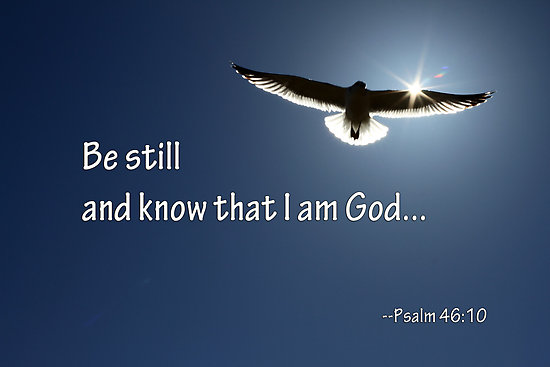
In v. 10 the psalmist spoke for God and said, “Cease striving and know that I am God; I will be exalted in the earth” (NASB).  Most of the other English translations say, “Be still, and know that I am God.”  Both renditions are accurate, but we are generally more familiar with the latter.  This simple statement, however, is the key to the power of this psalm.

How often have God’s people today missed out on the refuge and strength of God because they refused to be still and acknowledge Him as God?  This loss can be attributed, at least in part, to the fact that modern society has become averse to quietness.  It seems we cannot go anywhere without our ears being bombarded with the cacophony of the modern world.  Our culture has become one of incessant noise of various kinds and silence makes people uncomfortable, even in worship.

Our worship assemblies are highly structured, even those that give the appearance of informality and spontaneity.  Something is supposed to be going on at all times, and the absence of sound means that something is wrong.  Silence in the assembly for more than a few seconds puts worshipers on edge.  The discomfort is palpable.  Nevertheless, God says, “Be still, and know that I am God.”  How much more fulfilling might our worship be if we took more time in quiet reflection as we worshiped?  How much more prepared to face the challenges of life might we be if we followed God’s command?

The command to be still, however, is not limited to our worship assemblies.  In fact, Psa. 46 actually speaks more to our day to day affairs than to our worship.  This is where it gets tricky for us.  We scurry about each day like a hamster in a wheel, immersed in the noise and chaos of life, and we wonder why we feel overwhelmed by it all.  Perhaps if we took more time to be still, and to reflect on who our God is, we would find the fortitude and peace to successfully navigate our way through life.

Just being quiet, of course, is not the answer.  God said to be still AND know that He is God.  Our quiet time should be time when we reflect on God and on His word.  It should be time when we approach Him in prayer or just quietly meditate on some truth from the scriptures.  The point is that the refuge and strength we all need to face life is there, if we are willing to take advantage of it.  But, we need to be quiet in order to access it.  So then, let’s turn off the volume of life and sit quietly before the Lord.  Let’s turn of the TV, the computer, our cell phones, and our game devices, and be still so we can see and hear the God who is our refuge and strength, a very present help in trouble.

Social Media & Feathers

Wind-Blowing-Feathers


The advent of social media (Facebook, Twitter, etc.) has made it possible for us to be connected, albeit loosely, with people literally around the world.  We post pictures about our daily lives and make comments on all manner of topics from the mundane to the sublime.  Even though all users have identities on these media, our comments are essentially anonymous.  The fact that they are made in cyberspace, rather than face to face, makes it tempting to say things we might not otherwise say.  As a result, comments can be derogatory and hurtful, if not downright mean.  Even among professed believers comments can get out of hand.

This brings to mind the story of a new rabbi who was constantly berated behind his back by a businessman who was a member of his synagogue.  After many weeks of this, one of the other synagogue members confronted the man and reprimanded him for his behavior.  Chastened, the man went to the rabbi to ask forgiveness and to make restitution.  The rabbi told him to take one of his most expensive down-filled pillows up to the highest hill outside the village, scatter its contents to the four winds, and then return to him.  The man complied with this request, and when he returned, the rabbi instructed him to go back and gather up all of the feathers.  The man objected that this was impossible, to which the rabbi replied that so it was with gossip.  Hurtful words, once spoken, can never be retrieved, and the damage they do cannot be undone.

This story illustrates a potential danger inherent in social media.  When we make comments we have no idea how far they will travel, or what damage they may do.  What we may have intended for one person can literally travel around the world before the day is done.  Whatever our motivation may have been for making the comment, it is soon beyond our reach, either to correct, or to retract.  Even if we later apologize, there is no guarantee that all who saw the initial comment will also see the apology.  The damage will have been done and it cannot be undone.

This is an especially important truth for Christians.  Our words are to be “with grace, as though seasoned with salt” (Col. 4:6).  We are commanded to speak “only such a word as is good for edification . . . . so that it will give grace to those who hear” (Eph. 4:29).  We are also commanded to treat others in the way we want them to treat us (Mt. 7:12).  We are warned that the tongue is a fire, the very world of iniquity, which can set a great forest aflame (Jas. 3:5-10).

These commands apply to every facet of our lives, even the things we post on social media.  When the prophet Nathan confronted David over his sin with Bathsheba, he told David that his actions had given the enemies of the Lord an occasion to blaspheme (2 Sam. 12:14).  Christians who post hurtful words on social media are just as guilty as David was.  When we act like the world, whether in word or deed, our connection to Christ is compromised, and we give unbelievers an opportunity to mock the Lord and His church.

We must thoughtfully consider every comment we post online.  We must do so, first, because scripture commands us to speak only that which edifies.  Second, we must do so because of how far our words may spread and what damage they may do.  Third, we must do so because of the Golden Rule.  None of us appreciates it when others speak badly of us, especially in a public setting (which social media is), so we should never do so to others.  We must let our light shine before others so they will see our good works (and words) and glorify our Father in heaven (Mt. 5:16).  This applies to everything we say and do, even on social media.

My Ebenezer

hqdefault


One of the challenges we face when reading the scriptures is trying to understand certain terms that have been transliterated into English.  These instances most often occur in the Old Testament, where Hebrew words, especially place names, are simply anglicized rather than translated.  One such term is the word “Ebenezer,” which occurs three times in the Old Testament.  Twice it refers to an unknown location somewhere between the land of the Philistines and the territory of Israel.  The third time it occurs is in 1 Sam. 7:12 in the aftermath of a great victory over the Philistines.  Here the scripture says, “Then Samuel took a stone and set it between Mizpah and Shen, and named it Ebenezer, saying, ‘Thus far the Lord has helped us.'”

Many of our modern English translations have footnotes that offer either an explanation of such words, or a literal translation of them.  The Hebrew word “Ebenezer” literally means, “the stone of help.”  In the ancient world it was common to erect monuments of stone to commemorate great victories, or to call attention to some significant spiritual lesson.  In this case, Samuel erected some kind of a stone that would be a permanent reminder of what God had done for Israel.

It is important to recognize that this was not a monument to a great military victory, even though Israel had just soundly defeated their enemies the Philistines.  Instead, Samuel was honoring the providential care of God, who had made that victory possible.  The Philistines had only recently defeated Israel in battle and had captured the ark of the covenant.  After God afflicted the Philistines, they returned the ark to Israel, but continued to press them in battle.  In 1 Sam. 7:10, 11 Samuel was offering sacrifices to God as Israel prepared to meet the Philistines in battle yet again.  In response to these sacrifices, God sent thunder to confuse the Philistines.  This confusion enabled Israel to defeat them so badly that the Philistines no longer raided Israel (v. 13).

Samuel’s point in erecting Ebenezer was to acknowledge that Israel had come to this position only by the power of their God.  Ebenezer, the stone of help, reminded Israel that they routed the Philistines because God made it happen.  More than this, however, Ebenezer reminded Israel that it was only by the help of their God that they were even in this land at all.  Without God’s help, Israel would have still been slaves in Egypt.  In addition to this, Ebenezer, the stone of help, was intended to be a perpetual reminder so that all generations of Israelites would know that whatever they achieved was by the power and help of their God.

It is this last aspect of Ebenezer that has a timeless application.  Over time Israel forgot their Ebenezer and became vain and rebellious against God.  This attitude is exemplified by the rich fool in Lk. 12:16-21.  He failed to acknowledge God as the source of his prosperity and paid the price for it.  In a similar way, we today may commit the same sin if we fail to remember our Ebenezer.

The most notable example of forgetting one’s Ebenezer is the song, “My Way,” made famous by Frank Sinatra.  This song exemplifies the thinking of those who give no meaningful place to God in their lives, and who relish the idea that they have depended upon no one to achieve success.  Obviously this attitude is not consistent with the teachings of scripture.  Jesus said that God sends his rain on the righteous and the unrighteous (Mt. 5:45), so even the wicked should acknowledge God’s help in life.  Those who are believers, however, must not fail to do so.  Every day we should say, “Here I raise my Ebenezer.  Thus far the Lord has helped me.”

The Finger of God

Hand of a god-like creature pointing with finger.

When Jesus spoke to the Samaritan woman at the well, He told her, “God is spirit, and those who worship Him must worship in spirit and truth” (Jn. 4:24).  This is a fundamental truth about our Father in heaven.  He is not bound by physical limitations because He is spirit.  This enables Him to be everywhere present in time and space.  Theologians call this omnipresence.

However, as we read through scripture we often see references to the face of God, the ears of God, and the hand and arm of God.  Such references are not intended to suggest that God has a physical form.  Rather, they are descriptive ways of illustrating the actions of God toward mankind.  For example, He turns His face and ears toward the righteous (2 Chr. 7:14, 15), but He sets His face against the wicked (Lev. 20:5).

Another interesting description of God is what is said about the tablets of stone on which the Ten Commandments were written.  In Ex. 31:18 the scripture says, “When He had finished speaking with him upon Mount Sinai, He gave Moses the two tablets of the testimony, tablets of stone, written by the finger of God (emphasis added).  This is the only place in scripture where this description of God is found, and I wonder if we fully appreciate the significance of it.

In the 1996 move, “Twister,” a group of storm chasers is discussing the relative strengths of tornados, and they mention an F5 tornado.  Someone asks what an F5 is, to which one of the storm chasers replies, “The finger of God.”  Too often, it seems, this is the only way in which some people think of God’s power.  If God acts, it must be a destructive thing.  How sad it is that for many people the finger of God can only refer to something terrible.

This is not at all the idea conveyed in Ex. 31:18, however.  The finger of God reached down from heaven and wrote the ten words (the literal meaning of the Hebrew word that is translated “commandments”), so that Israel would know how to please Him.  In Deut. 10:13 Moses said that the commandments and statutes of God were given for Israel’s good.  In other words, the finger of God was wielded in order to help His people receive His blessings and to avoid His wrath.  What a contrast from the world’s view!

In 1956 Cecil B. DeMille created the definitive film portrayal of the deliverance of Israel from Egypt by the power of God.  His film, entitled, “The Ten Commandments,” depicted the finger of God as streaks of flame that etched the commandments into the stone tablets.  While we cannot say with certainty that this is how God wrote upon the tablets of stone, it graphically portrayed the fact that God’s commands came directly from His hand to mankind.  This was not the last time, however, that the finger of God revealed His will to mankind.

In 2 Tim. 3:16, 17 Paul said that all scripture is inspired (literally, God-breathed).  In 2 Pet. 1:20, 21 Peter said that men spoke from God, having been moved by the Holy Spirit.  This was the finger of God at work writing on the tablets of our hearts, so every person in every generation may know how to please Him and how to avoid eternal punishment.  Far from being the destructive force that is envisioned by the unbelievers, the finger of God is gracious and loving, showing us the way to eternal life through the word which He Himself inspired.  How grateful we should be that the finger of God has touched the world for our good!