Here Am I . . . Send Him?

Questions


One of the most inspiring passages in the Old Testament is the record of Isaiah’s call to be a prophet of God.  He relates this call in Isa. 6:1-8.  In this compelling account Isaiah described the vision in which he saw the Lord God sitting on His throne in heaven.  God’s majesty in this vision was enhanced by the presence of the Seraphim who flew around the throne room calling out, “Holy, Holy, Holy is the Lord of hosts, the whole earth is full of His glory” (Isa. 6:3).  As Isaiah viewed this scene he was overcome with his own sins, but one of the Seraphim took a burning coal from the altar and touched Isaiah’s lips, cleansing him of his sins.  The climax of this scene is in v. 8.  Here the scripture says, “Then I heard the voice of the Lord, saying, ‘Whom shall I send, and who will go for Us?’  Then I said, ‘Here am I, send me!'”

Even though Isaiah was overwhelmed by the majesty of God, and by his own inadequacies as a man, he immediately volunteered for duty when God called.  He did not ask what God intended for him to do, or how hard it would be, or how long he would have to serve.  He simply said, ‘Here am I, send me!”  From that day forward Isaiah devoted himself to proclaiming God’s word to Judah, and according to Jewish tradition he lost his life at the command of wicked king Manasseh for doing so.

The response of Isaiah to God’s call inspires us and we hold him in high regard for it.  For some of us, however, this is the extent of its effect on us.  We manage somehow to deflect the personal aspect of this call and instead turn it into a recruiting tool to put others to work in the kingdom.  In effect we say, “Here am I . . . send him!”  This, of course, is a distortion of the intent of this account.  The primary lesson of Isaiah’s example is to show that each of us should not fail to respond to the Lord’s call to service.

The New Testament ratifies this principle.  In Eph. 4:11-16 Paul spoke of all the works that God had placed in the church in order to facilitate its growth.  He spoke especially of spiritual leaders whose job was “equipping of the saints for the work of service, to the building up of the body of Christ” (v. 12).  Then, in v. 16 he stated that the growth of the body is dependent upon “what every joint supplies, according to the proper working of each individual part”.  In other words, every member of the body of Christ is expected to contribute to the growth of the body.

The call of God is for His people, individual members of the church, to supply what the body as a whole needs in order to grow.  We do this in many ways, of course, but one of the most important ways is in the teaching of God’s word.  In Heb. 5:12-14 the inspired writer chastised the Hebrew Christians because at a time when they should have been teachers, they were still in need of milk rather than solid food.  The fault, as he described it, was theirs alone because they had not trained their senses to discern good and evil.  They had not answered God’s call, but had instead relied on others to answer it.

The growth and maturity of the church depends on each Christian doing his or her part to insure it.  This means that we should be answering God’s call just as Isaiah did.  Isaiah did not feel himself worthy to stand before God, or to serve Him, but when God cleansed him, he knew that he must serve.  Every Christian has been spiritually cleansed by obedience to the gospel.  Therefore, we have no excuse to refuse God’s call to service.  Like Isaiah, let us be emboldened by this cleansing God has granted us, and say, “Here am I, send me!”
Unhindered

31d9ac08c9517f018c621fe41a56dd70


As Luke ended his account of what we call Acts, he made a final statement about the work of Paul, who was then a prisoner of Rome.  In Acts 28:30, 31 Luke wrote, “And he stayed two full years in his own rented quarters and was welcoming all who came to him, preaching the kingdom of God and teaching concerning the Lord Jesus Christ with all openness, unhindered.”  If Luke’s account were turned into a Hollywood movie, this would be the fade-to-black scene that brought the story to a close.  It is the “good guy rides off into the sunset” kind of imagery that suggests victory.

The power of Luke’s statement is found in the way he constructed his final sentence.  In the Greek language in which Luke wrote, word order was often used to emphasize the most important point.  A word placed last in a sentence was therefore the key idea in that sentence.  In this case, the word “unhindered” is the final word.  Luke wanted his readers to understand that the preaching of the kingdom of God and the teaching concerning the Lord Jesus Christ was unhindered.  This is significant given the fact that Paul was a prisoner who was literally chained to a Roman soldier, even though he lived in his own rented quarters.

This is an amazing reflection of the power of God that was at work in the great apostle.  In a setting that most would agree should have restricted Paul’s ability to preach and teach, the word of God was unfettered and freely went out from that place.  The effect of Paul’s preaching, and the accuracy of Luke’s assessment of it, is demonstrated in the letter to the Philippians, which Paul wrote during his imprisonment in Rome.

In Phil. 1:13 Paul said that the cause of Christ had become known throughout the whole Praetorian Guard.  These men were the personal body guards of the Roman Emperor, Nero, and they had charge over political prisoners such as Paul.  These soldiers heard the gospel as Paul taught visitors to his quarters, and apparently shared the message with their fellow soldiers.  At the end of this letter, Paul sent greetings to the church in Philippi from those who were with him in Rome, including “those of Caesar’s household” (Phil. 4:22).  Apparently, Paul’s teaching had made converts among Nero’s household staff.

Thus we see that the word of God was indeed “unhindered.”  It freely flowed from the apostle’s rented quarters to all those who were willing to hear it.  Paul was chained and restricted, but the gospel of Jesus Christ was not!  When we realize this great truth, we are both astounded and inspired by it.  At the same time, however, we are chastened by it as well.

Paul was in the most difficult of human circumstances, but he did not allow those circumstances to keep him from proclaiming God’s word.  Very few of us will ever be in such restrictive conditions as Paul was, but sometimes we act as though we are.  How often have we remained silent when others challenge or mock faith in Christ?  How often have we quietly gone our way without sharing the saving message of the gospel with a friend or acquaintance?  How often have we allowed ourselves to be muzzled by anti-Christian forces in our society?

If the gospel of Christ was unhindered in the capital of the Roman Empire when the most ruthless of the Caesars ruled, why should it be hindered today?  It is only hindered when Christians fail to speak a good word for Jesus.  Let us take courage from the great apostle and unleash the power of God’s word to save (Rom. 1:16; Jas. 1:21).  Let us, like him, preach “the kingdom of God and . . . . the Lord Jesus Christ, with all openness, unhindered.”

Upon This Rock

Upon-This-Rock


One of the most reassuring symbols of strength is the image of a rock.  For many years a prominent insurance company has featured the image of a rock in its corporate logo.  A popular auto manufacturer has long touted its trucks as being “like a rock.”  We even use this imagery in our conversations, saying that something is “solid as a rock.”

This same imagery is found throughout the scriptures to depict the faithfulness of God.  He is extolled in the psalms as our rock, meaning that He is unshakable and will always be able to sustain His people.  In the same way, the Lord Jesus used the idea of a rock to illustrate the assurance His disciples have when they give themselves in obedience to God’s will.  At the end of the Sermon on the Mount He said that one who heard His word and obeyed it would be like a man who built his house on a rock, and it would survive all the storms of life (Mt. 7:24-27).

The Lord used a rock to illustrate another important teaching in Mt. 16:17, 18.  At that time the Lord asked the disciples who the people thought He was.  He then asked them who they thought He was.  When Peter confessed that they believed He was the Son of God, the Lord replied, “Blessed are you Simon Barjona, because flesh and blood did not reveal this to you, but My Father who is in heaven.  I also say to you that you are Peter, and upon this rock I will build My church; and the gates of Hades will not overpower it.”

Some have taken these words to mean that the Lord was going to establish His church on Peter, whose name means “rock.”  However, this is not what the Lord meant.  We know this because the Lord used two different Greek words for “rock” in this statement.  The Greek word for Peter’s name is petros, which means a rock, or stone, or pebble.  The Greek word He used for the rock upon which His church would be built is petra, which means a bedrock or foundation stone.

The Lord’s church, then, is built upon an unshakable foundation.  In the context of these verses, that unshakable foundation is the truth that Jesus is the Son of God.  The church stands upon this truth.  Jesus is the Son of God, and the church is built upon Him, as Paul declared in 1 Cor. 3:11, where he said, “For no man can lay a foundation other than the one which is laid, which is Jesus Christ.”  Therefore, the church will not be overcome by the power of Hades, which is the grave.

This point is essential to our faith.  A church built upon a mere man, even one as great as Peter, cannot long stand.  Neither can it survive the power of death.  We see this in countless instances in which a man builds an organization that ultimately fails upon his death.  Only one person was ever raised from the dead, never to die again, and that person is Jesus Christ (Rom. 6:7, 8).  Because He is never to die again, He is the master over death, and His church is unaffected by the curse of death.

Since the church is built upon this rock, we have full confidence as we go about preaching the gospel and serving the Lord as His people.  Whatever Satan may hurl at us, the church will survive because we are founded upon the rock, Jesus Christ.  He upholds us and sustains us in every circumstance of life, and as a result, we have an unshakable hope for eternity.

Like the man of whom Jesus spoke at the end of the Sermon on the Mount, let us hear and do all that the Lord commands so our spiritual house will be founded upon the rock.

Run to Win

run-to-win-940-wplok


In Paul’s first letter to the church in Corinth he used a variety of examples from life to illustrate his teachings.  Some of these related to agricultural pursuits, such as planting a vineyard or tending a flock.  In another example, he used a soldier to illustrate the Christian life.  In 1 Cor. 9:24-27 he used two examples from sporting events to illustrate the kind of attitude Christians should have as they serve the Lord.

In this passage Paul said, “Do you not know that those who run in a race all run, but only one receives the prize?  Run in such a way that you may win.  Everyone who competes in the games exercises self-control in all things.  They then do it to receive a perishable wreath, but we an imperishable.  Therefore I run in such a way, as not without aim; I box in such a way, as not beating the air; but I discipline my body and make it my slave, so that, after I have preached to others, I myself will not be disqualified.”

Paul’s point was that we should run the race that is the Christian life in such a way that we will win the prize at the end of time.  This is an interesting teaching since we would assume that everyone who enters a race intends to do his best to win.  If this were the case, however, there would be no need of coaches to exhort and encourage the competitors.  Every athlete would give his best in every competition, with the full expectation of winning, and with the burning desire to do so.

The fact is that some do not have the burning desire to win, and consequently they do not compete in a way that will enable them to win.  The Lord anticipated this aspect of human nature, and warned that one who put his hand to the plow and looked back was not fit for the kingdom of God (Lk. 9:62).  One who looks back on his previous life, instead of looking ahead to the goal, will not serve in such a way as to reach the goal.  In short, such a person is not running to win.

We see this attitude played out too many times in the body of Christ.  One obeys the gospel and begins his walk as a Christian.  He may be zealous for a while, but begins to slack off over time.  Eventually, he loses enough interest that he is no longer a runner, but a spectator in the Christian race.  This kind of attitude will not bring him to victory at the end of time.  This is the implication of the testimony of Paul, and of the admonition of our Lord Jesus Christ.

In 2 Tim. 4:7, 8 Paul told Timothy that he fully expected to receive the crown of righteousness because he had fought the good fight, finished the course, and kept the faith.  He promised that this prize was also reserved for every other Christian who did the same.  In Rev. 2:10 the Lord encouraged the church in Smyrna to remain faithful “until death” in order to receive the crown of life. Running to win is an attitude that will not allow the runner to give up until he crosses the finish line.

This is where the Christian race is so superior to any earthly race.  As Paul said in 1 Cor. 9:24, in a human race everyone runs, but only one is the winner.  In the Christian race, however, everyone who finishes the course wins the prize of eternal life.  Our only competition in this race is a lack of desire to win it.  Only those who quit running lose this race.

Eternal life is for finishers, not quitters.  We do not have to be the fastest or best runners to receive the crown of life.  We just have to be runners who run until we finish the race.  Therefore, run to win!

Tickled Ears

пастор1


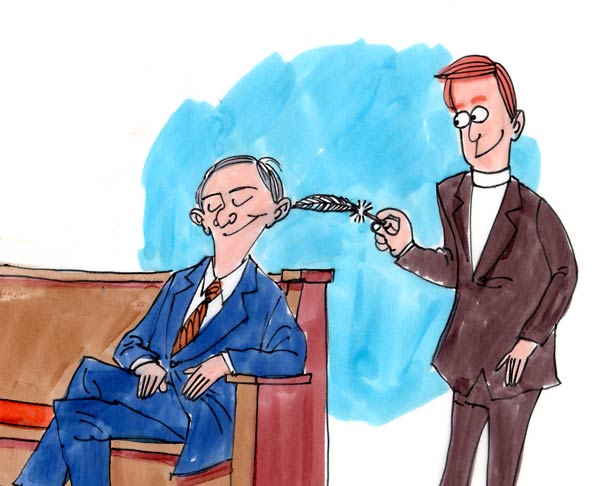
Much has been made in recent years of the need for churches to tailor their worship and their message in order to appeal to the “unchurched.”  (The term “unchurched” refers to people who do not have a heritage of attending worship on a regular basis.)  The thesis is that these people are not interested in the forms and rituals that are commonly associated with traditional Christian worship.  Likewise, we are told that they are put off by doctrines and preaching that appears to be judgmental.  As a result, many churches now conduct worship assemblies that are more like rock concerts than divine worship.  The messages proclaimed in these churches have been watered down to such a point that virtually nothing is viewed as wrong, so long as the individual “loves Jesus.”

When we consult the scriptures, however, we find no justification for this approach.  In fact, we find a decidedly narrow perspective from the inspired writers of the New Testament.  One of them, Paul, spoke very plainly about this issue.  In 2 Tim. 4:1-4 he said, “I solemnly charge you in the presence of God and of Christ Jesus, who is to judge the living and the dead, and by His appearing and His kingdom: preach the word; be ready in season and out of season; reprove, rebuke, exhort, with great patience and instruction.  For the time will come when they will not endure sound doctrine; but wanting to have their ears tickled, they will accumulate for themselves teachers in accordance to their own desires, and will turn away their ears from the truth and will turn aside to myths.”

Two things are evident in this statement from the inspired apostle.  First, preachers have a responsibility to proclaim God’s word, without reservation, and without alteration.  This has been true since the time of Moses, who commanded Israel not to add to or to take away from God’s commands (Deut. 4:2), and it is one of the last warnings in scripture (Rev. 22:18, 19).  To be ready “in season and out of season” means to proclaim God’s word whether the audience likes the message or not.  This was God’s command to Ezekiel in Ezk. 2:7, where He said, “But you shall speak My words to them whether they listen or not, for they are rebellious.”  When preachers obey this charge, they will reprove, rebuke, and exhort, albeit with great patience and instruction.  In other words, preachers are to proclaim the “whole purpose of God” (Acts 20:27).  They must do it in a spirit of gentleness and patience, so that those who hear their preaching will have the best opportunity to obey the Lord’s commands and thereby escape the snare of the devil (2 Tim. 2:24-26).

Second, people are always going to want the message to be tailored to their own likes and desires.  It was already so in Paul’s time.  This is why he warned Timothy of this danger.  No one likes a message that convicts him of sin, or that corrects what is wanting in his service to the Lord.  However, the clear implication of scripture is that we cannot hope to please God in life, or to live with Him in eternity, if we do not listen to and obey the preaching of sound doctrine.

The term “sound doctrine” in 2 Tim. 4:3 actually refers to that which is healthy.  The point is that when preachers proclaim the whole purpose of God, as it is revealed in the scriptures, it is good for us.  It warns us of the danger of disobedience, and encourages us to strive for the goal of heaven.  Just as cotton candy is not physically healthy for us as a steady diet, the messages that tickle our ears and water down God’s commands are not spiritually healthy for us.  The sooner we learn this truth, the better off we will be.

Thousands go away from worship assemblies each Lord’s Day having had their ears tickled.  They feel good about themselves, but they have substituted spiritual cotton candy for the live-giving meat of God’s word.  They go away feeling good about themselves, but drifting ever farther away from God.  We will never get to heaven with tickled ears.  There is no alternative to preaching the whole purpose of God, for it alone is the power of God to save us (Rom. 1:16).

Mother’s Day

Mothers-Day-Image


Today is the day that we give special honor to our mothers.  It is a day that is the source of some very interesting statistics.  For example, Mother’s Day is the busiest business day for Kentucky Fried Chicken.  It seems that giving Mom a break translates to fast food, and KFC is #1.  Another interesting statistic, that more accurately portrays our feelings on this day, is that Mother’s Day is the busiest holiday for phone calls.  (By the way, Dads, Father’s Day is the busiest day for COLLECT phone calls!)  In addition to these fun facts, we all know that Mother’s Day is one of our most special holidays each year.  There is something about the relationship between children and mothers that makes it so.

Why are we so devoted to our mothers?  It starts, certainly, from the fact that mothers give us life.  They are the ones who carried us in their own bodies for nine months, and then went through the pain of childbirth to bring us into this world.  Then, they are the ones who spent the most time with us through our formative years.  For many of us, “Mama,” or ‘Mom,” was the first word we ever spoke, and she was the one who gave us comfort through all the bumps and bruises of our youth.  This is not to say that fathers are not important, for they are, but rather to acknowledge that mothers are typically in the forefront of their children’s lives.

Why are mothers so important to us?  It is because their influence so deeply affects the way we grow and mature, and so greatly affects who we will become as adults.  In 1 & 2 Kings, the records of the various kings of Israel and Judah are marked by an interesting common feature.  As the account of each king’s reign begins, the scriptures tell us who his mother was.  In many cases, this is the only mention of that woman in scripture, but there is a sense that somehow the nature of the king and of his rule is closely associated with who his mother was.  For the good kings, this was a mark of esteem for the mothers mentioned.  For the evil kings, it was a mark of shame.

Perhaps this is why so much is made in the scriptures of women who were godly mothers.  One of the most often referenced is Solomon’s description of the worthy woman in Prov. 31:10-31.  Among her many virtues is the fact that she raised her children so that they later rose up and blessed her (v. 25).  This suggests that they were raised to be godly themselves.  Another godly mother of repute is Eunice, who instilled, with the help of her own mother, Lois, the sincere faith that sustained her son Timothy and prepared him to be a protege of Paul (2 Tim. 1:5).  Certainly these are mothers whom we would do well to emulate in the important business of raising our children.

Most of us will freely admit that it has been the influence of our mother that has had the greatest impact on who we have become.  This is especially true of those of us who are Christians.  A godly mother will do more to instill saving faith in her children than all the preachers and teachers they may ever meet.  This fact underscores how important it is for mothers to be godly, so their influence will lead their children to salvation.

It is important and appropriate that we honor our mothers today, and every day.  Their love, devotion, and godly example are some of the most significant influences in our lives.  There are not sufficient words to express our gratitude for our mothers, but may we simply say, “Thank You!”  Thank you, mothers, for all you do, and for all you have done.  God bless you and keep you, today and always!

Our Refuge & Strength

gods-hands


The book of Psalms is a collection of 150 songs composed by various authors over a period of many years.  A large number of the psalms were written by David, who had a special gift for music and verse.  Others who wrote psalms included in this collection were: Solomon, Moses, Asaph, and the sons of Korah.  Thirty-four psalms have no attribution, and are sometimes called “orphan” psalms.  The psalms cover a variety of themes and circumstances in Israel’s history, from times of great joy to times of great despair.

An oft-repeated theme in the psalms is the providential care of God for His people.  One of the most notable in this regard is Psalm 46, which is attributed to the sons of Korah.  The opening stanza says, “God is our refuge and strength, a very present help in trouble.  Therefore we will not fear, though the earth should change and though the mountains slip into the heart of the sea; though its waters roar and foam, though the mountains quake at its swelling pride” (Psa. 46:1-3).

We do not know the circumstances that prompted the composition of this song, and there may not have been any specific instance that motivated its creation.  One of the pillars of Jewish faith was the fact that their God was their protector and provider.  Therefore they often acknowledged this in songs of praise to Him.  Psalm 46 extols this fact and encourages the reader to trust in God’s providential care, no matter what life may cast before him.  This truth makes Psalm 46 timeless, for there will never be a time when God will cease being the refuge of His people and the strength by which they persevere through life.

The fact that this providential care did not cease with the Old Testament era is attested by our Lord Jesus Christ, and by His apostles.  In the Sermon on the Mount, the Lord exhorted His audience to not be anxious about the necessities of life, because their Father in heaven is well aware of their needs and will provide them if they seek Him first (Mt. 6:25-33).  In Jn. 10:27-29 the Lord said, “My sheep hear My voice, and I know them, and they follow Me; and I give eternal life to them, and they will never perish; and no one will snatch them out of My hand.  My Father, who has given them to Me, is greater than all; and no one is able to snatch them out of the Father’s hand.”  Later, Paul the apostle echoed this truth in Rom. 8:28, where he said, “And we know that God causes all things to work together for good to those who love God, to those who are called according to His purpose.”

These assurances do not mean that we will never be tested, or that we will never suffer at the hands of the wicked.  Rather, they mean that no matter what befalls us from the evil one, God will provide for us and enable us to persevere through it, if we put our trust in Him and obey His word.  This was the confidence of the first century Christians, and we should have it still today.  This world is not our home.  What happens here is nothing compared to the glory awaiting us in heaven (cf. Rom. 8:18).  If we remain faithful to God, then even the loss of our lives means nothing, because our souls are secure in His hands.

As we face times of trial, whether due to our own unwise decisions, or due to the assaults of the wicked one and his angels, we are never alone if we belong to God.  His desire is for us to be blessed on the earth, and to live with Him in heaven at the end of time.  If we trust in Him, He will provide for our needs.  Therefore, now, and until He takes us home to heaven, “God is our refuge and strength, a very present help in trouble.”

Sufficiency & Finality

holy-bible


One of the hallmarks of true New Testament Christianity is its insistence that the scriptures are the complete revelation of God’s will, and that they alone are sufficient for us to know how to please God.  This principle is often stated as our belief in verbal, plenary, inspiration.  This means that every word of scripture is inspired by God, and the scriptures are complete as He revealed them through the Holy Spirit.  For many generations this fundamental belief underscored the practices of every church that called itself Christian.

In the last century, however, some have forsaken this principle.  There are now some who deny this principle in favor of what they call “new” or “latter-day” revelations.  In some churches supplementing the Bible with additional revelations, whether written or oral, is central to their belief systems.  Indeed, in these churches many of their doctrines and practices can only be justified on the basis of these additional revelations.  The very existence of such a point of view casts doubt on the veracity of the Bible, although proponents of it seem oblivious to this truth.

In order to justify new revelations from God one must believe that the Bible is somehow incomplete.  If these new revelations are necessary for us to please God, then the scriptures cannot be truthful, and cannot be depended upon for any aspect of our faith.  This may seem a radical conclusion, but there is no alternative because of what the scriptures say about their sufficiency.

Before Jesus went to the cross He promised the apostles that the Holy Spirit would guide them into all the truth (Jn. 16:13).  If the Lord fulfilled this promise, then there is no further truth necessary, or forthcoming.  On the first Pentecost after the Lord’s resurrection, the Holy Spirit was poured out on the apostles (Acts 2:1-4).  The scripture says they were “filled” with the Holy Spirit.  This power enabled them to preach the whole gospel from that day forward, and to record God’s will in the books that we call the New Testament (2 Pet. 1:20, 21).

The testimony of the apostles is that they received and communicated, both orally and in written form, the whole purpose of God (Acts 20:27).  In the letters of Paul and Peter the sufficiency of the revelation they received is asserted in unmistakeable terms.  Paul said that all scripture is inspired by God and equips Christians for every good work (2 Tim. 3:16, 17).  Peter said that God has granted to us everything pertaining to life and godliness (2 Pet. 1:3).

These statements raise serious questions about faith in Jesus Christ if additional revelation is needed today.  If additional revelation is needed today, then Paul and Peter have misled us.  But, if they have spoken the truth, no additional revelation is necessary.  Consider this:  If the scriptures equip us for every good work, then what good work is there for Christians to do that might come from some other source?  If God has granted to us everything pertaining to life and godliness, what else is there that we need to know?  If additional revelation is necessary today, then the assertions of Paul and Peter cannot be true, and if they are not true, then nothing in the scriptures is trustworthy.  If, however, God has granted to us everything pertaining to life and godliness, as Peter proclaimed, and if the scriptures are sufficient to equip us for every good work, as Paul testified, then there is no further revelation forthcoming.

Jesus promised that the Holy Spirit would lead the apostles into all the truth.  The scriptures testify that the apostles received and communicated all the truth.  Therefore, the Bible is complete and inerrant (that is, it contains no errors).  All we need to know in order to please God is within its pages.  It is sufficient for all our needs and complete in every respect.  Therefore, it is God’s final word for mankind.

In Jn. 12:48 Jesus said that the words He spoke will judge us at the last day.  He communicated His word to the apostles and inspired writers of the New Testament though the Holy Spirit (2 Pet. 1:20, 21), and it is all we need in order to please God.  The Lord told some believing Jews to continue in His word and they would know the truth and the truth would make them free (Jn. 8:31, 32).  Instead of looking for new revelations, we would do well to follow the Lord’s command and continue in His word, which was handed down once for all time to the saints (Jude 3).

Fiery Trials

Unknown


When Peter wrote his first letter in the early 60s AD the first stirrings of Imperial persecution against Christians were beginning to be felt.  Peter had personally experienced persecution at the hands of his fellow Jews, and was aware of the sufferings his fellow apostle, Paul, had experienced and was even then enduring.  In anticipation of the more widespread persecution that would follow, Peter warned his readers to not be surprised when such things occurred.  In 1 Pet. 4:12-19 he encouraged them to expect to suffer for the Lord’s sake, and to do so as faithful members of the body of Christ.  Uninspired historical records suggest that Christians of that era mostly lived up to this exhortation.

Those of us who have grown up in the United States have been uncommonly blessed with an absence of persecution in our country.  For nearly 240 years we have enjoyed the protection of the First Amendment and have been free to practice our faith without governmental intervention.  This constitutional protection has also sheltered us from attacks by unbelievers, at least until recently.  The increasingly militant homosexual lobby has now been joined by other anti-Christian forces, including a surprising number of judges and politicians, to try to restrict the free expression of Christian beliefs.

It is clear that no one in the larger Christian community foresaw the consequences of the years-long propaganda war that has been waged under the banner of tolerance.  We have unwittingly gone along with the scheme that has brought us to where our First Amendment rights can be taken away by a lawsuit, or by a city or state ordinance.  Practicing Christians are now the open targets of activists whose sole purpose is to silence the voice of God’s word that condemns their ungodly behaviors.  At the same time, the fearful evil of Islam is being ignored by these same activists.  As a result, believers need to be prepared to suffer persecution as we have never experienced it before.

It is impossible to foretell exactly how this persecution will manifest itself, but only a seismic shift in the political climate in our country can forestall it.  As American citizens we have recourse through the election process and through our courts.  In the same way that Paul used his Roman citizenship to protect himself and to facilitate his ministry, we may use our American citizenship toward the same ends.  We should not, however, place all our trust in these means.  After all, the very Roman government that at one time protected Paul because he was a citizen, eventually took his life in spite of his citizenship.

Peter’s warning from nearly 2,000 years ago still rings true today.  “Beloved, do not be surprised at the fiery ordeal among you, which comes upon you for your testing, as though some strange thing were happening to you . . . but if anyone suffers as a Christian, he is not to be ashamed, but is to glorify God in this name . . . Therefore, those also who suffer according to the will of God shall entrust their souls to a faithful creator in doing what is right” (1 Pet. 4:12, 16, 19).

In spite of the fiery trials that are now upon us, we must not bow to this pressure.  We must continue “speaking the truth in love” (Eph. 4:15), and to “not shrink from declaring the whole purpose of God” (Acts 20:27).  Only in this way will we glorify God in the midst of persecution, and thus preserve our home in heaven which our Lord and Savior is preparing for those who obey Him.

A Perfectly Good Conscience

insects_cricket_jiminy_badge


Those of us who grew up in the 1950s remember a character created by Walt Disney whose name was Jiminy Cricket.  He was the companion of Pinocchio, the marionette who wanted to become a real boy.  He was such a popular character in the animated movie that he became a regular on the Mickey Mouse Club television program.  His signature advice to young people was, “Always let your conscience be your guide.”  As children we were led to believe that conscience was the part of our character that sought to keep us on the right path.  As we grew into adulthood we learned that it wasn’t quite as simple as that.

The incontrovertible truth is that one’s conscience is only a safe guide if it has been trained in the right way.  An excellent example of this in the New Testament is Paul the apostle.  In Acts 23:1, as he stood before the Jewish Council to make his defense, he said, “Brethren, I have lived my life with a perfectly good conscience before God up to this day.”  The high priest, Ananias, was so offended by this statement that he ordered Paul to be struck on the mouth (v. 2).  This action was not authorized by the Law of Moses because Paul had not yet been convicted of any crime, but it reflects the genuine outrage the high priest felt at this remark.

Even at first glance we can see why the high priest reacted so violently to Paul’s comment.  In his view, Paul was a blasphemer because he had forsaken the Law of Moses to become a follower of Jesus Christ.  As he saw it, it was not possible for Paul to have a good conscience.  His slap was intended to demonstrate that he considered Paul’s statement to be a lie.

Christians, however, take a wholly different view.  Paul was standing in defense of the faith in Jesus Christ, so of course he had a good conscience as he did so.  But, Paul’s statement was not just about his life as a Christian and an apostle of Jesus Christ.  He said he had lived his entire life with a perfectly good conscience before God.  When we consider the breadth of that statement, we begin to understand why one’s conscience may not be a reliable guide.

As Saul of Tarsus he had viciously persecuted Christians.  He held the robes of those who stoned Stephen to death (Acts 7:58).  He had gone from house to house dragging off men and women to put them in prison (Acts 8:3), and he had even traveled as far as Damascus in search of Christians in order to bring them bound to Jerusalem (Acts 9:1, 2).  He did all these things in good conscience because he believed this is what God wanted him to do.  Of course, he could not have been more wrong.  When the Lord appeared to Paul on the road to Damascus, Paul learned that he was not right with God, even though his conscience had not to that point convicted him.

So even though Paul’s conscience had been good all of his life, he learned that he was standing in opposition to God’s will when he persecuted Christians.  Paul humbled himself as a result of speaking with the Lord on the road to Damascus, and when the preacher Ananias commanded him to, “Get up and be baptized, and wash away your sins, calling on His name” (Acts 22:16), he immediately obeyed.  From this point forward Paul did what God actually wanted him to do and his good conscience was finally a safe guide.

The lesson is a simple one.  A good conscience is only reliable when it has been trained according to God’s word.  Let each of us strive to make our consciences good because they lead us to obey the Lord.