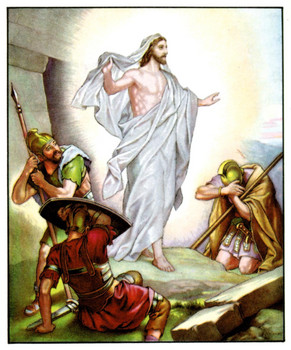
He Has Risen!

resurrection2


Every year at about this time much of the world gives special attention to what is arguably the most important event in human history.  That event was the resurrection of our Lord and Savior Jesus Christ from the dead.  Even though the Lord had promised His disciples that He would rise from the dead after His crucifixion, we know they were in the depths of despair when He breathed His last breath upon the cross.  They simply did not believe He would rise from the dead.  Some of the women who had been following Him and ministering to Him stood by watching as Joseph of Arimathea and Nicodemus took the Lord’s body from the cross, prepared it for burial, and then placed it in Joseph’s unused tomb.  This was late on the afternoon of Friday, just before the Sabbath began.

Early on the first day of the week, the third day since the Lord had died, some of these same women came to the tomb to administer additional spices to the body.  In Matt. 28:1-7 the scripture tells us that they found the stone rolled away from the tomb.  An angel was sitting on it, and the body of Jesus was gone.  The angel explained to them that he knew why they had come, but that Jesus was not there.  In v. 6 the angel said, “He is not here, for He has risen, just as He said.  Come, see the place where He was lying.”  These are the most pivotal words in the history of the world.  Jesus of Nazareth, the Son of God, the long-awaited Messiah, whom everyone knew to be dead only three days before, was alive, and would always remain so!

The importance of the resurrection cannot be overstated.  The Christian faith stands or falls on the fact of it.  Paul told the church in Corinth, “But if there is no resurrection of the dead, not even Christ has been raised; and if Christ has not been raised, then our preaching is vain, your faith also is vain . . . . and if Christ has not been raised, your faith is worthless; you are still in your sins” (1 Cor. 15:13-14, 17).  Our hope for the resurrection at the end of time rests upon the fact that Jesus came forth from the tomb.  If He did not rise, neither shall we, but because He did rise, so shall each of us when He calls all the dead from the grave (Jn. 5:25-29).

The truth of the Lord’s resurrection was the central feature of first century preaching, beginning with the apostles on the first Pentecost after the Lord’s resurrection from the dead.  After reminding the crowds of Jews that they had killed Jesus, Peter said, “This Jesus God raised up again, to which we are all witnesses” (Acts 2:31).  In v. 36 Peter added that God had made this same Jesus “both Lord and Christ.”  The power of these statements led the people to ask what they must do to be saved.  From that day forward, the fact of the Lord’s resurrection led countless others to obey the gospel just as the 3,000 did on Pentecost (Acts 2:38-41).

Others had been raised from the dead before Jesus was, but none of them was raised never to die again.  This was the point Paul made in Rom. 6:8-11, after telling the Christians in Rome that their baptism had united them with Christ in the likeness of His death, burial, and resurrection (vs. 3-7).  The imagery of replicating the Lord’s death, burial, and resurrection in baptism is not possible if Jesus was not raised from the dead.  Neither is the cleansing of baptism, which Paul calls the “washing of regeneration” (Tit. 3:5), possible if the Lord has not Himself been raised from the dead.

Christians of the first century acknowledged and celebrated the Lord’s resurrection from the dead every time they met for worship, and every time they preached the gospel.  They understood the power and significance of this wonderful event.  We would do well to emulate them in the exercise of our faith today.

Into the Hands of God

gods-hands


Near the end of David’s reign as king of Israel, he ordered a census to be taken of all the fighting men in Israel.  This action displeased God, who sent the seer Gad to inform David of His displeasure.  God also did something that was unprecedented.  He allowed David to choose which of three punishments would come upon Israel for this sin.  David’s response is recorded in 2 Sam. 24:14, where the scripture says, “Then David said to Gad, ‘I am in great distress.  Let us now fall into the hand of the Lord for His mercies are great, but do not let me fall into the hand of man.'”  This choice resulted in 70,000 men of Israel dying as God sent three days of pestilence on Israel for David’s sin.

In the New Testament we find another instance in which the scripture speaks of falling into the hands of God.  In Heb. 10:31 the scripture says, “It is a terrifying thing to fall into the hands of the living God.”  This statement is the exclamation point to the discussion which precedes it.  In that discussion the writer of Hebrews warned that those Christians who chose to willfully sin after receiving the knowledge of the truth would face a terrifying expectation of judgment from God.

In both cases the scriptures speak of falling into the hands of God, but the perspective is very different in each case.  In the first case, David seemed anxious to fall into God’s hands, even though he knew God was going to execute judgment against him.  In the other case, the readers were warned that they should not want to fall into the hands of God.  It is the same God in both instances, but what can explain the difference in the two situations?

In the first case, David was penitent about his sin, and he knew that his only hope was to commit himself into the hands of God.  His confidence in doing so was based upon his trust in God’s mercy and grace.  His confidence was well-placed because he had humbled himself before God with regard to his sin.  He was trying to do what was right after having violated God’s will.  For this reason, to fall into the hands of God was the most desirable option.

In the second case, however, the terror of falling into the hands of God is based upon an impenitent heart.  In Heb. 10:26-27 the scripture says, “For if we go on sinning willfully after receiving the knowledge of the truth, there no longer remains a sacrifice for sins, but a terrifying expectation of judgment and the fury of a fire which will consume the adversaries.”  Falling into the hands of God in this instance is terrifying because the one so falling is unbowed before God.  The Christian who willfully persists in sinful behavior should be terrified because he has “trampled under foot the Son of God, and has regarded as unclean the blood of the covenant by which he was sanctified, and has insulted the Spirit of grace” (Heb. 10:29).

It is the same God in each case, and the same hands, but the state of one’s heart determines whether he can confidently fall into them, or be terrified to do so.  If we are penitent about our sins, and if we humble ourselves before God in genuine remorse for our sins, He will forgive us (1 Jn. 1:5-10).  We may suffer some temporal consequence of our sin, but our souls will be clean because we fell into the hands of God with a penitent heart.  If we refuse to repent and humble ourselves, and if we have no genuine remorse for our sins, we need to be very afraid, for God will not allow the guilty to go unpunished (Ex. 34:7).  We will all fall into the hands of God at judgment.  What happens then depends on whether we have been forgiven or not.

The Flesh Is Weak

On the night of His betrayal, our Lord took the twelve, minus Judas, into the Garden of Gethsemane so He could pray.  He left all but Peter, James, and John near the entrance of the garden and went a little farther into it.  Then the Lord instructed Peter, James, and John to “keep watch with Me” (Mt. 26:38).  He went a short distance beyond them and fell on His face and prayed (v. 39).  After praying for about an hour, the Lord returned to find them asleep.  In vs. 40, 41 the Lord said, “So, you men could not keep watch with Me for one hour?  Keep watching and praying that you may not enter into temptation; the spirit is willing, but the flesh is weak.”

This last statement acknowledged that the Lord knew the disciples wanted to keep watch with Him, but their desire to do so was hindered by their physical limitations.  They had tried their best, but the weakness of their bodies undermined their efforts.  The Lord’s exhortation to keep watching and praying lest they fall into temptation was not simply a mild rebuke, but was also an encouragement to not give up the struggle.  The fact that they kept falling asleep as the Lord continued His prayers shows us that this exhortation is pertinent for every generation, because we, like they, struggle to do what the Lord wants us to do.

The struggle to do what is right, versus our natural inclination to do what is wrong, is summarized by Paul in Romans 7 & 8.  Using himself as an example, Paul gave voice to the inner struggle that every Christian has.  In Rom. 7:14-25 Paul spoke of the spiritual nature of the Law and of our fleshly bondage to sin.  He said that the good things he wanted to do, he did not do, and the bad things he did not want to do were the very things he did.

Every one of us has likely had this same experience at some point in our lives.  We set out to do the right thing, but stumble and fall, either by leaving the right thing undone, or by actually doing some bad thing instead.  Whenever this happens we are overwhelmed by remorse at our failure.  We may even be discouraged that despite our best efforts we have not lived up to the high calling of Christ our Lord.  In Rom. 7:24 Paul put into words how we feel when this happens.  He said, “Wretched man that I am!  Who will set me free from the body of this death?”

He gave us the answer to this anguished question in Rom. 8:1, 2.  He said, “Therefore there is now no condemnation for those who are in Christ Jesus.  For the law of the Spirit of life in Christ Jesus has set you free from the law of sin and of death.”  In context, Paul was showing that the Law of Moses could not resolve the issue of sin because it depended solely on man’s ability to live by it.  In Christ, however, sin is overcome by the power of His blood.

When we obey the gospel our sins are washed away (Acts 22:16), our old body of sin is done away with, and we rise to walk in newness of life (Rom. 6:3-7).  We are still capable of sinning, however, and will still sin.  This reality leads us to cry out in anguish because of the weakness of our flesh, but we can overcome this weakness if we set our minds on the Spirit of life in Christ (Rom. 8:3-11).

Our desire is to not sin, but we know we will.  The Lord has provided for this dilemma by the continual cleansing of His blood if we confess our sins (1 Jn. 1:5-10).  Therefore, we must not give up the struggle to do what is right, even though the flesh is weak.  The Lord will see us through this weakness if we rely on Him.

Let Justice Roll Down

Sometimes little snippets of scripture make their way into popular culture.  Thus, a character in a film may observe that someone’s actions are an example of “an eye for an eye”.  Or, we may hear someone glibly speak of “doing unto others. . . “.  Very often these particles of scripture are snatched from their biblical context and applied in ways never intended by scripture.  An example of this is the phrase, “let justice roll down”.

Civil rights advocates often use this phrase in reference to obtaining social justice for ethnic minorities.  The idea is that justice is not being served when these individuals are discriminated against, or are denied their rights as citizens of this country.  Naturally every honest-hearted American wants all citizens to enjoy the rights that our Constitution guarantees.  We want justice to be served, but is this what these words of scripture actually mean?

The phrase “let justice roll down” appears in Amos 5:24, and it is spoken by God Himself.  However, in the context of Amos this phrase has more to do with faithfulness to God than with social injustice per se.  The message of Amos was a call for God’s people to return to faithfulness.  Social injustice was one of the problems that plagued Israel at that time, of course, but this was just a symptom of Israel’s unfaithfulness to God.  This is especially the case in the immediate context of Amos 5:24.

In vs. 21-24 God said, “I hate, I reject your festivals, nor do I delight in your solemn assemblies.  Even though you offer up to Me burnt offerings and your grain offerings, I will not accept them; and I will not even look at the peace offerings of your fatlings.  Take away from Me the noise of your songs; I will not even listen to the sound of your harps.  But let justice roll down like waters and righteousness like an ever-flowing stream.”  God’s call for justice to roll down like waters was actually a call for Israel to be obedient to His law.  If they would do this, their worship would then be acceptable to Him, and social injustice would end.

This is the lesson that we must take from Amos.  The only certain cure for social injustice is to return to faithful obedience to God’s word.  Any attempt to rectify social problems devoid of God’s word is fruitless.  This ought to be abundantly evident.  Our country has been beset by calls for social justice for generations, and has engaged in multitudes of focused efforts to bring this about.  Nevertheless, we still struggle with these issues.  The truth is, we still struggle because our efforts have focused on the symptoms and not on the actual cause of social injustice.

Until individuals acknowledge their sins and seek God’s forgiveness in accordance with His word, we will never have the social justice we all desire.  Until our nation acknowledges the rightful place of God’s word to direct our path, we will never overcome the issues that plague us.  Until we truly become “one nation under God” we will continue to experience oppression and injustice, and no amount of self-righteous pontificating by our leaders will change this.

In 1 Tim. 4:8b Paul said, “But godliness is profitable for all things, since it holds promise for the present life and also for the life to come.” This is a fundamental truth that we all need to acknowledge.  If we pursue godliness, as God’s word directs us, then we will be the kind of people we ought to be, and our society will be better as well.  Only then will justice roll down like waters in the fullest sense of what God intended.

Hand In Hand

U99P200T1D162909F10DT20080525061207


A recent news story told of a couple from California, Floyd & Violet Hartwig, who died within hours of each other while holding hands.  They had been married 67 years and had previously expressed their desire to die together.  As their health declined in recent years they were eventually placed in hospice care.  Sensing that the end was near, family members pushed their hospice beds together and placed Floyd’s hand into Violet’s hand.  Floyd passed away holding his wife’s hand, and five hours later, Violet passed away, still holding her husband’s hand.

A story like this moves us because so many marriages end far short of the 67 years that Floyd & Violet attained.  This kind of story moves us also because it is a testament to love and fidelity that is far too uncommon in our world.  Sometimes the spark of love that gave birth to marriage fades over time, even among those who remain married to the same spouse for many years.  How sad it is, as the old Everly Brothers song said, “To watch good love go bad.”

The true love and faithfulness shown by Floyd & Violet reminds us of the kind of love our Lord has for us.  His promise of faithfulness is summed up by the words of His Father which are quoted in Heb. 13:6.  The Lord God said, “I will never desert you, nor will I ever forsake you.”  That promise has stood since the time of Moses, and will remain in effect until God takes us home to heaven at the end of time.  Yet, it has been an unchangeable part of God’s character from the beginning of time.

Ever since the Lord God put Adam and Eve into the Garden of Eden His desire has been to have close fellowship with us.  The scriptures suggest that God often came and walked with Adam and Eve in the Garden in the cool of the day (Gen. 3:8).  He kept doing so until their sin made it impossible for this close fellowship to continue.  Even then, however, God made provision to restore that fellowship.  He promised Adam and Eve that He would send enmity to stand between Satan and the woman and between his seed and her seed (Gen. 3:15).  That enmity was Jesus Christ, whose blood paid the ransom for our sins.

When we obey the gospel by being immersed into Christ for the forgiveness of our sins (Acts 2:38; Acts 22:16), our fellowship with God is restored.  We then, as His children, walk hand in hand with our older brother, Jesus, on our way toward our heavenly reward.  In Amos 3:3 God reminded Israel of what it takes to do so.  He said, “Do two walk together unless they have agreed to meet?” (ESV).  The implication of this statement is that we cannot walk hand in hand with our Lord unless we have agreed to follow Him in accordance with His word.

The bottom line is that we cannot walk our own way and remain hand in hand with the Lord.  In Prov. 16:25 Solomon said, “There is a way which seems right to a man, but its end is the way of death.”  Jesus said, “I am the way, and the truth, and the life; no one comes to the Father but through Me” (Jn. 14:6).  Therefore, in order to be assured that we will arrive at heaven at the end of time, we must walk with our Lord, holding His hand by our obedience to His word.  The Lord loved us so much that He freely gave His life on the cross to give us the opportunity for salvation.  The least we can do is take His hand and follow in His footsteps all the way to heaven, faithful until death, so we will receive the crown of life (Rev. 2:10).

The Implanted Word

holy-bible


The scriptures make a powerful case for the importance of God’s word.  The phrase, “Thus says the Lord,” for example, appears more than 400 times in the Old Testament.  It is a signature phrase used by the prophets when introducing a message from God.  It signifies the authority for the statement that follows and certifies that the statement is not of the prophet’s own devising, but is indeed from God Himself.

Time after time Moses reminded the people of Israel to keep the word of God in every aspect of their lives.  They had to know God’s word and obey it in order to receive His blessings in the Promised Land.  If they did not know and obey God’s word, they would suffer His wrath. Moses often punctuated these reminders by telling Israel not to stray from God’s word either to the right hand or to the left.  One cannot read the Old Testament without seeing the necessity of knowing God’s word and obeying it.

However, some professed believers today act as though somehow God’s revealed word is not as important as it once was.  They speak of “knowing Jesus” as if it is some mystical thing that envelopes them like a foggy night.  They often look down upon those who stress the importance of reading and knowing scripture, as though reliance on the written word somehow separates one from the Savior.  When pressed, they will attest that they believe in God’s word, but their attitudes toward it and their actions suggest that their feelings are far more important to them.

When we honestly read the New Testament, we discover that God has not changed His attitude about His word.  He still requires that we know and obey His word in order to receive His blessings.  One of the places where this truth is powerfully proclaimed in the New Testament is Jas. 1:21.  Here James said, “Therefore, putting aside all filthiness and all that remains of wickedness, in humility receive the word implanted, which is able to save your souls.”

James’ choice of words in this verse is interesting and very meaningful.  He said it is the “implanted” word that is able to save one’s soul.  This means that the word of God must abide within one’s heart in order to bear the “fruit” of salvation.  The most obvious illustration of this truth is a farmer and the seed from which he wishes to harvest a crop.  So long as the seed sits in a bag in his barn, it cannot produce a crop, and he is foolish to expect it to do so.  Only when the farmer has planted the seed in the ground and watered and nurtured it, will a crop grow and fruit be produced.

In the same way, as long as our Bibles sit on the shelf unopened and unread, the word of God will not produce salvation for us.  Only when we open God’s word, plant it in our hearts, and nurture it there will we know God’s will and obey it.  Only then will we receive the salvation for which God sent His Son, Jesus Christ, to die on the cross.

We cannot implant the word of God in our hearts unless we devote ourselves to it and to doing what it commands us.  Systematic study is essential to knowing God’s will, but until we do what the scriptures command us to do, the word will not bear fruit in our lives.  In Jas. 1:22 James said, “But prove yourselves doers of the word, and not merely hearers who delude themselves.”  This is the rest of the story.  One who hears (or reads) God’s word and does it, has implanted the word in his heart.  The implanted word will bear the fruit of salvation in that person’s life and that person will have a home in heaven at the end of time.

God Looks At The Heart

10646842_1667956306764860_846679667309978834_n


The picture above recently appeared on Facebook.  It depicts Adam and Eve in the Garden of Eden at the moment they sinned against God by eating from the tree of the knowledge of good and evil.  The comment attributed to Eve in the caption at the bottom of the picture is a common attitude expressed by many today.

While we may not have heard this idea in reference to Adam and Eve in the Garden, most of us have indeed heard it in other contexts.  It is the trump card usually played by one whose conduct or attitude has come under criticism.  In the face of reproof from God’s word, the offending party will often brush the criticism aside by asserting that God does not care about rules, but only about the condition of one’s heart.  The implication is that if one loves God in his or her heart, then God is pleased, no matter what that person may or may not do.  Also implied in this statement is that “rule keepers” are actually hypocrites who really don’t love God in their hearts.

As is the case with most lies, there is a kernel of truth in this assertion.  The Pharisees were the premier rule keepers of their day, but the Lord correctly identified them as hypocrites, whose hearts were far away from God (Mt. 15:8, 9).  They were hypocrites, not because of their insistence on obedience to God’s commands, but because they were voiding God’s commands by their human traditions.  This is very different from the sincere chastisement given to one who has strayed from God’s will.

It is true, of course, that God looks at the heart.  In 1 Sam. 16:7 Samuel the prophet learned this when he looked upon the sons of Jesse trying to determine which one of them God wanted to be king of Israel.  The Lord said, “Do not look at his appearance or at the height of his stature, because I have rejected him; for God sees not as man sees, for man looks at the outward appearance, but the Lord looks at the heart.”  Samuel was impressed with the physical attributes of Jesse’s older sons, but God had chosen the youngest, David, to be king because he was a man after God’s own heart (1 Sam. 13:14).

The fact that God looks at the heart does not, however, discount the fact that He requires mankind to obey His commandments.  David is an excellent example of this truth.  David was a man after God’s own heart because he obeyed God’s commands.  His good heart led him to respect God’s will and to do his very best to always obey it.  The love he held in his heart for God was demonstrated by his obedience.  If he had done otherwise, he would not have had the right kind of heart.

This is what is lost on those who claim that their hearts are right with God even as they do their own thing in their worship and walk with Him.  The one who loves God obeys His commands.  The one who disobeys God’s commands does not love Him.  Our Lord and Savior made this very point on the night of His betrayal.  In Jn. 14:15 Jesus said, “If you love Me, you will keep My commandments.”  He made the same point using different words in Jn. 4:24.  Jesus told the woman at the well, “God is spirit, and those who worship Him must worship in spirit and truth.”

God is not pleased by actions performed superficially, no matter how correct their form.  Neither is He pleased by warm, heartfelt actions that have the appearance of love, but which violate His revealed will.  God requires us to love Him sincerely, from the heart, and to demonstrate that love by our obedience to His commands.

No Greater Love

No_greater_love


On February 14th we celebrate a special day to commemorate our love.  We give flowers and candy, we plan romantic dinners and we send cards that express our devotion for that one special person in our life.  We sing songs that extol the fervency of our affection, and we make a special effort to demonstrate the love that we hold for that person the year round.  Even the most “macho” of men will find ways to express tenderness on this one day of the year.

The gifts we give on such an occasion, no matter how expensive or how simple, are usually accepted with great joy.  Everyone appreciates being loved, and even the smallest expressions of love touch us deeply.  This is one reason why mothers tend to keep and to cherish the little hand-made cards and trinkets that their children give them.  It is also why a wife will keep every Valentine card her husband has ever given her.

We understand that true love is much more than the size or monetary value of a gift given on a special occasion.  In fact, we treasure the daily expressions of love, and count them to be more indicative of love, than even the most elaborate and expensive of gifts.  A fancy gift on a special day does not make up for unspoken love the rest of the time.  What we desire more than anything is a demonstration of love in all the ups and downs of life.  We want to know that our husband or wife is giving his or her very best each and every day.  This is how it works in the most successful marriages (although gifts on special occasions are also appreciated and must not be neglected!).

As Christians, we are the recipients of the best of both worlds in this regard.  We have the daily gift of God’s love as He blesses our lives with all that we need (Mt. 6:33).  We have the ongoing presence of His Holy Spirit, who has been given to us as the pledge of our inheritance (Eph. 1:14).  We have His promise that He will not allow us to be tempted beyond our ability to resist it (1 Cor. 10:13), and we have the assurance that He will never desert us or forsake us (Heb. 13:5).  All of these things demonstrate God’s love for us each and every day of our lives.

In addition to this, He has given us the greatest gift that could possibly be given to us.  “For God so loved the world, that He gave His only begotten Son, that whoever believes in Him shall not perish, but have eternal life” (Jn. 3:16, NASB).  Jesus told His disciples that there is no greater love than to lay down one’s life for his friends (Jn. 15:13).  This He did for each of us when He shed His precious blood on Calvary as the atoning sacrifice for our sins.  He did it because God loved us, even while we were yet sinners, and because He loved us as well (Rom. 5:8).  There is no greater love that could be shown to us.

As the recipients of such love, it behooves us to do two things.  First, we must show our appreciation for it by always obeying the Lord’s commands.  Jesus said, “If you love Me, you will keep My commandments” (Jn. 14:15).  If we do this, the Lord’s sacrifice of love will not have been in vain.  Second, we will love one another, even as our Father and His Son have loved us.  John said, “Beloved, let us love one another, for love is from God; and everyone who loves is born of God and knows God.  The one who does not love does not know God, for God is love” (1 Jn. 4:7, 8).  What God has done for us, we must do for each other, for there is no greater love than this.

Flee Immorality

In Gen. 6:5 the scripture says, “Then the Lord saw that the wickedness of man was great on the earth, and that every intent of the thoughts of his heart was only evil continually.”  These words describe the sorry conditions that led God to destroy all life on the earth, except for those who were saved in the Ark.  The text does not tell us the specific wickedness that was prevalent on the earth, but we may safely conclude that it involved every kind of ungodly behavior that is common to mankind.

If we wonder what it must have been like in that long-ago time, all we have to do is take a look at the state of things today.  There is no question that our current culture is very much like that described in Gen. 6:5.  All around us we see wickedness and ungodly behavior glorified in society.  One of the most obvious evidences of this fact is our culture’s obsession with sex, and its shameless promotion of ungodly sexual conduct.  It has gotten so bad that even the advertising on television is flooded with sexually-charged images and innuendos.

The influence of this ungodliness cannot be overstated.  The more we are exposed to these things, the more likely we will become tolerant of them.  When we become more tolerant of such things, we will be more likely to engage in them ourselves.  This is a fact of human nature that our God fully understands.  This is why His word is so outspoken against sexual immorality.

In Eph. 5:3-5 Paul said, “But immorality or any impurity or greed must not even be named among you, as is proper among saints; and there must be no filthiness and silly talk, or coarse jesting, which are not fitting, but rather giving of thanks.  For this you know with certainty, that no immoral or impure person or covetous man, who is an idolater, has an inheritance in the kingdom of Christ and God.”  He went on in vs. 11-12 to say that we must not participate in such unfruitful deeds of darkness, but should rather expose them.  He added that it is disgraceful even to speak of such things.

The Greek word that is translated “immorality” in these verses is porneia.  This is the word from which our English word “pornography” is derived.  It is a word that refers to any kind of sexual immorality.  In the context, then, Paul is telling us that we cannot be sexually immoral and expect to enter the kingdom of Christ.  This flies in the face of our culture, which wants us to believe that there is nothing wrong with “a little sex”.  God’s word, however, warns us that sexual activity is a blessing that is limited to a man and his wife within the bounds of holy matrimony.  Any other sexual activity is immorality, and it will keep those who practice it out of heaven at the end of time.

In 1 Cor. 6:18-20 Paul tells us to flee sexual immorality because our body is a temple of the Holy Spirit and we are not our own.  He says, “Flee immorality (that is, sexual immorality).  Every other sin that a man commits is outside the body, but the immoral man sins against his own body.  Or do you not know that your body is a temple of the Holy Spirit who is in you, whom you have from God, and that you are not your own?  For you have been bought with a price: therefore glorify God in your body.”  We have been bought by the blood of Jesus Christ, and we must glorify God in all that we do.  And here is the key to achieving this: we must flee from sexual immorality.  We cannot expose ourselves to sexually immoral images and themes lest they lead us into sin.  Those who do such things place their souls in eternal jeopardy.

Thankfully, sexual immorality can be forgiven if we confess our sins and seek the Lord’s forgiveness in accordance with His word.  In 1 Cor. 6:9-11 Paul said some of the Corinthians had been sexually immoral before they became Christians, but they had been washed by the blood of Christ.  Their sins were forgiven when they were baptized into Christ (Acts 2:38; Acts 22:16; Rom. 6:3-7), and they were made new creatures in Christ (2 Cor. 5:17).  For this reason, they were no longer their own but the Lord’s, and the apostle commanded them to live sexually pure lives.

Do not be seduced by our ungodly society.  Flee sexual immorality in all its forms.  Those who live sexually pure lives will enjoy richer lives here on earth, and eternal life in heaven at the end of time.

The Eleventh Hour

clock

In Mt. 20:1-16 the Lord told the parable of the workers in the vineyard.  The essence of the parable is that the landowner went out at various times of the day and hired men to work in his vineyard.  He did so right up to the eleventh hour of the work day.  This was unusual because workers were typically hired early in the morning and not thereafter.  At the end of the work day all the workers were paid the same amount, including those who had been hired at the eleventh hour.

This parable illustrates the graciousness of God in two ways.  First, He will continue to call us to come into His vineyard right up until the very end.  In other words, the opportunity for salvation is open to everyone until the “work day” of life is done.  Second, those who are saved at the very last will receive the same reward as those who have spent a lifetime in the kingdom.  All of the saved will be in heaven, no matter at what point of life they obeyed the gospel.

When we ponder this aspect of God’s character, we see that He is giving us every possible opportunity to be saved.  Like the workers who were hired early in the morning, God wants us to go to work in His vineyard at the earliest possible time.  However, like the landowner in the parable, God keeps coming back to offer us the opportunity to enter His vineyard.  Day after day, year after year, God calls us to obey the gospel and to come work in His vineyard, which is the kingdom of Christ, the church that the Lord purchased with His own blood (Acts 20:28).

Like the workers in the parable, who needed work in order to survive, we need the salvation that only our Lord and Savior Jesus Christ can provide.  Like the workers in the parable, we must answer the call in order to enter His vineyard.  A worker who refused an offer of work could not expect to be paid at the end of the day.  One who refuses to answer the call of the gospel cannot expect to enter heaven at the end of time.  Therefore, it is essential that we obey the gospel just as soon as we hear its call.

This is where we learn the most important lesson from this parable.  The men who were not present to be hired at the beginning of the day had no guarantee that they would be hired later in the day.  When the landowner hired men at the third, sixth, ninth, and eleventh hour, this was an unexpected and unwarranted blessing to them.  In the same way, when God calls us by His gospel at various stages of our lives, it is the very epitome of what grace is.  It is an unwarranted opportunity that we have done nothing to merit.  For this reason we must not ignore it.

Someone once said, “The opportunity of a lifetime must be grasped in the lifetime of the opportunity.”  The point of this statement is that even the best of opportunities will one day be gone and once they are gone they cannot be recovered.  The Lord illustrated this truth in the context of salvation by declaring that no one knows the day or hour at which He will return for judgment (Mt. 24:36).  To this James added that human life is a vapor that appears for a little while and then vanishes away (Jas. 4:14).

Even though the Lord will accept us even at the eleventh hour of our lives, we have no idea when that hour may be.  Therefore, we must obey the gospel at our very first opportunity, lest our eleventh hour come and go while we remain disobedient.