Everybody Will Be There

Most people seem to go through life with no apparent idea of, or interest in, the purpose for their existence.  Are we here simply for the pleasure of a “puppet-master” God who enjoys pulling our strings and watching us dance to His manipulations?  Are we nothing more than the current stage of random evolution, with no lasting destiny and no ability to affect it?  Or are we here as the result of a divine purpose, and with a divine goal in mind?

How one answers these questions plays a large part in the course of his life.  Those who reject the idea of God tend toward the view that when one dies, he simply ceases to exist.  Some among us gravitate toward the cynical and fatalistic attitude that things are bad in life and then, after suffering all those things, one dies.  Neither of these views seems open to the idea of life after death.  These may be more of a defense mechanism than a studied conclusion, but they are real attitudes nonetheless.

Among those who do believe in life after death, there are several attitudes.  One is the “all dogs go to heaven” perspective.  In this view, it doesn’t matter how one lives on earth because God is going to save everyone anyway.  Another view is the annihilation idea.  This philosophy suggests that the evil people just cease to exist when they die.  Both of these perspectives may offer some measure of comfort to those who hold them, but are they compatible with what the Bible actually teaches?

When we look at the scriptures, there is one teaching and only one teaching about life after death.  This teaching involves three parts.  The first part is that everyone, whether good or bad, will live after death.  The Lord taught this in the story of the rich man and Lazarus, recorded in Lk. 16:19-31.  Both the rich man and Lazarus were alive and cognizant in Hades after passing from this life.  One was in torment and the other was in Paradise, but both were alive.

The second part is that everyone will stand in judgment and give an account of his life on the earth.  In Jn. 5:28, 29 the Lord said, “Do not marvel at this; for an hour is coming, in which all who are in the tombs will hear His voice, and will come forth; those who did the good deeds to a resurrection of life, those who committed the evil deeds to a resurrection of judgment.”  In 2 Cor. 5:10 Paul said, “For we must all appear before the judgment seat of Christ, so that each one may be recompensed for his deeds in the body, according to what he has done, whether good or bad.”  In Rev. 20:11-15 John described his vision of the judgment, and he noted in v. 12 that all the dead, both great and small, stood before the throne of God.  Everyone will be present at judgment, and everyone will stand before God.

This leads to the third part, which is that everyone will face the consequences of his or her conduct in life.  In Rev. 20:11-15 John tells us that the dead will be judged from the things written in the books, and those whose names are not in the book of life will be thrown into the lake of fire, which is the second death.  Those consigned there, do not cease to exist, though.  In Rev. 20:10 John says they will be tormented day and night forever and ever.  The righteous, however, will be welcomed into God’s presence, to the place prepared for them from the foundation of the world (Mt. 25:34).

Since everyone will be there and everyone will be judged, we must prepare ourselves for the afterlife by obeying God’s will while we live here on the earth.

The Christian & Social Mores

The word “mores” (pronounced morays) is defined as “customs that are considered conducive to the general welfare of society, and which, by observance develop the force of law, often becoming part of the legal code.”  We recognize these as generally accepted attitudes and practices that mark an orderly and moral society.  They are conventions that have, until recently, been expected as the norms for our behavior in a community, state or nation in the world.  There are variations in some of these conventions from one nation or culture to another, but many of them are the same in every culture.

One aspect of social mores is that they tend to change with the passing of time.  For example, in the 19th century it would have been scandalous for a woman to appear in public in a dress that revealed her ankles.  By the mid-20th century, however, women not only wore shorter skirts, but also lower cut tops, shorts, and tank-tops in public.  The same kind of changes also took place in other social mores, including the now infamous sexual revolution of the 1960s.

Whether we admit it or not, Christians are affected by social mores.  As society’s customs have changed over the years, Christians have followed along in varying degrees.  In some cases, the changes in our societal customs have little effect on our spiritual walk.  In other cases, however, these changes can raise significant issues for us.  As is the case with many circumstances in life, some Christians deride any changes, whether they affect our spiritual walk or not.  Others jump whole-heartedly into every change with little regard for the consequences.  Some, on the other hand, try to ignore the tensions produced by changing social mores as though ignoring them will make them go away.

A case in point is the changing societal attitude toward homosexuality.  The Attorney General of the United States recently declared that all U.S. courts  must grant the same status to same-sex partners that they would to a heterosexual married couple, whether the laws of their states recognize such unions or not.  This is an attempt to force the homosexual agenda on states against their will.  It is, in fact, unconstitutional, but few seem willing to press this point in our government.

For Christians, the push for so-called equality for homosexuals is a challenge to our faith.  God’s word is clear that those who practice homosexuality will not inherit the kingdom of God (1 Cor. 6:9, 10).  To say this does not mean that we hate homosexuals.  It simply upholds God’s will on this subject in the same way as observing that those who practice heterosexual immorality will not inherit the kingdom of God (1 Cor. 6:9, 10).  The Lord said that His word will judge at the last day (Jn. 12:48).  Therefore, as slaves of Christ we must abide by His word and warn everyone to do the same.

When legislators propose a law to require some kind of moral conduct we often hear critics say, “You can’t legislate morality.”  This is a cop-out offered by those who do not wish to be bound by any moral code.  In contrast to this, though, we must observe that one cannot legislate immorality.  As Christians we are bound to obey those who rule over us (Rom. 13:1ff).  However, as Christians we are also bound to an even higher authority.  If our government decrees that evil is good, we cannot obey it.  We cannot change our attitude about sin simply because society decides to condone it.  Like the apostles, we must obey God rather than men (Acts 5:29).

Mea Culpa

Sometimes words or phrases from one language are adopted into the common usage of another language.  Often the adoption of such words or phrases occurs simply because the foreign terms are a more direct means of communicating a particular idea.  For example, the initials RSVP, that we often use when inviting friends to an important event, come from the French phrase which means “respond, if you please.”  Another phrase that has come into common use in English is the Latin term, mea culpa.  In the Latin it literally means “through my fault” and it is used when one is admitting his guilt in some matter.

Most of us are unlikely to use this phrase, unless we’re trying to impress someone, or if we’re having some fun with one another.  We have, however, heard it used, most often in the context of a news story about a prominent person who has been caught in some indiscretion.  Many times in such cases, the person involved will face the media in a public show of remorse over his actions.  A person in this situation will often admit to his or her wrongdoing, and will ask for the forgiveness of family, friends, teammates or constituents.

In the scriptures, the principle of admitting one’s wrongdoing is a fundamental element in how God expects us to conduct ourselves.  Both Old and New Testaments contain stories of individuals who were caught in some sin and were called upon to admit their guilt.  In each case we see that forgiveness of the particular sin is dependent upon one’s willingness to admit his sin.  This just makes sense because one will not repent of a sin that he is unwilling to admit he has committed.

Two Old Testament examples illustrate this truth.  In 1 Sam. 15 King Saul of Israel sinned against God by failing to utterly destroy the nation of Amalek as God had commanded.  Instead of killing every living thing in that nation, Saul and the people spared the king and the best of the flocks and herds.  When confronted by the prophet Samuel, Saul claimed that the animals had been spared to make sacrifices to God.  Finally Saul admitted his sin vs. 24 & 30; however, it is clear in these verses that Saul’s primary concern was looking good before the people.  Saul was not penitent, even though he offered a mea culpa to Samuel.  The proof in the pudding is that Saul continued to disobey God thereafter.

In 2 Sam. 24 King David of Israel sinned against God by ordering a census of the people.  When God brought pestilence against the nation because of David’s sin, David cried out to God, “Behold, it is I who have sinned, and it is I who have done wrong; but these sheep, what have they done?  Please let Your hand be against me and against my father’s house” (2 Sam. 24:17).  David was truly sorry for his sin and he openly admitted it to God with a sincerity that cannot be questioned.  The proof in this case is that David went on obeying God and is called a man after God’s own heart.

The lesson for us is that God still requires a mea culpa from each of us when we sin.  In 1 Jn. 1:8, 9 John says, “If we say that we have no sin, we are deceiving ourselves and the truth is not in us.  If we confess our sins, He is faithful and righteous to forgive us our sins and to cleanse us from all unrighteousness.”  The beginning point for forgiveness is to admit one’s sins.  Then, in godly sorrow, we must ask the Lord to forgive us for those sins.  His gracious promise to His people is that the blood of Jesus His Son continues to cleanse us from all sin.  May we always have tender hearts that say, “Mea Culpa,” to God and that ask Him to forgive our sins.

The Big Lie

One of the most basic principles of propaganda is called “The Big Lie.”  The origin of this principle has been variously attributed to such men as Adolf Hitler and his propaganda minister, Joseph Goebbels.  It appears in Hitler’s book, Mein Kampf, and is one of the features of the government of “Big Brother” in George Orwell’s book, 1984.  The principle has been stated in various ways, two of which are:  “If you tell a big enough lie and keep repeating it, people will eventually come to believe it.”  And, “If you repeat a lie long enough, it becomes truth.”

“The Big Lie” has found a place in virtually every aspect of modern society.  Politicians are masters of this principle, often repeating outrageous statements, either of the success of their policies, or deriding the character or policies of an opponent.  Environmentalists have also used this principle to convince an entire generation of people that man-made global warming (now called climate change) is destroying the planet.  So, also, have proponents of gay marriage and the homosexual agenda used this principle to advance their ideas.

It is important to understand that those who use “The Big Lie” in order to advance their agendas know they are telling a lie.  The fact that their statements or policies are lies is not the issue for them.  The issue is winning approval of their position and gaining power as a result of it.  Hitler and Goebbels understood this and used it to perfection in Nazi Germany, but they were rank amateurs in comparison to their modern counterparts.

The power of “The Big Lie” is such that it blinds us to the truth.  Jesus spoke of this principle as He dealt with the religious leaders of the first century.  They taught things that were patently false, but had done so for so long that they were believed to be true.  In Mt. 15:14 Jesus called them blind guides and warned that if a blind man guides a blind man, both will fall into a pit.  Paul the apostle later warned that the time would come when people would be sent a “deluding influence” so they would believe a lie, because they did not love the truth so as to be saved (2 Th. 2:10-12).

The very idea that one would promote a lie for his own personal gain is abhorrent to any honest person.  Yet, from the time that Satan entered the Garden of Eden, God’s people have been subjected to one big lie after another.  Satan’s big lie to Eve was that eating the forbidden fruit would make her like God.  He knew this wasn’t true, but it advanced his purposes to tell the lie and to convince Eve to believe it.  The same thing continues today, with the potential for the same kind of consequences as Adam and Eve experienced.

This is why the scriptures exhort us to not allow the world to brainwash us into doing that which violates God’s word.  In Rom. 12:2 Paul said we are not to be conformed to the world, but to be transformed by the renewing of our minds.  In Jas. 1:27 James said that one aspect of pure religion is to keep oneself unstained by the world.  In Jas. 1:21, 22 James said we must receive the implanted word which is able to save our souls and to be doers of the word and not just hearers.

“The Big Lie” takes many forms today, urging us to discard the moral standards of scripture in favor of man’s standards.  The lie is being repeated in books, magazines, television, radio, the movies, the halls of Congress, and even from some pulpits in the land.  This influence is leading many to now believe a lie, instead of God’s truth.  Those who truly love God will rely on His word alone to mold their attitudes and actions in life.

The Only Answer

The wickedness of today’s world is such that it ought to evoke comparisons to the ancient world that perished in the flood.  Of that time the scripture says, “Then the Lord saw that the wickedness of man was great on the earth, and that every intent of the thoughts of his heart was only evil continually.” (Gen. 6:5).  If the world is not to this same point today, it has to be very close.

In that ancient time, God decided to cleanse the earth by means of a world-wide flood that swept away all those who were not in the Ark with Noah and his family.  During the time that Noah was preparing the Ark, the only answer to the judgment that was coming was to be in the Ark when the flood came.  Noah preached righteousness to those around him as he built the Ark in order to give them an opportunity to be saved from the flood.  Unfortunately, no one outside of his immediate family responded to his preaching.

Such a cleansing of the world is not going to happen again, for God promised Noah that He would never again send such a flood upon the earth (Gen. 9:11).  Instead, the earth is being reserved for fire that will utterly destroy it at the last day when the world will be judged (2 Pet. 3:7-10).  This judgment is just as certain as the flood was in Noah’s day, for our Lord compared His return for judgment to this historical event (Mt. 24:37-39).  He also warned, as Noah must have done concerning the flood, that no one knows when He will return again for this judgment (Mt. 24:36, 42).

Knowing that the world is such a wicked place, and that judgment is coming, where do we turn for an answer to this dilemma?  In Noah’s time, the Ark was the only answer to impending judgment.  Today, as it has been ever since the flood, the only answer to judgment is God’s word.  In Psa. 19:7-11 David said of God’s word, “The law of the Lord is perfect, restoring the soul; the testimony of the Lord is sure, making wise the simple.  The precepts of the Lord are right, rejoicing the heart; the commandment of the Lord is pure, enlightening the eyes.  The fear of the Lord is clean, enduring forever; the judgments of the Lord are true; they are righteous altogether.  They are more desirable than gold; sweeter also than honey and the drippings of the honey comb.  Moreover, by them Your servant is warned; in keeping them there is great reward.”

In David’s view, the only hope for mankind is to devote itself to God’s word.  Everything about God’s word is for our benefit, and if we avail ourselves of its power, we will live well here in life and we will live with God in eternity.  This is God’s intent for us.  This is why He has revealed His will in the scriptures.  As David said, we are warned by His commandments and if we keep them we will receive a great reward (Psa. 19:11).

In order to avail ourselves of this power, and to avoid the judgment that is coming upon the wicked, we must devote ourselves to God’s word.  In Rom. 12:2 Paul said, “And do not be conformed to this world, but be transformed by the renewing of your mind, so that you may prove what the will of God is, that which is good and acceptable and perfect.”  In Jas. 1:21 James said, “Therefore, putting aside all filthiness and all that remains of wickedness, in humility receive the word implanted which is able to save your souls.”

Judgment is coming; of this we may be certain.  We may also be certain that when the Lord returns the wicked will not go unpunished, just as it was in the flood.  Therefore, the only answer to this impending judgment is to know God’s word and to obey it.

Precious Feet

Precious Feet Picture                            Precious Feet Pin

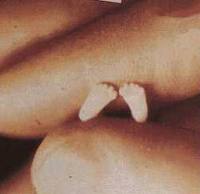
They are about three-eighths of an inch long.  They are about one-quarter of an inch wide at the narrowest point, and about seven-sixteenths of an inch wide at their widest point.  They would fit, with room to spare, on the average man’s thumb nail.  What are they?  They are the feet of an unborn child at ten weeks after conception.  There is no mistaking what they are, for they are clearly human feet, complete with ten tiny, yet perfectly formed, toes.

In 1970, Dr. Russell Sacco, who shared a lab with a pathologist who kept unborn babies in jars of formaldehyde on his shelf, was struck by the highly developed state of the tiniest of these unborn babies.  He took a picture with the feet of a 10-week old unborn baby held between his thumb and forefinger.  This picture, showing two tiny, but perfectly developed feet, each complete with toes and toe nails, powerfully demonstrated that unborn babies are indeed human, even at this very early state of gestation.

In 1974 Mrs. Virginia Evers used this picture in a March for Life on the first anniversary of the Roe V. Wade Supreme Court decision which legalized abortion on demand.  Using this photograph as a model, Mrs. Evers designed a lapel pin the exact size and shape of the a 10-week old unborn baby.  In 1979 a world-wide pro-life symposium in Dublin, Ireland designated these “Precious Feet” as the International Pro-Life Symbol.  Today, millions of these precious feet pins have been distributed world-wide.

These “precious feet” dramatize the fact that abortion destroys a human life, not an inhuman blob of protoplasm euphemistically called a “fetus.”  They also help dramatize the fact that human life is sacred, even in the womb, and should be protected.  It is important to note that the precious feet do not prove these truths.  They simply illustrate them.  With or without this symbol, however, God’s word declares the sanctity of human life.

We know that human life is precious to God because it is made in His image.  In Gen. 1:26 God said, “Let Us make man in Our image, according to Our likeness; and let them rule over the fish of the sea and over the birds of the sky and over the cattle and over all the earth, and over every creeping thing that creeps on the earth.”  Later, in Gen. 9:6, God told Noah that whoever sheds man’s blood shall have his blood shed, because He had made man in His image.  This statement is one reason why capital punishment was authorized by God.  If someone murders another, he has destroyed a life made in God’s image and must therefore pay with his own life.

This provision of God’s will, which predates the Law of Moses, also applies to the unborn because God commanded in the Law of Moses that anyone who caused an unborn baby to die must pay with his own life (Ex. 21:22-25).  In addition to this, God inspired Solomon to write that He hates “hands that shed innocent blood” (Prov. 6:17).  Obviously “innocent blood” may refer to any person murdered by another, but it is also clear that there is no more innocent blood than the blood of unborn babies.  Therefore, we correctly understand that God hates those who murder the unborn by the barbaric practice of abortion.

Since 1973 more than 57 million “precious feet” have been murdered by abortionists in the United States alone.  The souls of these unborn have returned to the God who gave them, but God will not leave the guilty unpunished (Ex. 34:6-7).  All human life, even that of unborn babies, is made in God’s image.  Therefore, it is precious in His sight.  Let us pray that all “precious feet” will be allowed the opportunity to be born.

The Precious Feet pin above may be ordered from Heritage House, a supplier of pro-life materials, through their web site: http://www.hh76.org

Sanctity of Human Life Sunday is the third Sunday in January, which is the closest Sunday to the anniversary of the Roe V. Wade decision, that was handed down on January 22, 1973.  This year Sanctity of Human Life Sunday is January 19th.

“Ducking” The Truth

A few weeks ago an article appeared in a popular magazine in which the patriarch of the “Duck Dynasty” family made some comments about the state of morality in our nation today.  Using a rather crude manner of expression this man stated his personal views on homosexual behavior.  As he did so, he loosely, but accurately, quoted a passage from 1 Corinthians that condemns homosexual activity.  The firestorm that erupted after his comments hit the airwaves was massive, and, predictably, negative.

As might be expected, the homosexual lobby immediately demanded that he be fired from the very popular reality program about his family and business in which he has appeared for several years.  News stories about his comments and attitude flooded the airwaves for days, and the Christian faith that he espouses was viciously attacked by the media and various other anti-Christian voices.  The network on which his program airs issued a statement distancing themselves from his views and announced that he had been indefinitely suspended from the program.  Amazingly, even some professed believers joined in the attacks on this man.  The backlash against the network from fans of the program and from conservative believers ultimately led the network to reinstate him to his program, which will continue to be seen in its normal time slot.

As this drama unfolded, it was clear that the outrage expressed against this man’s statement ignored one important element.  It ignored the truth.  Every argument was based upon the presumed unfairness that has been experienced by homosexuals, and upon the shock and disgust that anyone could not support the current efforts to bring equality to this segment of our society.  Every argument worked from the premise that it is only right and just to bring homosexuality into acceptance in our modern, enlightened world.  The fact that this man quoted scripture as the basis for his statements about this subject was conveniently ignored or cast aside.  In other words, the media “ducked” the truth.

For the record, I am not a fan of Duck Dynasty.  The point, however, is that it is scripture which determines what is right and just, not public opinion.  The verses quoted in this man’s statement are 1 Cor. 6:9, 10.  Here Paul says, “Or do you not know that the unrighteous will not inherit the kingdom of God?  Do not be deceived; neither fornicators, nor idolaters, nor adulterers, nor effeminate, nor homosexuals, nor thieves, nor the covetous, nor drunkards, nor revilers, nor swindlers, will inherit the kingdom of God.”

Whatever one may think about how the “Duck Commander” related these verses of scripture, the fact is that he accurately related them.  This is what God’s word says, and it isn’t simply about homosexuality.  Paul mentions many sins in these verses which will keep a person out of heaven at the end of time.  If we are going to remove homosexuals from this list, we must also remove adulterers, thieves, idolaters, drunkards and the rest.  This, of course, is not the only place in scripture where homosexual behavior is condemned by God’s word, but this truth is apparently too inconvenient for the world.

When Jesus prayed to His Father on the night of His betrayal, He asked on behalf of His apostles, “Sanctify them in the truth; Your word is truth.”  Paul said that all scripture is God-breathed (2 Tim. 3:16, 17).  This means that all scripture is truth.  This is not a matter of opinion or interpretation.  The statements in scripture against homosexual behavior are clear and simple.  We cannot “duck” the truth and be right with God.

Something New

Most of us like new things.  There is just something about an item, whatever it may be, that has never been owned or used by someone else.  We may have to buy a used car because of the expense of a new one, but if given the choice, most of us would prefer the new one.  Those who grew up as a younger brother or sister in a family always enjoyed it when they received new clothes that were new off the rack, rather than hand-me-downs.  And, when the holiday season at the end of the year concludes, most of us relish the idea of the opportunity to begin afresh in a new year.

In terms of beginning a new year, we have all experienced the disappointment of making resolutions for the new year and then failing to keep them.  Whatever our resolutions might be, if we have taken time to make them we genuinely intend to have a different result this year than last.  However, what we fail to consider, or at least what we often fail to remember each year, is that we have to make changes in our attitudes and lifestyle in order to make those resolutions come true.

A prominent and successful educator from the East coast wrote a book in which he addressed the idea of changing the cycle of failure that characterizes too many inner city youth.  One of the primary principles he used to motivate his students was this statement:  “If you keep doing what you’re doing, you’ll keep getting what you’ve got!”  A successful motivational speaker in the business world has a similar philosophy.  He says, “In order for things to change, you’ve got to change.”  The principle is so simple, yet it is so routinely ignored.

In order for this year to be different from last year, and presumably better, each one of us will have to make changes in the way we live.  It may mean avoiding the donut shop, or foregoing that second helping at the dinner table, or eating more fruits and vegetables.  It may mean consciously taking the time to stop and consider how to respond to someone’s actions or comments, instead of just flying off the handle.  Whatever the situation, if we want this year to be better we will have to start by changing the way we conduct ourselves.

Nowhere is this more important than in our spiritual walk.  If we want to improve our walk with the Lord, we will have to make some kinds of changes in order to accomplish this.  Of course, the beginning point is obedience to the gospel.  We cannot have something new, in terms of our relationship to God, until we do what He requires in order to be saved.  If we obey the gospel, then new things will come (2 Cor. 5:17).

As Christians, the same is true.  We cannot coast along in our spiritual routine, whatever it may be.  Our call as Christians is to grow and to mature in the faith (1 Pet. 2:1-3; Heb. 5:11-14).  We cannot allow ourselves to be satisfied with being what we are.  We should be taking action to make ourselves better each day, for this is what truly glorifies God.

Arriving at something new in our maturity of faith is a process that continues until we reach heaven.  It begins with a personal commitment to put the Lord first and to let Him mold us into the best we can be here in life.  It takes work and dedication, an exercising of the mind by the study of God’s word, which, when put into practice makes us the living sacrifices He wants us to be (Rom. 12:1, 2).  Make something new this year in your walk with God and you can have that “new car smell” not only here in life, but also in eternity.

Consider Your Ways

The prophet Haggai ministered among the returned exiles in Judah about 500 years before the birth of Christ.  He and fellow prophet Zechariah were tasked by the Lord to call the Jews back to the purpose for which they had been returned from captivity.  They were supposed to have rebuilt the temple, repaired the walls of the city of Jerusalem, and restored the worship of the Lord.  They had diligently done some of this work, but had not completed the full task.  Instead, they had become distracted from the Lord’s work by focusing more on their own desires and needs than on His.

Haggai’s proclamation to the people of Israel was a simple one.  He said, “Now therefore, thus says the Lord of hosts, ‘Consider your ways!'” (Hag. 1:5, 7).  The Hebrew phrase literally means, “set your heart on your ways.”  In other words, God wanted His people to take stock of what they had been doing and weigh that in the balance against what they should have been doing.  In their case, God was scolding them for having lost their focus.  Their priorities were out of order.

It is common for us to reflect on the course of our lives as we approach the end of a calendar year.  Businesses do this to see how well or how poorly they have met their sales or production goals for the year.  Non-profit organizations do the same to measure how successful they have been raising funds to do their good works.  Elders of congregations, if they are wise, will also take time to reflect on the year that is about to end.  they will want to evaluate the congregation’s success at meeting the spiritual goals that were set at the beginning of the year.

For each of us as Christians, considering our ways should be an ongoing exercise that is particularly appropriate as we approach a new year.  We may or may not have set spiritual goals for ourselves, but we still should be interested in where we are in our journey toward eternity.  Am I more knowledgeable of God’s word than I was at the beginning of the year?  Am I more mature in my faith than I was twelve months ago?  Am I more faithful in my participation in the work and worship of the church, or am I still where I was last year at this time?  Do I study more, pray more, give more, serve more than before, or am I just treading water?

Each of us knows the answers to these questions, and so does our Father in heaven.  It is easy for us to become distracted, just like the Jews in the time of Haggai.  We become so busy with earthly concerns that the spiritual side of our lives gets neglected.  Very few of us make such a choice intentionally, but the effects are the same, even if done unintentionally.

As we approach the beginning of a new year, should the Lord grant it to us, let us each take a few moments of serious, personal introspection about our spiritual health.  The standard for this reflection, of course, is God’s word.  If we compare ourselves to ourselves, we will never improve, but when we compare ourselves to the standard of God’s word, we will always see the need to do better in His service.

One of the great blessings of being a Christian is that so long as the Lord gives us life, He gives us opportunity to consider our ways and to change our ways to be more like His.  Let us take advantage of the Lord’s grace and mercy, while He still extends them to us.  Let’s consider our ways, and consider how to stimulate one another to love and good deeds in the New Year (Heb. 10:24).

Spoken Against Everywhere

When Paul arrived in the city of Rome to await his trial before Caesar, Luke tells us that he was allowed to stay by himself with a single soldier to guard him (Acts 28:16).  Because of this relative freedom, Paul was able to receive not only the brethren who were in Rome, but also to call for the leading men among the Jews who lived in Rome.  When these men came to Paul’s residence, he explained that he had called them so he might inform them why he was in custody.  He wanted to be sure that these Jews knew the truth about his imprisonment.

When Paul explained how he came to be a prisoner of Rome, the leaders of the Jews told him that they had heard nothing about his case from the Jews in Jerusalem.  No representative from the leaders in Jerusalem had come to Rome with a report, nor had any letters been written to them about Paul.  They went on to say this, recorded in Acts 28:22:  “But we desire to hear from you what your views are; for concerning this sect, it is known to us that it is spoken against everywhere.”

This comment certainly represented the prevailing view of many, if not most, of the Jews at that point in the first century.  The force of this statement, which was offered almost casually, tends to shock modern day believers in Christ.  We can hardly imagine faith in Jesus Christ as being spoken against.  In fact, many who claim the name of Christ go out of their way to portray Christianity as inoffensively as possible.  They go to great lengths to have their faith spoken of only in the most positive of terms.

It is this desire to be approved of, however, that has led many professed believers to modify their tenets of faith in order to avoid any negative reaction by the world.  This has recently occurred as leaders of some churches have courted the favor of the homosexual lobby and other special interest groups.  They have done so by suggesting that God’s word does not condemn homosexual behavior and by jumping on the bandwagon of the social liberals in society.

Obviously all of us want to be liked, if not loved.  It is a part of our make-up as human beings.  No one likes or appreciates a person or group that is obnoxious and purposely offensive.  Part of good manners is being courteous and kind and respectful toward others, whether we believe they deserve it or not.  At the same time, however, faith in Christ and the practice of that faith is not subject to modification to soothe the feelings of those who oppose it.  Professed believers must not fall into the trap of  trying to please or to appease unbelievers.

The reality of Christianity in the first century should prove this beyond doubt.  Nothing that we read in the New Testament suggests that faith in Christ is an oppressive thing.  Nothing in scripture even hints at Christians being obnoxious or offensive in the practice of their faith.  They did, however, cause offense in many instances.  They did so by proclaiming the truth, the whole truth, and nothing but the truth.

This is a fact that must not be ignored.  No one who is in violation of some code of conduct ever enjoys being corrected.  Think about how it feels to be pulled over by a police officer and written up for speeding.  No one would suggest that traffic laws should be modified to allow any kind of driving one pleases, so why would we bend God’s law to make it less offensive to those who are in sin?  If we faithfully proclaim God’s word, we will be spoken against by those who stand against it.  This, however, is what we must always do.

NOTE:  This article was written days before Duck Dynasty patriarch Phil Robertson’s comments on homosexuality sparked the current furor.  This incident perfectly illustrates the point of this article.  Mr. Robertson accurately conveyed the teaching of the scriptures on homosexual behavior, and now he and the Christian faith are being “spoken against everywhere.”  So it will always be, until the Lord comes again.