The Mother Road

hl_00113_route66


When automobiles became affordable for more people, it soon became imperative to create roadways on which these automobiles could operate.  In 1925 Congress passed legislation which authorized the creation of a federal highway commission to create and maintain highways across the country.  The next year, a highway route from Chicago, IL to Los Angeles, CA received the designation, US 66.  It was among the first interstate highways to be created by the federal government.  This road stretched about 2,448 miles from the heartland of America to the West Coast, and passed through eight states.  In 1938 it became the first U.S. highway to be completely paved.

The highway, which came to be known as Route 66, was the main thoroughfare from the Midwest to California during the Depression, and in the war years, as people moved to work in the agricultural and industrial centers of California.  Over time this route captured the fascination of Americans and was immortalized in songs and television programs in the 1960s.  Although its official designation was US 66, it came to be known as “The Mother Road.”  It was decertified in 1985, due to the completion of the U.S. Interstate Highway system, which in many places bypassed the old route.  Nevertheless, the lure of the old Route 66 still captivates many travelers, and restoration and historical efforts mark its route in nearly every state in which it passed.

The story of Route 66 is interesting and entertaining, but it also illustrates an important spiritual truth.  When Jesus was coming to the conclusion of the Sermon on the Mount, He told His audience that there are only two ways in which they could travel through life.  In Mt. 7:13-14 He said that they must enter through the narrow gate because this is the one that leads to eternal life.  But, He added, few would find it.  In contrast, He said that the other way, the broad way, leads to destruction, and many enter it.

The narrow way of which the Lord spoke is like old Route 66.  It is not a super highway.  It is not built for comfort and speed.  It is sometimes difficult to navigate, and it takes considerable thought, and planning, and attention in order to travel it.  However, like Route 66, it is a road that is marked by things of great beauty and inspiration.  Those who travel this road will experience things that simply cannot be experienced on the only other available route.  The broad way, on the other hand, is convenient and easy to travel.  It is marked by all the things a traveler might desire, and promises both speed and comfort to those who use it.

Every analogy breaks down at some point, and so we acknowledge that one can travel from Chicago to Los Angeles by any number of routes and still arrive at the destination.  However, the Lord did not offer a variety of options for our spiritual journey through life.  He said there are only two routes that we may take through life, and we must carefully choose which one we take.  One is certainly  the route of less resistance, the super highway as it were, but no one truly wants to go where this route leads.

Instead, we need to choose the spiritual “Mother Road,” which is the narrow way that leads to eternal life.  Yes, it will be the more challenging route to take, but these challenges will be more than offset by the many blessings we will receive as we travel it, and by the greatest blessing of all, a home in heaven at the end of it.  Though few may find it, all who do find it will discover that they are among like-minded people who will help them along the way.  When all is said and done, there is no better route that we may travel.  Let “the Mother Road” take you all the way to heaven.

Best Laid Plans

unknown


Founding Father Benjamin Franklin is reported to have said, “If you fail to plan, you are planning to fail.”  These are strong words that suggest that success is largely dependent upon having a definite goal in mind and then having thought through the steps to reaching that goal.  Modern motivational speakers have taken Franklin’s words and modified them to be somewhat less harsh.  The declaration today is, “Most people do not plan to fail.  They simply fail to plan.”  Most of us understand and accept the premise behind this statement.  We recognize the need to make plans, and to follow them, in order to achieve our goals in life.

There is another side to this principle, however.  It is suggested in the statement, “The best laid plans of mice and men often go awry.”  This is a line from a poem entitled, To A Mouse, On Turning Her Up in Her Nest with a Plough, written by Robert Burns.  Burns’ point was that no matter how well one may plan a course of action, it often doesn’t work out as planned.  Military commanders understand this point all too well, and often note that a battle plan gets thrown out the window as soon as the first shots are fired.

Interestingly, both of these aspects of planning have biblical foundations.  The first is suggested by our Lord in the Sermon on the Mount.  In Mt. 7:13-14 He exhorted His audience to enter through the narrow gate that leads to life, rather than through the wide gate that leads to destruction.  The idea of planning is seen in the Lord’s statement that many enter the wide gate, but only a few find the narrow gate.  This suggests that one does not enter the narrow gate by accident.  He must plan to do so by his obedience to the gospel.  Those who do not plan to be saved will wind up on the broad path that leads to destruction.

The second aspect is seen in the Lord’s parable of the rich fool in Lk. 12:16-21.  In this parable the rich man had great plans for himself, but things did not turn out as he had planned.  In vs. 18-20 the rich man laid out his plans to tear down his old barns and to build larger ones.  Then, he planned to take his ease, to eat, drink and be merry, for many years to come.  This man had detailed plans for reaching the goal he had set for himself.  However, in v. 20 God called him a fool because that very night his soul would be required of him.  In this case, the best laid plans absolutely went awry.

The reason the rich man’s plans did not work out for him is explained in v. 21.  The Lord said, “So is the man who stores up treasure for himself, and is not rich toward God.”  The rich man’s plans failed because they were self-centered and took no account for God’s will.  This is exactly the point that James made in Jas. 4:13-15.  In these verses James chastised those who proudly spoke of the plans they had for themselves.  He reminded them that life is a vapor that appears for a little while and then vanishes away (v. 14).  For this reason, James concluded that we should say, “If the Lord wills, we will live and also do this or that” (v. 15).

Taken together, we see from these things that it is important to make plans so we will have the best opportunity to reach our goals.  However, our plans must always be made with God’s will in mind.  We do so by insuring that our plans are in accordance with His revealed will.  We cannot expect to be successful in any plan that goes against God’s plan for us, which is our salvation (1 Tim. 2:4).  Also, our plans must also take into account the fragile nature of life.  As we plan, we must say, “If the Lord wills”.  If we have planned to walk the narrow path that leads to life, and if we have acknowledged that life is fragile, then we will indeed have “best laid plans”, and these plans will not go awry.

Huddle Up!

usc-alabama-1978-huddle


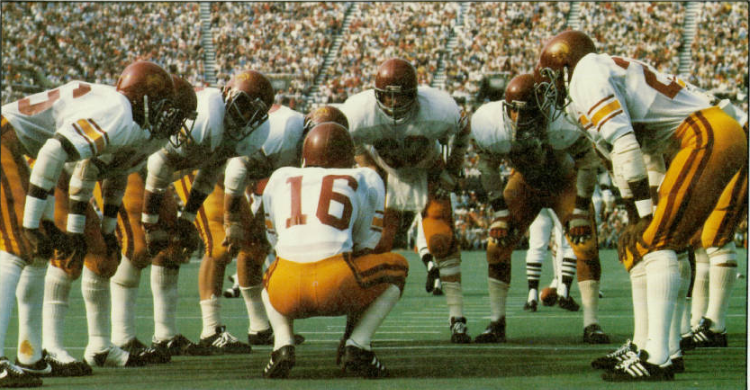
In a recent article in a brotherhood journal the writer related a story told by a Christian university official in a sermon.  This brother used the analogy of a football huddle to teach important lessons on Christian living.  He pointed out that in the huddle the players lean on each other for mutual support.  While in the huddle they communicate a plan to overcome their opponent during the next play.  Finally, he said that the huddle symbolizes a sense of unity, even though each person in the huddle has different talents and assignments.

This brother was not the first to use a sports analogy to represent the Christian life.  Paul used the examples of running a race and boxing in his letter to the church in Corinth (1 Cor. 9:24-27).  These examples were based upon individual athletic effort, which fit into the context of his exhortation to this church.  His point was that each individual Christian must put forth the effort to win in the great struggle against evil.  Nevertheless, Paul was also keenly aware of the corporate, or team, aspect of the Christian endeavor.

He spoke of this aspect in his analogy in which he described the church as a body.  His words in 1 Cor. 12:14-27 are especially important in this regard.  In this passage Paul spoke of the various members of the body, each of whom is different, and has a different purpose in the body.  Even so, he pointed out that the body needs each of these various members in order to function properly.  He underscored this point in Eph. 4:11-16, where he concluded that the body is held together by that which each joint supplies, and grows because of the working of each individual part (v. 16).

These truths suggest that the brother’s analogy of a football huddle fits perfectly into the reality of the Christian walk.  Like football, the Christian walk cannot be successfully navigated alone.  It takes eleven players working together to make a successful football team.  In a similar way, it takes all the members of the body of Christ working together to be successful in our pursuit of eternal life.  In football, each of the players has different skills and different tasks.  If any one of them fails in his assignment, the play fails, and the game may be lost.  In our walk as Christians, we each have differing abilities and gifts from God.  Each of these gifts and abilities are necessary for the success of our team, the church.  If any of us fails to do his or her part, the church suffers for it.

This brings us back to the imagery of the huddle.  For Christians, the huddle occurs every time we gather together for Bible study or worship.  Our first purpose in assembling, of course, is to offer acceptable worship to God the Father, but an adjunct to this is the encouragement we give to each other when we assemble.  Like a football huddle, we pump each other up and gain mutual support.  Like a football huddle, we communicate the plan that God has given us in order to overcome our spiritual enemy, the devil.  And like a football huddle, we experience unity, even though we are of differing gifts and abilities, and have different assignments in the body of Christ.

A football player who misses the huddle will not be able to contribute to the success of his team.  The same is true of Christians.  If we’re not in the huddle, we aren’t helping the church.  The writer of Hebrews said it this way: “And let us consider how to stimulate one another to love and good deeds, not forsaking our own assembling together, as is the habit of some, but encouraging one another; and all the more as you see the day drawing near” (Heb. 10:24-25).  Therefore, let’s huddle up, each and every time the church meets.

Thank You, Lord!

maxresdefault


Two of the most important words in any language are, “Thank You.”  They are some of the very first words we learn to speak as children, and most parents are very diligent to be sure that their children use them regularly.  They are words of common courtesy that reflect one’s gratitude for something done for them by another.  Even in as rushed and impersonal a society as the one in which we now live, saying “Thank You” is still pretty common, and it is noticed when it is neglected.

When it comes to expressing gratitude, there is no one more deserving of thanks than our Father in heaven, and our Lord Jesus Christ.  All we need do is consider the world in which we live.  It is a special place, created by God just for human beings.  It contains all the resources necessary for us to thrive.  Despite the alarmist warnings of unbelievers that the earth’s resources are limited or diminishing, God has provided for us far in excess of what mankind will ever need.  The earth will continue to abundantly provide for mankind until our Father sends His Son for judgment at the end of time (cf. Gen. 8:22).

As a result, just waking up in the morning, breathing the fresh air, eating a meal, and enjoying all that God has placed at our disposal should be more than enough reason to say, “Thank You, Lord!”  When we look up at the stars at night and see the majesty of the heavens, and note that all the stars and planets travel in their courses at God’s command and under His control, we should also be prompted to say, “Thank You, Lord!”  What a marvelous and wonderful world God has provided for us!

In the Sermon on the Mount, Jesus taught us that our Father in heaven cares for us in such detail that He will provide for all of our physical needs.  The unbelievers worry about what they will eat, or what they will drink, or how they will be clothed, but Jesus said that His Father knows our needs and will abundantly supply them.  In Mt. 6:24-33 He spoke in detail about this truth and concluded by saying, “But seek first His kingdom and His righteousness, and all these things will be added to you.” (v. 33).

As important as these physical blessings are, there is something even more important for which we should express our gratitude to our Father in heaven.  The most important thing our Father has done for us is to provide His one and only Son, Jesus Christ, to be the atoning sacrifice for our sins (1 Jn. 2:1-2).  In Christ we have all spiritual blessings, redemption through His blood, and the forgiveness of our trespasses (Eph. 1:3-7).  Because of this sacrifice, we have hope, not only in life, but also in eternity.  If this is not something for which we should say, “Thank You, Lord,” it is hard to imagine what would deserve such a response.

In Phil. 4:6 Paul said, “Be anxious for nothing, but in everything by prayer and supplication with thanksgiving let your requests be made known to God.”  In Col. 4:2 Paul said, “Devote yourselves to prayer, keeping alert in it with an attitude of thanksgiving.”  In Rev. 7:9-12 John describes a marvelous scene in heaven in which all the angels, the twenty-four elders and the four living creatures all fell down before the Father’s throne and offered praise, saying, “Amen, blessing and glory and wisdom and thanksgiving and honor and power and might, be to our God forever and ever.  Amen.” (v. 12).

May this be our prayer of thanksgiving every day as we remember God’s marvelous gift of eternal life.  For Christians, every day is a day to say, “Thank You, Lord!”

A Timeless Message

clock-wallpaper-4


One of the characteristics of modern society is its infatuation with things that are new.  Marketing experts recognize this and capitalize on it whenever possible.  They convince a company to make a minor adjustment in the appearance or in the ingredients of a product, and just like that, the product is “new and improved.”  It may not be substantially different from its predecessor, but because it is not exactly the same, it can be called “new.”  Consumers, who have been conditioned to think that they must have the newest version of every product, flock to purchase these “new” items with little thought as to whether the new thing is actually better than the old one.

It may be surprising to some to learn that this fascination with “newness” is not itself a new thing.  One proof of this fact is what Luke said about the Athenians when Paul visited that city during his second missionary journey.  In Acts 17:21, after the Athenians had invited Paul to speak to them in the Areopagus, Luke noted, “(Now all the Athenians and the strangers visiting there used to spend their time in nothing other than telling or hearing something new.)”  This was nearly 2,000 years ago and even back then people loved “new” things.

The irony of this fascination with newness, especially in a spiritual context, is that “new and improved” was never a part of God’s plan.  In Eph. 3:1-12 Paul explained to the church in Ephesus that the message he had proclaimed to them was the eternal purpose of God that He carried out in Christ (v. 11).  Even though it had been a mystery in past generations (vs. 4-5), and had only been fully revealed in the ministry of the apostles, it was the same message that God had ordained before the foundation of the world.

This should suggest something to us about the content of our preaching, and about the substance of our beliefs.  The message of God may, in fact, be new to those who have never heard it, but it is actually an old message.  It is a message that was first revealed in Gen. 3:15 when God told Satan that He would put enmity between him and the woman, and between his seed and her seed.  That enmity is Jesus Christ, by whose sacrifice on the cross the sins of all mankind for all time have been atoned.

More than this, however, it is a perfect and timeless message.  It is a perfect message, because it came directly from the mind of God.  When the Lord Jesus lived on the earth, He said that He only spoke what the Father gave Him to speak (Jn. 12:49).  Before He left the earth, He told the apostles that He would send the Holy Spirit to guide them into all the truth, but in doing so also pointed out that the Holy Spirit would only speak what God the Father commanded Him to speak (Jn. 16:13).  Therefore, the message the apostles proclaimed was the one the Holy Spirit give them, and it was perfect and complete in every respect because it came from God Himself.

Because that message was, and remains, perfect, it is timeless and it needs no improvement.  Jude, the Lord’s half-brother, said that the faith was “once for all handed down to the saints” (Ju. 3).  For this reason, there is nothing new to be added to it.  There is nothing new which can improve it.  It must, therefore, be proclaimed just as it was by the men who first received it from the Lord.

We must be wary of anyone who claims something new with regard to God’s will for mankind.  The scriptures tell us that they are God-breathed (inspired), and that they equip us for every good work (2 Tim. 3:16-17).  Since this is true, the message they proclaim is a message for all people for all time, until the Lord comes again.  Let us therefore seek “the ancient paths, where the good way is, and walk in it” (Jer. 6:16, NASB).