This program aired on KIUN 1400 AM in Pecos, TX on February 23, 2018.
This program aired on KIUN 1400 AM in Pecos, TX on February 23, 2018.
When I was a boy my mother would sometimes take me to visit an elderly lady for whom she had worked many years before. This lady was very religious and had a favorite statement about the Lord that she often inserted into her conversations. She would say, “Always trust in the Lord, who doeth all things well.” As a young boy I lacked sufficient knowledge of the scriptures to know the source of this statement. Only many years later did I discover that the heart of her statement was completely biblical.
In Mk. 7:31-37 Mark records an incident in which the people in the region of Decapolis brought to the Lord a man who was deaf and spoke with difficulty. The Lord put His fingers in the man’s ears and touched his tongue. He then commanded his ears to be opened. The man’s hearing and ability to speak were immediately restored and the crowd reacted in amazement. In v. 37 the scripture says, “They were utterly astonished, saying, ‘He has done all things well; He makes even the deaf to hear and the mute to speak.'”
We should not be amazed that the Lord did all things well. In fact, we should be grateful that He did, and still does, all things well, because we depend upon Him to do so. In Lk. 19:10 the Lord said, “For the Son of Man has come to seek and to save that which was lost.” In 1 Tim. 2:5-6 Paul said, “For there is one God, and one mediator between God and man, the man Christ Jesus, who gave himself as a ransom for all, the testimony given at the proper time.” In Heb. 7:25 the scripture says, “Therefore He is able also to save forever those who draw near to God through Him, since He always lives to make intercession for them.” Where would we be if the Lord did not do these things well? We thank God that He does indeed do all things well.
This being true, it places a level of responsibility on those who are the beneficiaries of His well-done work that we may sometimes overlook. In the parable of the talents (Mt. 25:14-30), the master gave each slave responsibility equal to that slave’s ability. Two of them did their work well. One turned five talents into ten, and the other turned two talents into four. They were praised by their master and rewarded by being welcomed into the joy of their master.
The one-talent slave, however, did not even try to do his job, much less to do it well. When he returned his master’s money he was condemned for being a wicked, lazy slave. Too late he discovered that even a small amount of effort on his part would have satisfied his master. Because he did not do his job well, he was cast into the outer darkness.
We who are Christians are slaves, like the men in the parable. Our Lord Jesus Christ is our master. He has given us responsibilities to fulfill in His service based upon our abilities. Like the master in the parable, He expects us to do all things well. He expects this of us, because He was also a slave to His Father’s will. He humbled Himself to do the Father’s will, and He did all things well. Therefore, we must do the same.
However, doing all things well has nothing to do with human standards of success or failure. In the Lord’s service, as in the parable of the talents, doing well simply means to expend the energy necessary to demonstrate respect for what our master has entrusted to us. When we make our master’s will the primary concern in our lives, we are doing well. When we devote ourselves to serve in His kingdom, we are doing well. We will not all have the same results, but if we each do our best, we will have done well, and we will be welcomed into the joy of our master at the end of time.

This program aired on KIUN 1400 AM in Pecos, TX on February 21, 2018.
The reality of death is inescapable. From the moment we are born we begin to die, and death comes all too quickly no matter how long one lives. Every one of us has lost, or will lose, someone dear to us, and every one of us will one day suffer death. In cemeteries all over the world the living pay tribute to and remember those who have passed on. Death is the great equalizer because the rich and famous, the powerful and prominent, lie alongside the poor and unknown, the weak and insignificant.
On the outside graves can be very different. Some are very simple, others are ornate and ostentatious. Some lie in poorly maintained grounds that seem as forgotten as the dead interred there. Others lie in carefully tended, garden-like surroundings. Yet, from one end of the spectrum to the other, all graves are the same on the inside. They all contain the mortal remains of someone who once lived on the earth. All except one, that is.
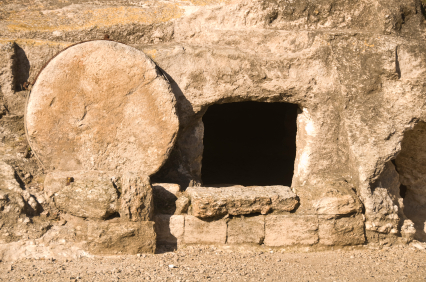
That grave is the one we read about in the gospels. It is the tomb into which Joseph of Arimathea and Nicodemus placed the body of Jesus after He died on the cross. In Jn. 19:38-42 the scripture says they wrapped the Lord’s body in strips of cloth according to the burial custom of the Jews. They then placed the body in a tomb in which no one had ever been laid. These were the same actions that would have been done for anyone who died in this era.
Mt. 27:62-66 tells us that the leaders of the Jews persuaded the Roman governor Pontius Pilate to place a guard at the tomb, and to seal it with his seal. This was to ensure that no one could steal the body and claim that Jesus had been raised from the dead. On the first day of the week, however, Jesus came forth from the tomb, just as He had promised He would. In Mt. 28:1-7 the scripture says an earthquake occurred, an angel of God rolled away the stone covering the tomb entrance, and the Roman guards became like dead men. Jesus left the tomb, and when Peter and John looked inside a little while later, they saw the grave cloths lying where the body had been (Jn. 20:1-10).
Jesus was alive, never to die again (Rom. 6:9), and this was the message the apostles proclaimed on the first Pentecost after His resurrection. As they apostles preached that day they declared that God had raised Jesus from the dead and asserted that they were all eyewitnesses of this truth (Acts 2:32). This proclamation could have been thwarted that very day by producing the dead body of Jesus. Yet, the leaders of the Jews did not do so, because they knew the truth. His body was not in the tomb!
Someone once said that the Christian faith stands or falls with the resurrection. As Paul told the church in Corinth, “if Christ has not been raised, your faith is worthless; you are still in your sins” (1 Cor. 15:17). He then said, “If we have hoped in Christ in this life only, we are of all men most to be pitied” (1 Cor. 15:19). Our faith in the Lord stands because Christ was raised from the dead, never to die again. Because He lives, we believe that we, too, will live again after death.
We have hope for eternal life in the place being prepared in the Father’s house (Jn. 14:1-3). We have this hope because of the greatest event in human history: the resurrection of Jesus Christ. We have hope to live for Him in preparation for eternity because He rose the third day after His crucifixion. We commemorate His death, but we do not mourn Him. Instead, we rejoice, because we have an empty tomb!

This program aired on KIUN 1400 AM in Pecos, TX on February 16, 2018.

A common desire among most parents is for their children to have a better life than they did. This is especially true of those who grew up in poor or modest circumstances but is not limited to them. Part of the strength of western civilization is the expectation of progress. We believe that through hard work and diligence society will be elevated from one generation to the next. The imagery of this upward climb is often characterized as standing on the shoulders of those who went before us.
However, not everyone works hard or diligently. Some drift through life with little ambition and with little or no success for the next generation to build upon. This attitude provides nothing for the next generation to stand upon, and worse yet, may undermine their efforts. The imagery that comes to mind in such a case is a sinkhole. With no foundation to build upon, the likelihood of progress or success is diminished.
These alternatives are significant in our physical existence, but are even more important in our spiritual pursuits. God’s plan from the beginning has been that each generation be a stepping stone for the next. His plan is succinctly stated in Deut. 6:4-9. Here Moses said, “Hear, O Israel! The Lord is our God, the Lord is One! You shall love the Lord your God with all your heart and with all your soul and with all your might. These words, which I am commanding you today, shall be on your heart. You shall teach them diligently to your sons and shall talk of them when you sit in your house and when you walk by the way and when you lie down and when you rise up. You shall bind them as a sign on your hand and they shall be as frontals on your forehead. You shall write them on the doorposts of your house and on your gates.”
This is shoulder building/shoulder standing in God’s matchless wisdom. Each generation must love the Lord God with all their heart, soul, and might. Loving God in this manner means learning His will and obeying all His commands. When one generation does this, it builds the foundation upon which the next generation can stand and build. This is the first part of the plan.
The second part of the plan is to diligently teach God’s will to the next generation. Doing this instills the proper respect for Almighty God in that generation and equips them to build upon what their ancestors have accomplished. When done as God intends, each generation moves closer and closer to God and farther away from anything that would deter this progress.
Each of us must choose to obey these commands or to ignore them. However, the consequences of our choices are not just personal. The consequences can stretch far into the future and affect descendants yet unborn. One who forsakes faith in the Lord puts his soul in jeopardy, but in so doing robs his children and grandchildren of the opportunity to build their own faith. Instead of giving them shoulders to stand upon so they can grow closer to God, he leaves them in a sinkhole that could lead them to the abyss at judgment.
Therefore, we must seriously consider God’s plan as we go about our lives. Paul exhorts us to not lose heart in doing good, for in due time we will reap (Gal. 6:9). He also exhorts us to fight the good fight, finish the course, and to keep the faith so we will receive the crown of righteousness (2 Tim. 4:7-8). We must do so for our own spiritual good, but we must do so, also, for the good of the generations that follow us. If we truly love our offspring, we must build shoulders they can stand on, so they will have the best opportunity for eternal life.

This program aired on KIUN 1400 AM in Pecos, TX on February 12, 2018.

According to the scriptures, the church came into existence on the first day of Pentecost after the Lord’s resurrection from the dead (Acts 2:1-41). The church grew and spread across the globe as first the apostles and then ordinary Christians proclaimed the good news wherever they went. Over the course of several centuries the church began to change as more and more human ideas took root within it. In time it was so far removed from its first century antecedent that sincere men sought to reform it. Their efforts, though noble and well-intended, did not result in a return to the first century model.
The protestant denominations which arose from these efforts, while closer to the first century model, were still marked by more human ideas than the original church. In the early 1800s in America a renewed effort began whose stated goal was to restore first century Christianity. The focus was on doing Bible things in Bible ways, and calling Bible things by Bible names. Their motto was, “Where the Bible speaks, we speak. Where the Bible is silent, we are silent.” This mantra sought to complete the work the reformers of the 1500s had begun by going back to the biblical model alone as a guide for what the church should believe and practice.
Now in the second decade of the new millennium, it appears that this noble effort, like the reformation before it, has begun to drift on the tide of human opinion and desires. There are perhaps many manifestations of this drift, but a significant element in it is the way we “do” church. A drive through any major city reveals countless multi-million-dollar church facilities. Large, beautiful buildings replete with every creature comfort are the norm. Amenities, including family-life centers, day-care facilities, and K-12 schools are commonplace. Recovery programs and other social services, conducted by credentialed or licensed staff, are more and more frequently offered. Worship assemblies are multi-media events, even if not accompanied by a worship band or praise team. In short, many churches are doing everything they can to appeal to every conceivable human interest. The question, however, is if this is what the Lord meant the church to be.
When we examine the New Testament, we find none of the things that seem so necessary today. First century churches did not own property or buildings. They met in rented rooms or in homes. Their worship was simple and focused on commemorating the Lord’s death each Lord’s day by the observance of the Lord’s Supper. The sang, prayed, read scripture, and exhorted each other to walk in the light. Each Christian understood that he or she bore responsibility for the overall welfare of the church, as passages such as Eph. 4:11-16 instruct. They saw their primary task as proclaiming the gospel to the lost, and encouraging each other to remain faithful. They often did this daily and from house to house (Acts 2:46-47).
Too many churches today are consumed with keeping up with the amenities offered by their religious neighbors. They fret over the money needed to equip themselves to do church like everyone around them, and consequently run the risk of not being the church the Lord meant them to be. Members and leaders alike fall into a check-list mentality that seems to equate facilities, amenities, and programs with being the Lord’s church.
Is it wrong to have a comfortable building in which to meet, or to show concern for the issues so many face today? No, but when so much of our attention is focused on these things, and the money it takes to maintain them, we have lost sight of our true mission. We have become so busy doing church that we have ceased being the church. Perhaps it is time, once again, for a call to restore simple New Testament Christianity.

This program aired on KIUN 1400 AM in Pecos, TX on February 9, 2018.

On the night of His betrayal, the Lord observed the Passover with His twelve apostles. Each of the four gospels refers to the events of that evening, but John gives us the most complete account of what transpired between the Lord and these chosen men. No other gospel account contains this information. In John 13-16 we have a detailed record of the Lord washing the apostles’ feet, dismissing Judas to complete his treachery, and His final instructions and exhortations to the eleven remaining men. Then, in chapter 17 John recorded the words of the Lord’s prayer which concluded their time together in the upper room.
Near the end of this prayer the Lord said, “I do not ask on behalf of these alone, but for those also who believe in Me through their word; that they may all be one; even as You, Father, are in Me and I in You, that they also may be in Us, so that the world may believe that You sent Me” (Jn. 17:20-21). This plea for the unity of all believers has long been a rallying point in churches that identify with the Christian faith. However, like so many things the Lord said, this plea has been used in ways the Lord never intended.
For example, many who call for the unity of all believers, do so based on emphasizing the areas of agreement among the various churches, while de-emphasizing areas of disagreement. The net effect is that areas of disagreement are rendered unimportant. In this way churches with differing doctrinal beliefs can still claim unity with their religious neighbors. From a human perspective this seems to make perfect sense. Unfortunately, it entirely misses the point of what the Lord said.
In the context of Jn. 17 the Lord’s plea for unity was based upon the unity that exists between Himself and His Father in heaven. His plea was that His disciples would be one with Himself and the Father, just as He and the Father are with each other. This is a particular kind of unity that is far different from what many call unity today. While we may not be able to fully comprehend the unity of the Father and the Son, we can be certain of what it is not. It is not based upon them emphasizing their areas of agreement, while de-emphasizing their areas of disagreement. This is because there are no areas of disagreement between the Father and the Son.
In Jn. 12:48 the Lord said that His word will judge at the last day. However, He went on to say, “For I did not speak on My own initiative, but the Father Himself who sent Me has given Me a command as to what to say and what to speak. I know that His commandment is eternal life; therefore the things I speak, I speak just as the Father has told Me” (Jn. 12:49-50). This means that everything the Lord spoke is exactly what the Father told Him to speak. They are one, because they both speak the same thing.
This fact cannot be overemphasized. The unity of the Father and the Son is based upon compliance with the Father’s will. Even as a full-fledged member of the godhead, Jesus did not go His own way. He bowed to the Father’s wises in everything He did. If we today wish to experience this unity, we also must comply with the Father’s will. In Eph. 4:3 Paul exhorted the Christians in Ephesus “to preserve the unity of the Spirit in the bond of peace”. The unity of which he spoke is the unity that comes to us when we obey the gospel and the Father adds us to His kingdom. We preserve this unity by being of the same mind and judgment on matters of faith, as Paul said in 1 Cor. 1:10. We can only be of the same mind and judgment, however, if we bow to the Father’s will in everything we do. If we humbly submit to the Father’s will, then we will all be one, just as the Lord prayed.
 ". . . let God be found true, though every man be found a liar."