Because He Lives

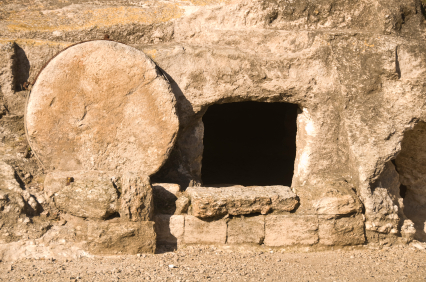
1st Century Tomb


When the Lord appeared to John on the island of Patmos to deliver His revelation of the things that were soon to take place, He identified Himself in a powerful way.  In Rev. 1:17-18 Jesus said, “Do not be afraid; I am the first and the last, and the living One; and I was dead, and behold, I am alive forevermore, and I have the keys of death and of Hades.”  In the midst of this brief statement is the bedrock of Christian faith.  Our Lord was dead, but now is alive forever more!  This essential truth sets Christianity apart from every other religious belief.  Our founder is alive and will never die again!

This was the argument that Paul made to validate our hope of eternal life.  In Rom. 6:8-11 he said, “Now if we have died with Christ, we believe that we shall also live with Him, knowing that Christ, having been raised from the dead, is never to die again; death no longer is master over Him.  For the death that He died, He died to sin once for all; but the life that He lives, He lives to God.  Even so consider yourselves to be dead to sin, but alive to God in Christ Jesus.”

When Paul wrote his first letter to the church in Corinth, he told them that the gospel was the death, burial, and the resurrection of Christ (1 Cor. 15:1-4).  His death was necessary in order to atone for our sins.  Without His shed blood, God’s justice could not be satisfied.  However, a dead Savior is no Savior at all.  Our Lord had to come back from the dead in order to complete His exaltation as “Lord of Lord and King of Kings”.  He did this on the third day, according to the scriptures (1 Cor. 15:4), and now He is the master of death and of Hades (Rev. 1:18).

Because our Savior lives, we have hope in life as well as in eternity.  We have hope because He is alive to mediate between us and our Father in heaven (1 Tim. 2:5).  We have hope because He lives to make intercession for us (Heb. 7:25).  We have hope because He holds us in His hands and no one can snatch us away from Him (Jn. 10:28).  We have hope because He reigns over His kingdom and will continue to reign until He hands over the kingdom to God the Father at the last day (1 Cor. 15:24-26).

Because our Savior lives, we also have obligations in life.  Since we know our Savior lives, we must live for Him in everything we do.  In Rom. 12:1-2 Paul said we must present our bodies as a living and holy sacrifice in order to prove what the will of God is.  In Col. 3:22-24 Paul said we must do everything we do as though we were doing it for the Lord, because it is He whom we serve.  Because He lives, we must let our light shine so that others will see our good works and glorify our Father in heaven (Mt. 5:16).

A prominent theologian of the last century said that Christianity stands or falls on the resurrection of Christ.  If the Lord did not come back from the dead on the third day, then we have no reason to believe in him.  As Paul said, “and if Christ has not been raised, your faith is worthless; you are still in your sins” (1 Cor. 15:17).  If, however, He was raised from the dead, then we must believe in Him.  To refuse to do so would be foolish, for one day our living Lord will call all the dead from the tombs for judgment (Jn. 5:28-29).

Therefore, let us rejoice in the fact that our Savior and Lord lives.  Let us live in such a way that honors our living Lord and thereby secures eternal life for us.  Let us look with joy at the empty tomb.  And let us sing with heartfelt sincerity, “Because He lives I can face tomorrow, Because He lives all fear is gone; Because I know He holds the future, And life is worth the living just because He lives.”

This World Is Not My Home

47311_Papel-de-Parede-Planeta-Terra_1600x12001


One of our favorite hymns is entitled, This World Is Not My Home.  It is an uplifting song that makes our hearts soar as we sing its words.  The theme of the song is the joyous anticipation we have of the time when we will enter the heavenly city to live with our God and Father for eternity.  That theme is summarized in the line that precedes the chorus: “And I can’t feel at home in this world anymore.”

As we sing this song, we are not expressing displeasure with the place God created for us to live.  The world that He created was “very good” (Gen. 1:31).  It was, in fact, perfectly prepared for humans to inhabit, but it was never intended to be our final destination.  God’s plan from before the beginning of the world was to redeem a people for Himself to live with Him in heaven.  How people live while upon the earth determines who among them will receive this great reward.

Those who are Christians should understand this better than any others.  When we obey the gospel by being baptized into Christ, we commit ourselves to walk through the small gate that opens onto the narrow way that leads to life (Mt. 7:14).  We have been purchased by the cleansing blood of Christ to be His slaves, and we are not our own (1 Cor. 6:19-20).  Our citizenship is no longer upon the earth, but is instead in heaven, where our names are written in the Lamb’s Book of Life (Phil. 3:20; Rev. 20:11-15).

Nevertheless, we are residents of the earth and must live on it and within its many constraints until our time here is done.  This reality often poses challenges for us, as it has for Christians since the church began.  In the first century some in the city of Thessalonica were so anxious for the Lord to return, and so ready to be freed from the bounds of earth, that they stopped taking care of their physical responsibilities.  In 2 Th. 3:6-13 Paul chastised them for what he called their unruly and undisciplined behavior.  The point then, and now, is that we must take care of all our physical responsibilities on earth, even as we anticipate going home to be with the Lord.

Another of the challenges that we face as residents of the earth is the presence of suffering and pain.  Too many times our lives are marked by sickness, disease, and death.  Too often we suffer the pain of the actions of sinful people around us.  Nearly every day we may wonder why God allows our hearts to be broken by the things that happen in life.

There are at least two reasons for these things.  One is the fact that sin exists on the earth.  From the time of Adam and Eve we have been afflicted by its presence, either because of our own sinful conduct, or because of the sins of others.  Sickness, disease, natural disasters, and man-made mayhem of all kinds are the results of sin being present in the world.  God is not responsible for these things, and He will hold the guilty accountable at judgment (Ex. 34:7).

The second reason for these things is to constantly remind us that we must not fall in love with this world.  In 1 Jn. 2:15-17 John tells us that all that is in the world (that is, the sinful things) is not from the Father, and if we love the world, the Father is not in us.  John also said that all that is in the world is passing away.  What he means by this is that it will one day be destroyed at God’s command (2 Pet. 3:10-13).  Only those who have done the will of God will live forever.

We are going to suffer while we are here on the earth, but that suffering will not compare to the glory awaiting us in heaven (Rom. 8:18).  Christians know this because this world is not our home.

In the Beginning . . . At the End . . . God

the_world_in_his_hands_by_saviourmachine


In recent years much ado has been made by alarmists who claim that mankind is destroying the earth.  On the one extreme are those who believe mankind must essentially give up all modern technology and conveniences, and curtail population growth in order to save the earth.  On the other extreme are those who live in constant fear that mankind will destroy the planet in a nuclear holocaust.  In either case the underlying belief is that mankind will indeed one day destroy itself and the world on which we live.

Such beliefs and fears are the product of ignoring a simple truth of scripture.  That truth is that the world’s destiny rests solely in the hands of God.  The Bible begins with the magnificent statement, “In the beginning God created the heavens and the earth” (Gen. 1:1).  The record of Genesis 1 continues with a description of how God turned nothing into a perfect home for the man and woman He created on the sixth day of creation week.  The plants, animals, and Adam and Eve, were created full grown and able to reproduce (Gen. 1:12, 22, 28).  God spoke it all into existence in six days, and at the end of that time the scripture says, “God saw all that He had made, and behold, it was very good.  And there was evening and morning, the sixth day” (Gen. 1:31).

God created the world as a place for mankind to live in preparation for eternal life with Him.  By His own command mankind is supposed to multiply and fill the earth and subdue it (Gen. 1:28).  This means everything on earth is for our use as we live here.  This does not mean we should be wasteful or wantonly destructive of our beautiful home, but it means that it is not inherently wrong to use these resources for the betterment of our lives.

If we believe in God and in His word, we know that this planet will not run out of resources to sustain human life.  If we believe in God and in His word, we know that mankind will never destroy the earth.  We know this because the scriptures tell us the ultimate fate of the world is in God’s hands, not ours.  In 2 Pet. 3:5-7 the scripture says that the ancient world was formed out of water and by water by the word of God.  That world was also destroyed by water at the command of God. Peter then says that the present heavens and earth are being reserved for fire by the same word of God (2 Pet. 3:10-13).  This world is indeed going to end, but it will only end when God commands it to end.

The simple truth is that we cannot destroy the earth.  Even with all the nuclear weapons we might ever create, or with all the billions who might populate it, we do not have the power or the authority to do so.  Only God has this power, and only God has the authority, to destroy the world.  Only He, who made it all at the beginning, can make it all go away at the end.

In the beginning was God, and at the end is God.  All of earth’s history is bookended by this fundamental truth.  It is this truth that gives us our only hope for eternity.

Vanity of Vanities!

1st-session-who-am-i-what-is-the-meaning-purpose-in-life-61-728


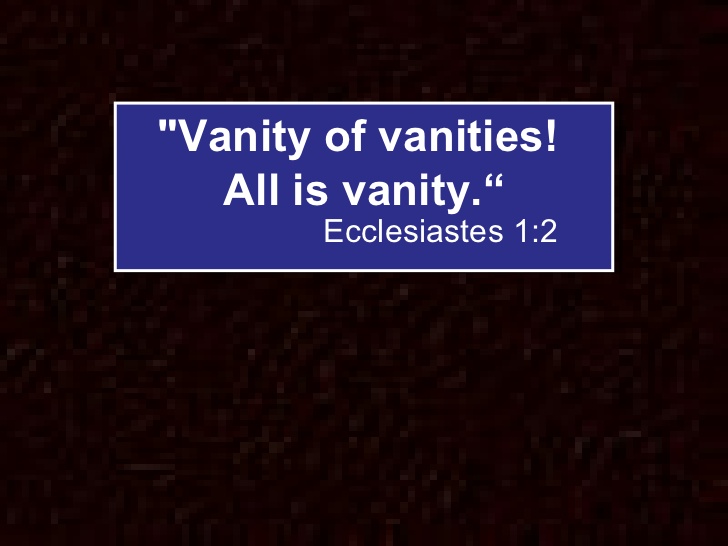
The book of Ecclesiastes is one of the strangest books in the Old Testament.  It is included in the section of scripture that we call Wisdom Literature, and is generally agreed to have been the work of King Solomon.  The aspect of this book that makes it seem so strange to us is the author’s attitude about life.  Ecclesiastes is gloomy and dark, and is characterized by the statement, “Vanity of vanities.  All is vanity” (Eccl. 1:2).  This gloomy perspective is difficult for us to fathom, especially considering its source.

Solomon was the wisest man who ever lived.  He was also one of the wealthiest kings who ever lived.  By most standards we would consider him to have had it made.  He ruled a stable nation that held the upper hand against all its enemies.  He was favored by God as the son of David and the ruler of God’s people.  The many blessings that had been poured out on him were the sign of God’s approval resting upon him.

But the Solomon who wrote Ecclesiastes was not the humble man who had asked God for an understanding heart to judge His people (1 Kgs. 3:9).  As he aged Solomon violated God’s command to not marry foreign women.  In 1 Kgs. 11:4 the scripture says that when Solomon was old his foreign wives turned him away from God.  He worshiped and served the despicable gods of the pagan nations, and even built high places as sites to worship them.

This is why Ecclesiastes is so gloomy.  As Solomon wrote this book he was reflecting on the dissatisfaction that had engulfed him due to his rebellion against God.  At this point in his life he saw nothing good in his future, and with good reason.  While he was estranged from God Solomon had no hope and he correctly observed that everything he had done up to that point was vanity.  All his labor, all his wealth, all his wisdom, all his majesty as a king was literally like dust in the wind.  He realized that he would soon die and all that he had acquired would fall into another man’s hands.

This is the simple truth about human endeavor undertaken apart from an obedient relationship with God.  Unless one’s life is devoted to God’s will, all is vanity.  One can amass great wealth or power, but if he is not obedient to God, it is all for nothing.  Like the rich fool in Lk. 12:16-21, Solomon was not rich toward God, and he could see the futility of his situation.

Fortunately, Solomon learned his lesson before it was too late.  At the end of Ecclesiastes, he said, “The conclusion, when all has been heard is: fear God and keep His commandments, because this applies to every person” (Eccl. 12:13).  If one reverences God and obeys all He commanded, then his life’s pursuits will not be in vain.  He will have the satisfaction of having accomplished God’s eternal purpose in his own life, and in the lives of his family, no matter how much or how little of the world’s goods he might amass.  The greater satisfaction, however, will be in knowing that his name is written in the book of life, and a home in heaven awaits him.  Nothing about this kind of life is vain.

Spiritual Guardrails


God-of-the-Guardrails-675x380


A cartoon by Mike Waters has made the rounds of social media recently.  It shows two men standing near a rail fence.  The fence is labeled, “God’s Commands.”  One of the men says, “I hate being confined by this fence.  I’m jumping over it.”  As he jumps over the fence, the other man yells, “Wait!  It’s not a fence, it’s a guardrail!”  In the final frame the jumper is seen going over a cliff.  Below the cartoon the words of Prov. 19:16 are written: “He who keeps the commandment keeps his soul, but he who is careless of conduct will die.”

This cartoon perfectly illustrates the self-destructive nature of human beings.  We constantly chafe and grouse against any kind of restraints that are placed on us.  As children we willfully ignore the warnings and admonitions of our parents because we do not recognize that they are intended for our benefit and well-being.  As teen agers we buck against the rules because we think it’s cool to rebel against authority.  As adults we push the envelope in order to avoid compliance with rules that we dislike because we may think that they are unreasonable in some way.  The sad irony is that we often continue to rebel against such restraints even after suffering some kind of loss due to our lack of compliance.

In Jn. 8:31-32 Jesus told some believing Jews that they must continue in His word in order to truly be His disciples.  He promised them, however, that if they did so they would know the truth and the truth would make them free.  In 2 Jn. 9 John said, “Anyone who goes too far and does not abide in the teaching of Christ, does not have God; the one who abides in the teaching, he has both the Father and the Son.”  These two passages tell us that our spiritual guardrails are the word of Christ.  The purpose of these guardrails is to keep us from jumping off the cliff of sin.

If we remain within the confines of the teaching of Christ, we will not engage in the ungodly behaviors that will condemn us at judgment.  In so doing we will have a better life here on earth, as well as the promise of eternal life hereafter (1 Tim. 4:8). If we remain within our spiritual guardrails, we will have nothing to fear when we stand before the Lord at the end of time, as all of us must do (2 Cor. 5:10).

In Jas. 1:21 James said, “Therefore, putting aside all filthiness and all that remains of wickedness, in humility receive the word implanted which is able to save your souls.”  It is a simple choice.  We can abide within the restraints of God’s word or we can jump over our spiritual guardrails into the abyss of sin.  Those who jump the guardrail may seem to be enjoying themselves, but the scriptures teach that the pleasures of sin are fleeting (Heb. 11:25).

On the other hand, those who remain within our spiritual guardrails will find their names written in the Lamb’s book of life at judgment, and eternal life will be their reward.  If we are wise, we will recognize that our spiritual guardrails are there for our eternal benefit, and we will remain within them.

A Prayer for Our Nation

prayinghandsflag


We are once again in the election cycle for the highest office in our land.  The airwaves are literally saturated with non-stop political ads and campaign coverage.  When we listen to the campaign rhetoric and consider the state of our nation today, it is clear that this is one of the most critical periods in our history.  Ungodly behavior that would have been publicly condemned in the past is now openly endorsed by prominent political leaders.  Graft and corruption are rampant in government and society, and millennials are generally adrift in a sea of self-absorption and the opiate of entitlement.

In addition to this, we are witnessing an unprecedented assault on the Christian principles upon which our nation was built.  Anyone who even remotely stands for Christian values is mocked and attacked by the media, by many judges, and even by some of our elected officials.  Those of Christian faith are being told that biblical truth about certain lifestyle choices is hate speech and will not be tolerated.  Lawsuits and imprisonment for the practice of Christian faith are becoming very real possibilities.

In troubling times such as these Christians must not stand idly by and let these things continue without voicing our concerns.  Neither must we unthinkingly lend our support to those who endorse or promote such ungodly things as are now commonplace.  Since we live in a nation where we may make our voices heard, we must speak up for the Lord, for His word, and for His church.  And, we must call upon our God to act on behalf of His people in order to preserve us from the wickedness that has engulfed our land, if it is His will.

So then, let us pray that we as a people will not neglect the leading of God’s word as we face the days ahead, and as we make our choices in the election cycle now upon us.  Let us remember the words of the wise man Solomon, who said, “Righteousness exalts a nation, but sin is a disgrace to any people” (Prov. 14:34).  Let us pray that instead of putting up with the national disgrace of leaders who endorse and promote sinful behavior, we will seek out and support those who stand up for godly principles and behavior.  Let us pray that instead of being participants in ungodly behavior, we will repent of our sins and become a positive influence for others.

Likewise, let us pray that we will remember the warning of Isa. 5:20, which says, “Woe to those who call evil good, and good evil; who substitute darkness for light, and light for darkness; who substitute bitter for sweet and sweet for bitter.”  Let us pray that we will cease making excuses for the evil that we do, and return to living as God has commanded us to do.  Let us also pray that our leaders will cease promoting lies about immoral conduct, and instead stand up for godliness.

Our nation has become a haven for those who endorse and practice ungodly behavior.  May God forgive us for allowing this to happen!  Our silence on these things has given our tacit approval to them.  May God forgive us for this sin!  May God grant us time to repent and to restore our land to its godly roots!  May God save us from the wickedness that surrounds us!

Who Loves Ya?

wholoves2_sally


The late actor Telly Savannas played a lollipop-loving police detective in the television series, Kojak.  One of his signature lines in that role was, “Who loves ya, baby?”  This is a question that is important at any time, but is especially so on Valentine’s Day.  On days like this one many people profess their love for one another.  That expression may be in words or in deeds or in gifts, but the intent is to declare undying love for the object of one’s affection.

In the world these expressions may or may not be consistent with the daily actions of the one who makes them.  That is to say, a man or woman may say, “I love you,” to another, and shower that person with gifts on Valentine’s Day, but in the regular course of daily life their actions may say just the opposite.  Women are particularly sensitive to this inconsistency, and they are justified in being put off by it.  A woman wants her man to say, “I love you,” in the way he treats her every day of the year, not just on special occasions.  She wants him to say, “I love you,” with his lips, and with his actions.  If he does not, she knows in her heart that he really doesn’t love her.

What true love comes down to is consistently doing what is best and right for another in every circumstance of life.  It does indeed include saying the words “I love you,” but it also, and more importantly, includes what one does each and every day.  A young man may say the right words to woo a young lady, but if his words are only a pretense to lead her into ungodly behavior, they are a lie.  One who truly loves another will never do anything that would purposely hurt that person.  Neither will he lead that person into sin.  Anyone who does such things does not love.

This brings us to the most important answer to the question, “Who loves ya?”  As much as one may be loved by another here in life, there is one person who loves you more than anyone on earth is capable of doing.  That person is our Father in heaven.  He loved us so much that He sent His one and only Son, Jesus Christ, to die on the cross for our sins (Jn. 3:16).  He planned this from before the foundation of the world (Eph. 1:3-14).  Everything He has done, from creation until this very day, has been for the purpose of demonstrating His love for us in very possible way.

Our Father in heaven shows us that He loves us by having provided this world in which we live (Gen. 1).  He shows His love by providing for our every physical need (Mt. 6:33).  And He shows His love by providing the only means by which we may be saved and spend eternity with Him in heaven (Rom. 5:8).  We know God loves us because of what He has done.  Therefore, as John says in 1 Jn. 4:11, “Beloved, if God so loved us, we also ought to love one another.”

Let us follow our Father’s example and always demonstrate our love for one another in everything we do, and by doing everything we can to help each other go to heaven.  Truly, there is no greater love that we may show.

Do You Love Me?

do-you-love-me-image


After the Lord’s resurrection from the dead He appeared to the apostles and other disciples for a period of about forty days before He ascended back into heaven.  One of these appearances is recorded in Jn. 21.  On that occasion the Lord appeared to Peter, James, John, Thomas, Nathanael, and two other disciples after they had been fishing all night on the Sea of Galilee.  They had caught nothing, but the Lord directed them to cast their nets on the right side of the boat, whereupon they caught 153 large fish.  When they came to shore they found that the Lord had prepared breakfast for them.

After they had eaten breakfast, the Lord asked Peter three times, “Do you love Me?”  In each case Peter responded that he did love the Lord, and in each case the Lord told Peter to care for His sheep.  We often make a point of the different words for love used by the Lord and by Peter.  Twice Jesus used a form of the Greek word agape, which is the highest form of love. Peter, on the other hand, used a form of the Greek word phileo, which is typically understood as brotherly love, or friendship.

The more important point, however, is the question itself.  Do we truly love Jesus?  We are happy to sing, “Oh, how I love Jesus,” and we sincerely mean it when we do.  But do our lives actually reflect the words we so joyfully sing?  Many will affirm that they do, but, like Peter, they may mean something other than what the Lord meant when He asked this question.  The concept of love has become so diluted in modern culture that it often means little more than a moment of passion.  How else can we explain people falling into and out of love so quickly?  Obviously our culture has moved far away from the kind of love the Lord expects of us.

The kind of love the Lord calls us to have is an act of the will that is not driven solely by emotion.  It is a choice we make to do what is best and right for all people in every circumstance of life.  This is how biblical love is demonstrated in our relationships with each other.  But how is this kind of love demonstrated toward our Lord?

The answer is surprisingly simple.  When the Lord asks if we love Him, He is asking if we are willing to obey Him.  In Jn. 14:15 the Lord told the apostles, “If you love Me, you will keep My commandments.”  The beloved apostle John made this same point in 1 Jn. 5:2-3.  Here he said, “By this we know that we love the children of God, when we love God and observe His commandments.  For this is the love of God, that we keep His commandments; and His commandments are not burdensome.”

This should not come as a surprise to us.  We express this same sentiment in our relationships with each other.  When someone says, “I love you,” but then does things that are hurtful, we know his profession of love is meaningless.  There is, perhaps, no greater pain than to be hurt by one who claims to love us.  If we feel this way about our human relationships, how much more so do our God and Father, and His Son Jesus Christ?

When we live our lives as though God’s commands are only suggestions, we are telling Him we don’t love Him.  When we twist and distort His commands to fit our own desires, we are telling Him we don’t love Him, just as surely as the person who makes no pretense of loving God.  When we ignore God’s commands, we hurt Him deeply because in so doing we are treading underfoot the precious sacrifice of His Son to redeem us from sin.  If we truly love Jesus, and if we truly love our Father in heaven, we will always do our best to obey all He has commanded us in His word.  When we do this, He will know that we do indeed love Him.

It Stands Written

open-bible


After Jesus was baptized by John the scripture says, “Then Jesus was led by the Spirit into the wilderness to be tempted by the devil.  And after He had fasted forty days and forty nights, He then became hungry” (Mt. 4:1-2).  In the ensuing verses Matthew records how the devil tempted Jesus in three ways that summarize every kind of temptation that can befall us.  An important aspect of this record is the fact that in each instance the Lord responded to the devil’s temptation by quoting scripture.  In vs. 4, 7, and 10 the Lord said, “It is written”, and then quoted the appropriate scripture to deal with the temptation.

In the original language in which the New Testament was written the phrase “it is written” has the force of long-standing and enduring truth.  If we were to translate this phrase literally it would read, “it stands written.”  In other words, the word of God had been declared, it was then in force, and it would remain in force forever.

The fact that God’s word has been written is significant.  That which is written does not change.  It is not dependent on our frail memories in order to be remembered.  Anyone who reads it, in whatever time or place or circumstance, receives the very message that the author intended when he wrote it.  We see this principle at work every time we follow a recipe to make a favorite food or dessert.  If we follow the instructions in the recipe, we will end up with the same dish every time.

This is why God committed His word to written form, beginning with the two tablets of stone upon which He wrote the Ten Commandments on Mt. Sinai.  This is why God directed Moses to write His law in a book.  In Deut. 31:9-13 the scripture says that Moses wrote that book, which we call Deuteronomy, and gave it to the priests.  They, in turn, were to read it to all the men, women, and children of Israel every seventh year at the Feast of Booths.  In reading what had been written, every generation would learn to love and obey God.

This is also why the books of the New Testament were written.  The truths of the life and ministry of our Lord, of His sacrifice on the cross for our sins, and what we need to do in order to be saved, are clearly stated within its pages.  Anyone with normal intelligence can pick up the written word and know exactly what God intends him to do in order to have eternal life.  Paul said that this written word was inspired by God and equips us for every good work (2 Tim. 3:16-17).  Peter said that this written word is everything that pertains to life and godliness (2 Pet. 1:3).  For this reason Paul said, “Be diligent to present yourself approved to God as a workman who does not need to be ashamed, accurately handling the word of truth” (2 Tim. 2:15).

Because God’s word stands written, it will be the final arbiter in determining who enters heaven at the end of time.  In Rev. 20:11-15, as John witnessed the vision of final judgment, he noted that everyone who had ever lived stood before the throne of God.  Then, he says books were opened, and everyone was judged from the things written in the books.  Those whose lives were found wanting were cast into the lake of fire, which is the second death (vs. 14-15).

Final judgment will not be based upon feelings or opinions.  It will not be based upon the views of the majority, or on the whims of society at the end of time.  It will be based upon what is written in the books.  The psalmist said that God’s word is a lamp to our feet and a light to our path (Psa. 119:105).  If we follow God’s word, it will lead us all the way to heaven and eternal life.  It will do so without fail, because it stands written.

Let Me Be Clear . . .

politician-clipart-soapbox_clipart


One of the trademarks of most politicians is the ability to speak without actually saying anything.  This often happens when a reporter asks a question that the politician does not want to answer.  Instead of refusing to answer, however, he or she will respond with a lengthy comment that dances all around the question.  In many cases, a particularly ambiguous part of the response will be prefaced with the phrase, “let me be clear.”  The sad irony is that the clearer the response is asserted to be, the more convoluted and vague it typically is.  We have become accustomed to this practice, even while being frustrated by it.

Most of us prefer a straightforward answer to our questions, even if we do not agree with the response.  We appreciate an individual who speaks from the heart and who clearly states his position on any particular subject.  We especially need this kind of clarity when it comes to the laws that govern our lives.  If a law is so vague that it may be interpreted in multiple ways, it seriously complicates our ability to obey it.  This is why we cringe when our elected officials offer thousand-page bills designed to regulate some aspect of life.

Most of us are genuinely disgusted by the kind of ambiguity and duplicity that exists in our political system today.  We correctly understand that this ambiguity is intentional in order to subvert the system in favor of the ruling class and their contributors.  However, in spiritual matters many among us have embraced the very ambiguity that we despise in secular affairs.  Instead of viewing the scriptures as the clearly revealed will of God, these folks suggest that God was less than forthcoming in many of His commands.  This leaves the way open, they say, for multiple interpretations of important issues such as salvation and worship.

The assertion that the scriptures are ambiguous enough on these matters as to allow for various interpretations calls into question God’s ability to communicate.  If the scriptures are not clear on the subject of salvation, for example, which is the most important question of all, what does this say about our Father in heaven?  The only options are either that God is incapable of clearly communicating His will, or that He purposely chose to disguise His will from us.  Neither of these options speaks well of Him.

The plain truth, however, is that God is not only able to clearly communicate His will, but He has done so in unmistakable terms.  In Jn. 12:48 Jesus said His word will judge us at the last day.  In Rev. 20:11-15 the scriptures say that when we stand before God we will be judged by the things written in the books.  If the books, which are God’s word, are not clear enough for us to understand and obey, how can God judge us justly from them?  All through the scriptures, literally from beginning to end, we are told to do exactly what God has commanded.  For example, in Deut. 5:32 the scripture says, “So you shall observe to do just as the Lord your God has commanded you; you shall not turn aside to the right or to the left.”  We are also commanded to neither add to nor take away from all that God has commanded (Deut. 4:2; Rev. 22:18-19).

Some assert that the existence of so many interpretations suggests that God has been purposely vague on the matter of salvation.  Therefore, they declare that all these interpretations must be valid.  The simple answer from God’s word, however, is that only those who do the Father’s will are going to enter heaven (Mt. 7:21-23).  The fact is that some people just don’t like the answer they find in God’s word.  Therefore they turn away from the truth and turn aside to myths (2 Tim. 4:3-4).  Those who do so place their souls in eternal jeopardy.

God has spoken clearly about all things that are essential for us to obtain eternal life.  Anyone of honest heart and normal intelligence who reads the scriptures will know exactly what God requires in order for us to be saved.  On this He has been absolutely clear.